Daily insights for city builders, delivered every morning at 6 AM ET. I’m Brandon Donnelly — a Toronto-based real estate developer and founder of Globizen. I’ve been writing here since 2013.

Tag: lisbon

  • My first dockless scooter ride

    I now know what all the fuss is about. Yesterday I rode a dockless (Lime) scooter for the first time. I took in lieu of an Uber in order to get to the Museum of Art, Architecture, and Technology (MAAT) on Lisbon’s waterfront.

    Here’s another photo from my ride:

    We don’t have these scooters in Toronto, but I understand they are imminent. And now that I’ve used one — and learned how shockingly fun they are — I can see why they are proliferating across so many cities.

    They’re a solution to the last mile problem, but they’re also fast enough (20 km/h) that they can be a substitute for other forms of urban mobility, as was the case for me yesterday. I can also see myself using one to get to the office when I would rather not sweat through my suit.

    Of course, there is the much talked about problem of scooters as urban litter. It’s a real thing and I am seeing that firsthand here in Lisbon. Because they are dockless, people leave them anywhere and everywhere. At the same time, part of what makes them so convenient is that, well, you can leave them anywhere and everywhere.

    I’m confident there’s a tidier solution that doesn’t involve fixed docking stations. Geofencing, perhaps? Cars are “dockless” and we’ve sort of figured that out. Many cities are already working on and experimenting with different solutions. Here’s an example from Tel Aviv. I have also noticed a natural clustering effect.

    I’m not sure how good of a business they will prove to be. The barriers to entry seem fairly low right now. You just need some Chinese scooters and an app, which is why I am noticing so many competing companies. But as the market matures, increased regulation could change this.

    We are going through a period of growing pains and it’s not particularly elegant. However, I believe we’ll get there. So I am looking forward to riding these scooters when they do finally land in Toronto.

  • Out of office: Lisbon

    The out of office responder is on.

    I am currently on a multi-day stopover in Lisbon on my way to Malaga, Spain. One of my oldest friends (we went to elementary school together in Toronto) is getting married there this weekend. They chose Spain because that’s where they met (she is Parisian). They have an incredible love story and I’m looking forward to celebrating with them in a few days.

    The above photo was taken with my iPhone from Sky Bar.

    The green you see in the foreground is Av da Liberdade. Here is another photo from a different angle, where you can begin to see the water (Tagus). Its tree canopy is one of the most impressive that I have ever seen. Its grandeur (largely its width) is quite a contrast against the small and winding streets in the rest of Lisbon. And it may be one of the only level places in this exceptionally hilly town.

    I’m a big fan of Lisbon, already.

  • Lisbon creates 24-hour district

    About a year ago I wrote a post called, Lisbon is the new Berlin. The timing of the post happened to coincide with Monocle’s first ever Quality of Life Conference, which was held in the city.

    Since then, I’ve been keeping an eye out for all things Lisbon and the city has quickly jumped to the top of my list of places I want to visit. I am obsessed with understanding the triggers that catalyze change within a community and/or city.

    On a related note, Lisbon has recently put in place new regulations to control nightlife in the city. Bars in certain areas must now close at 2am on the weekdays and 3am on the weekends. Outdoor patios must close at midnight. If you have the right kind of soundproofing though, your bar can remain open until 4am. The impetus for these changes was to address nightlife noise complaints – a perennial problem in many cities.

    However, Lisbon has also created a 24-hour district along a supposedly underdeveloped area of the waterfront. This means that bars and clubs in this area will have the option of staying open 24/7. At the same time though, investments are being made (Portuguese article) to transform the area into something more than just a place for drinking and dancing.

    I am noticing a real trend in European cities around using nightlife as a strategic lever to attract talent and revitalize neighborhoods. Oftentimes the knee jerk reaction is to simply focus on the negative externalities associated with nightlife. But there are strategic benefits. Many cities today recognize that.

    Image: Mhx on Flickr

  • Are there enough nerds in Miami?

    image

    I was browsing through my online reading list this morning (as I do every morning), and I stumbled upon this Dezeen article talking about a big new 6.5 million square foot development being proposed in Miami’s Park West neighborhood. 

    The goal of the project is to transform Miami into “Florida’s Silicon Valley.”

    This sort of thing is happening all around the world. From Buffalo to Lisbon, cities everywhere are betting on tech, startups, and entrepreneurship to grow their economy in the 21st century. And I personally think that’s really exciting.

    But as I was reading the article, I couldn’t help but think of an old essay that Paul Graham wrote back in 2006 called, How to be Silicon Valley. (Paul Graham is a famous Silicon Valley entrepreneur/investor).

    In his essay Graham argues that to be or to replicate the model of Silicon Valley in your city, you basically need two types of people: rich people and nerds. The idea, of course, being that the nerds work on the cool new ideas and the rich people then fund them.

    Using this logic, he specifically calls out Miami as a city where few startups happen and as a city not likely to become another Silicon Valley. Though there’s lots of money and rich people in Miami, there simply aren’t enough nerds. In Graham’s words: “It’s not the kind of place nerds like.”

    But that was back in 2006. 

    The iPhone didn’t even exist yet. Things have since changed. Now there are successful tech companies like Snapchat (valuation north of $15 billion) that are based out of cities like Los Angeles. And I think you could argue that Los Angeles and Miami do share some similarities.

    So while it may have seemed far fetched in 2006 for Miami to become a startup hub, is that really the case today?

    Image: Dezeen

  • The perfect high street

    How do you create and maintain a thriving high street in this era of increasing online shopping? This was one of the questions that Monocle asked at its recent Quality of Life Conference in Lisbon and here’s a video with its recommendations. Click here if you can’t see the video below.

    [youtube https://www.youtube.com/watch?v=Ox2WJwDbuIo?rel=0&w=560&h=315]

  • Driverless cars, urban mobility, and Toronto’s Gardiner Expressway

    image

    About a week ago I wrote a post questioning what driverless cars will mean for cities. I ended by saying that that it feels as if we’re going to see increasing tension between private and public transport.

    What I meant by that was simply that conventional notions around private car use are going to change. And ultimately that is going to mean that we need to rethink public transport and how that fits into a broader urban mobility framework.

    What do I mean by this?

    The International Transport Forum at the OECD recently published a fascinating report called, Urban Mobility System Upgrade: How shared self-driving cars could change city traffic. And it deals with exactly the sorts of things I am thinking about.

    The study looked of what might happen when all cars become self-driving in a mid-sized European city (specifically Lisbon, Portugal). They leveraged existing transportation data from the city, but replaced 100% of the human powered cars with two types of self-driving cars: TaxiBots and AutoVots.

    TaxiBots were driverless cars that would be shared with multiple people at the same time. In other words, they were a kind of pseudo-public transit. And AutoVots we’re your more conventional private taxi. They picked up one person at a time.

    So, what did they find?

    In the first scenario, they combined their TaxiBots and AutoVots with public transit (light rail) and discovered that the same number of people could be moved around with only 10% of the cars currently on the road. That’s a 90% reduction!

    They also found that the city needed 20% less on-street parking and 80% less off-street parking since driverless cars don’t need to sit idle waiting for a driver.

    In the second scenario, they removed mass transit from the equation. And in this instance they found that the city was still able to get around, but with an 80% reduction in the number of cars on the road. Remarkably, it also led to a 10% reduction in rush hour commute times.

    These are pretty profound changes. Reducing the number of cars on the road by 80-90% is a significant change. 

    But it’s also why I’ve been thinking about the tension between private and public transport. As we get better at optimizing “cars” (their definition will change), what becomes the role of true public transit?

    Ultimately, I think what will happen is a blurring of the two. In the example above, the TaxiBots served basically as small scale public transit. But that does not necessarily mean that true mass transit will become irrelevant. We’re just going to need to rethink how the entire mobility network fits together.

    I’d now like to bring this discussion back to Toronto for a minute.

    As many of you probably know from this blog, Toronto is on the cusp of deciding what to do with the eastern portion of the Gardiner Expressway (an elevated highway that runs across the downtown waterfront). It will go to City Council next month. 

    I firmly believe that we should remove it, but there many people who believe we shouldn’t. The main objection seems to be that the traffic projections indicate that removing it could make commuting into downtown – by car – 3 to 5 minutes longer by 2031

    By today’s standards, I believe this concern represents an outdated way of thinking about cities and urban mobility. Adding more lanes is like loosening your belt to deal with obesity. However, it gets even worse when you think about urban mobility in the context of this post.

    Given the profound transportation changes that are currently underway, I think there’s a strong likelihood that the Gardiner projections we have today will be completely wrong by 2031. I don’t know know for sure, but I’m guessing the models don’t account for the efficiencies being created by driverless cars and peer-to-peer networks.

    In other words, I am suggesting that those 3 to 5 minutes could prove to be a red herring. The relevant question should be: Which decision will allow Toronto to build the absolute best waterfront in the world? And in my opinion that leads to removing the Gardiner East.

    If you feel similarly, I would encourage you to write your local City Councillor.

  • Lisbon is the new Berlin

    Photograph Tramway à Lisbonne by yannick le goff on 500px

    Tramway à Lisbonne by yannick le goff on 500px

    This morning I stumbled upon a blog post by a Berlin-based venture capitalist (Ciarán O’Leary) talking about how Lisbon feels like the next Berlin. In other words, it feels like the next great European startup hub.

    Here’s his reasoning:

    • The tech scene is organic – it happened on its own, came out of nowhere. That is much more fun and sustainable than any kind of political or targeted economic strategy.
    • There are a ton of constraints (funding, local talent base, etc.) so entrepreneurs need to hustle to make things happen. Hustle is good.
    • Berlin was an economic void, Portugal had a massive economic crisis and Lisbon sure isn’t letting that crisis go to waste.
    • Entrepreneurship has the real chance to be a center stage act, not a side gig. It’s everywhere.
    • The city is very, very cool. You just want to be here.
    • You can have a great life on a startup salary.
    • Everyone speaks english; everyone is welcoming and open. That matters a lot when you want to attract international talent and funding.

    Of course, he’s not the only one calling Lisbon the next Berlin. The EU also named Lisbon “the most entrepreneurial region in Europe in 2015.” Isn’t it interesting what can grow out of economic crisis? See PIGS.

    I also don’t think it’s a coincidence that Monocle held its first ever Quality of Life Conference in Lisbon. It’s a testament to O’Leary’s point above that, “You just want to be here.”

    And while being “very, very cool” may not seem immediately relevant to creating a robust startup environment, it really is. It may be the most important point. It makes the city a magnet for talent. 

    Just the other day I was trying to explain Berlin to someone and I used a similar lexicon. I said: “It’s an unbelievably cool city. It bleeds hipness. You will love it.”

    If you’re a city, that’s a great thing to be.

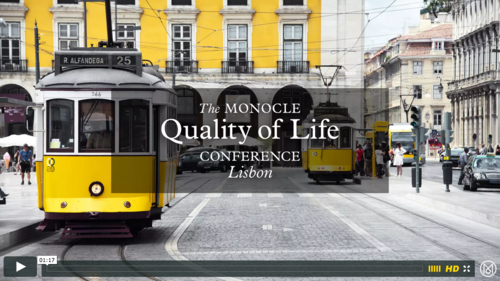
  • The Monocle Quality of Life Conference

    image

    Monocle magazine is launching their first ever conference this spring in Lisbon and it’s dedicated to quality life in the world’s greatest cities. It’s going to take place Friday, April 17th to Saturday, April 18th, 2015.

    You can click the image above for a video synopsis (there’s great urban eye candy), but if you don’t feel like doing that, here’s the text version:

    MONOCLE invites you to a weekend of peerless hospitality, great debates and in-depth conversations about the forces shaping the world’s great cities. Join our editors, correspondents and key thinkers in discussing topics ranging from architecture to independent retail, city planning to national branding.

    It sounds like a wonderful event and very much inline with some of the topics discussed here on Architect This City. If I had a conference budget that needed to get spent, I would be the first to sign up. If you’re interested, you can “register your interest” by clicking here. Tickets are €1,500.

  • When rent control goes too far

    I was catching up with a friend of mine over coffee this morning and he was telling me about his recent trip to Porto, Portugal. I’ve never been, but it’s fairly high up on my list of places to visit.

    He was telling me about how beautiful the center of the city is and how it’s a UNESCO World Heritage Site. But he was also telling me how eerie it was to see so many abandoned and decaying buildings.

    And part of the reason for this – I learned – is that up until fairly recently, Portugal had some incredibly onerous pro-tenant rent controls in place that dated back to the beginning of the 1900s.

    In fact, they were so onerous that, by some estimates, roughly 150,000 households in Portugal were paying less than €50 per month in rent before the laws were changed!

    Because of this, landlords in many cases could not, and cannot, actually afford to maintain their properties. Buildings were left to decay, and in some cases they were completely abandoned. That was their only option. And it led to a virtually non-existent rental housing market (according to the IMF).

    Clearly, this is a problem. If you have a market distortion as serious as this one – where there’s virtually no incentive to invest – you’re on a highly unsustainable economic trajectory.

    Which is why when Portugal received its bailout package from the International Monetary Fund and European Union following the 2008 financial crisis, it was asked to reform its rent control laws – which it agreed to do.

    The hope was that the reforms would allow Portuguese landlords to charge more reasonable and market-oriented rents, as well as do other crazy things like evict tenants that don’t actually pay their rent. Not surprisingly, many fought the changes.

    I don’t know precisely how these reforms have ultimately played out in the market over the past few years (if you do, I’d love to hear from you in the comments below), but I do believe that liberalization of the market was, and probably still is, needed.

    While paying €5 a month for a 4 bedroom apartment in a desirable central neighborhood might be great for that one individual family, it’s not so great for the economy as a whole. And ultimately that comes around to impact even that household.

    Image: Flickr