Daily insights for city builders, delivered every morning at 6 AM ET. I’m Brandon Donnelly — a Toronto-based real estate developer and founder of Globizen. I’ve been writing here since 2013.

Tag: linkedin

  • No is the second best answer

    image

    In addition to email, phone, and text, we live in a world where you can also easily and directly connect with people on LinkedIn, Facebook, Instagram, Twitter, Tumblr, Snapchat, Swarm, WhatsApp, Slack, as well as on many other platforms.

    As much as I love tech, I personally find this exhausting and far too distracting. So early last year I turned off all social media and messaging notifications – on both mobile and desktop – other than on the two platforms that I most commonly use. (Facebook and LinkedIn are not on this shortlist.)

    The result is that I am now missing (and consequently ignoring) a ton of direct messages. But as the saying goes, there’s no such thing as too much information, just poor filters. If you really want to reach me, I am not hard to find. You’re reading my public and daily journal right now.

    Zooming out from social media DMs, I am reminded of one of my all-time favorite Seth Godin posts where he talks about the value in saying no – which is, of course, just another kind of filter:

    No I can’t meet with you, no I can’t sell it to you at this price, no I can’t do this job justice, no I can’t come to your party, no I can’t help you. I’m sorry, but no, I can’t. Not if I want to do the very things that people value my work for.

    No is the foundation that we can build our yes on.

    And nobody should feel bad for saying no. A friend of mine likes to remind me that no is the second best answer. Yes is obviously the best, but a firm no is far better than an indecisive maybe that leaves everyone wondering what to do next.

    I should probably say no more often than I do. But I am working on it. Every now and then I remind myself that there’s huge value in saying no. Today’s post is that reminder and maybe it will be yours too.

    Photo by Kai Pilger on Unsplash
  • People you may know

    If you’ve ever wondered how Facebook figures out all of the people you may know, here is some reading material. 

    The short answer is that Facebook doesn’t just know the things you’ve told it about yourself, it also knows what other people have told it about you. 

    One of the ways in which this is done is through its so called “shadow profiles". These are profiles that get created when other people share information about you with Facebook. 

    For example, you may not want to share your work email address with Facebook, but if it’s sitting in someone’s phone and that person decides to share his/her address book with Facebook, then it could show up in your shadow profile.

    And if there’s a common data point, such a phone number, then Facebook can fairly easily link that work email address back to you and start suggesting people from your work that you may know.

    The scary part, of course, is that Facebook is getting your information without you explicitly sharing it with them. It could be coming from that person you gave your business card to at the bar.

    It goes to show you just how fierce the competition is for our attention. It may be an assault on our privacy, but more Facebook connections means a higher likelihood that we’ll stay engaged on the platform.

    Over the past year I have been growing increasingly intolerant of this demand for my time. Slowly but surely I have been turning off all nonessential notifications on my phone. 

    Very few now remain, which is why if you’ve been trying to reach me on Facebook, WhatsApp, LinkedIn or some other platform, and I’m not responding, it’s because there’s a good chance I’m not seeing the notifications.

    And let me tell, it feels liberating.

  • The U.S. cities that gained the most workers over the last 12 months

    One of the great things about social media is that it gives us access to data that previously didn’t exist or was difficult to collect.

    Take, for example, LinkedIn’s monthly report on employment trends called the Workforce Report. They look at which industries are hiring, where people are moving for jobs, and so on. Click here for the June 2017 edition. 

    Note that architecture/engineering hiring appears to be up nationally, which is usually a positive leading indicator.

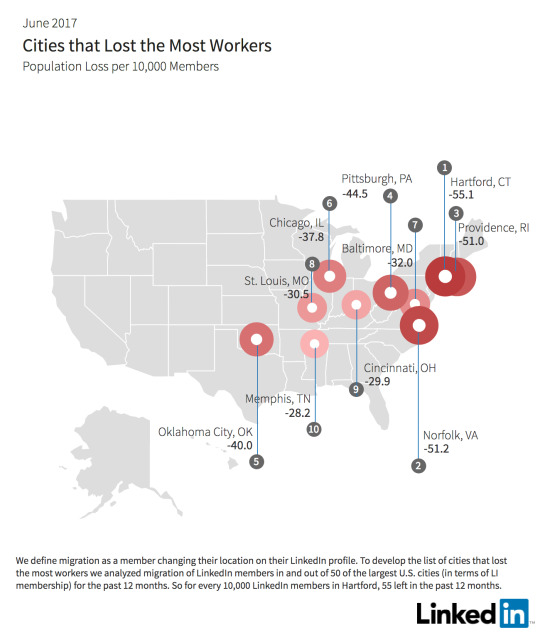
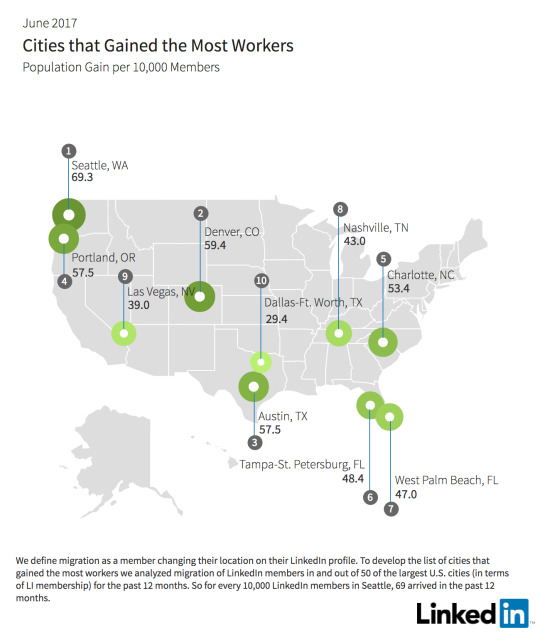
    I’ll leave you all to go through the report, but I did want to pull out a few of their maps and one of their takeaways. Below are maps of the cities that lost the most workers and gained the most workers over the last 12 months.

    The established trend of people moving from colder northern cities to warmer amenity-rich cities seem to play out here.

    That said, one of their “key insights” is that fewer workers today are moving to the San Francisco Bay Area. Since February 2017, there has been a 17% decline in the net number of workers.

    They blame housing affordability (ahem, lack of supply). People are simply turning to other great cities like Seattle, Portland, Denver, and Austin. They’re growing and cheaper.

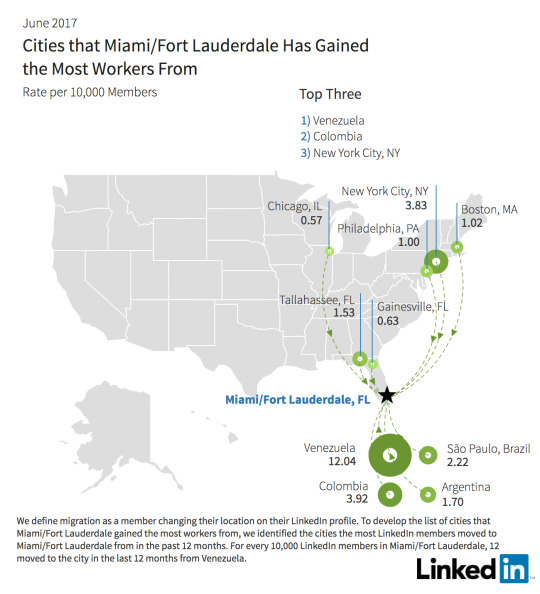
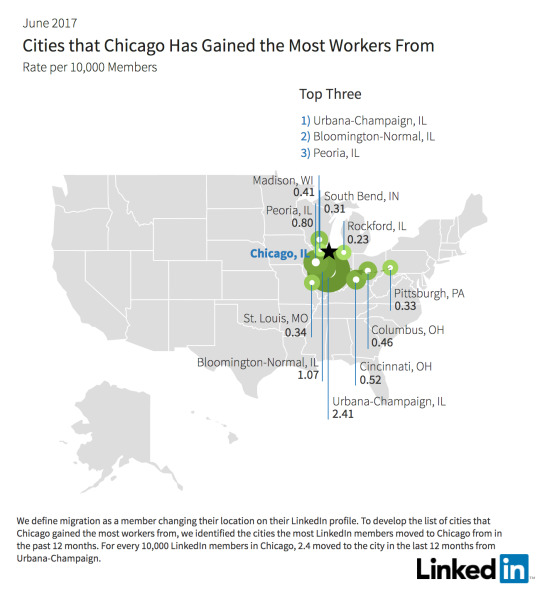
    One of the other cool things about the report is that you can drill down into individual cities to see where people are moving from. I looked up Miami and Chicago just to do a quick comparison. 

    Not surprisingly, Miami is seeing a significant contingent from South America. What’s interesting about this random comparison is how international Miami is and how regional Chicago is in terms of their draws.

    I would love to see similar data for Canada. This is valuable stuff.

  • The second coming of the car

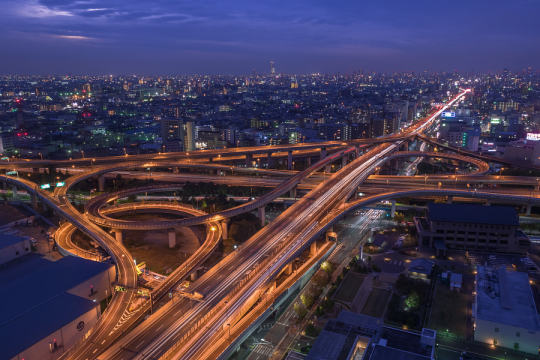
    Blue hour by Ryusuke Komori on 500px.com

    https://500px.com/embed.js

    As a kid growing up in the suburbs of Toronto, I remember when getting my driver’s licence and getting a car were some of my biggest priorities. 

    As soon as I turned 16, I went immediately to get my learner’s permit and then enrolled in a driving school so that I could shorten the time required until I could drive on my own. Every month counted at that age.

    It was such an important milestone that people born earlier in the year were seen as lucky. Because someone born in January, for example, could gain their driving independence before someone born at the end of the year even got their learner’s permit. As silly as it sounds to me right now, that spread was huge back then.

    But the world has changed and we are at the dawn of a new era: driverless cars. 

    Sooner than most people think, we are no longer going to drive ourselves around cities. I absolutely believe this. That means no more steering wheels. No more traffic calming measures on quiet residential streets. Safer streets. Perfect traffic information because all the cars will be networked. And a dramatic increase in urban efficiency. (Relevant post: The tragedy of the commons.)

    I can’t wait for this happen.

    Reid Hoffman, who is the co-founder of LinkedIn, recently wrote a fascinating article on autonomous vehicles called, Driving in the Networked Age. And in it he argues that cities should be starting to look at banning human-driven cars and generally putting in place policies to support networked autonomous cars. In fact, he sees it as an opportunity for Detroit to reestablish itself as the 21st century motor city.

    Again, I don’t doubt that this transition will happen. I think it’s a question of when, not if. But I also think that it’s going to be incredibly important to think about what driverless vehicles will mean for our cities and the built environment. 

    It’s once again an example of Marshall McLuhan’s famous phrase: The medium is the message

    Cars as a medium have had a profound impact on the way we live and the way we build our cities. We know this. But the medium is now changing. And while simply taking out the driver may seem like a small change, it is not. Have a read of Hoffman’s article.

    I’m excited about the possibilities. I don’t really like driving anymore. But let’s make this second coming of the car more positive for cities than the first. Deal?

  • Blogging is helping my startup idea

    Background

    I started blogging about Dirt (my startup idea) a few weeks ago in the hopes of finding a technical cofounder to join me in my journey to change the real estate industry. And while I am still searching, perhaps one the biggest benefits of blogging about my idea is that it’s forced me to bring additional order to my various sketches, wireframes and UX designs. It’s also forced me to clearly articulate what I’m trying to do.

    I spent a number of months working with Toronto-based agency Jar Creative on Dirt and at the time we were fixated on “real estate activity.” Specifically, finding a way for people to discover, track and share the real estate activity happening all around us. I still think this is a valid objective, but I’ve been questioning how exactly to go about this. One way to do it, is how I’ve outlined here: by having a property-only newsfeed. Users would follow properties and people and this would create a custom newsfeed surrounding their interests. 

    Evolution of the idea

    But the other thought I’ve been having is to allow people to build their own property portfolio, just like real estate companies and moguls do. The effect would be similar to above (users would receive updates on the properties they’re interested in), but it would be done through a kind of virtual property ownership.

    This is what I was getting at with this sketch:

    Dirt Property Portfolio Sketch

    Here’s an example: I’m walking down the street and I see a property I like. It’s not for sale and so there’s little information available online. There’s no MLS listing, although if I google it, I may find an old one. Similar to when I described the Problem on Greenlaw, I may have a bunch of questions surrounding this property: Who owns it? When was it built? What was the last sale price? 

    Solution

    So what can I do? Let’s add it to my virtual property portfolio. I take a picture of it and locate the address/property in the Dirt database (or ideally it’s done automatically from the photo). It then gets added to my Dirt property portfolio, such that when updates do become available (for example: it goes on the market), I get notified. It would also allow me to socialize/network around the property to find the information I’m looking for — a forum, if you will, for these discussions to take place.

    Why is this better?

    One of the big things I think this subtle change does better, is that it taps into an innate desire to own stuff. Home ownership is heavily subsidized and promoted, particularly in the US, and this would allow people to build virtual property portfolios. Reid Hoffman, founder of LinkedIn, once argued that the best social networks tap into one of the 7 deadly sins (WSJ):

    “Social networks do best when they tap into one of the seven deadly sins. Facebook is ego. Zynga is sloth. LinkedIn is greed.”

    Putting this spin onto Dirt would do exactly that. People would be given a quick and simple way to collect properties they like — without all the messy legal fees and mortgage commitments. It would also help to create a unique brand for Dirt. Instead of “user x is following property y”; it would be “user x has added property y to his/her portfolio.”

    Of course, these properties are actually owned by somebody in real life and so that’s a consideration, but could this not be the way to truly socialize the real estate industry?