Daily insights for city builders, delivered every morning at 6 AM ET. I’m Brandon Donnelly — a Toronto-based real estate developer and founder of Globizen. I’ve been writing here since 2013.

Tag: land values

  • Unclear and unknowable

    Development land, as we often talk about on this blog, should be the residual claimant in a pro forma. Meaning, start with your revenue, subtract your costs and required margin, and then see how much money is leftover to pay for the land. This is, in theory, how you should value land.

    It’s also the most disciplined way to go about your underwriting. In fact, it can be beneficial to not know the asking price or broker guidance for a new site until you’ve completed this exercise. That way you won’t bias yourself.

    However, in practice, it can be difficult to do all of this. In a rising market, you might find that there’s always some other developer who is willing to be more aggressive on their assumptions, which means they will be willing to pay more for the same piece of land.

    And so if you want to be in the game, you might find yourself doing the exact opposite: starting with the land price and then trying to figure out how to make the rest of your model work. We’ve all been there.

    During this stage of the cycle, you get punished for being conservative and disciplined — you don’t win sites. But when the market turns, discipline and conservatism get rewarded handsomely. You then become thankful for the deals you didn’t do. And I’m sure that many prudent risk managers are feeling this way right now.

    It is very challenging to underwrite new sites today. Many of the assumptions that go into a pro forma are unclear and unknowable. And so the spread between what developer’s models are telling them to pay and what landowners want to sell for is often significant. That is why everyone is trying to find “creative deal structures” that can be used to close this gap.

    At some point, though, the gap will actually close; things will once again feel clear and knowable. I have absolutely no idea when that will happen, but I do know that when it does, it will then be too late from a maximum opportunity standpoint.

    Because that’s how risk works. Once the uncertainty is gone, it’s no longer a risk. And if it’s no longer a risk, then you’re not going to be paid for bearing it.
  • Land prices can be weird

    Jeremiah Shamess of Colliers made the claim this week that land values in some areas of the Toronto region are down 25%. He then shared a chart from Alan Leela showing how various factors have increased or decreased land values since 2020.

    Broadly speaking, a revenue increase and/or more development density should increase land values; whereas something like inclusionary zoning, which is a cost to the project, should decrease land values. Indeed, this is one of the arguments in favor of inclusionary zoning: “Don’t worry about the additional cost to the project because landowners will simply pay for it through reduced land prices.”

    In theory, all of this is correct.

    Land is (or should be) the residual claimant in a development pro forma. Start with your revenue, subtract your costs, and then see what is left over for the land. (Though keep in mind that what is left over for the land could be $0 or even a negative number.)

    But as I have argued before in the context of inclusionary zoning, I don’t think things always play out so neatly in the market. Put differently, if the cost impact of inclusionary zoning is something like $44 psf, I don’t think all landowners suddenly drop their prices accordingly — especially in a rising market where developers are competing fiercely for land.

    They don’t care about your residual value model. Many or most will just hang on to their number and wait for someone to pay it.

    So what I am saying with all of this is that, yeah, there are factors that put either downward or upward pressure on land values. But how it all actually plays out in the market tends to depend on the macro environment and what else is going on at the time. And right now we are at a point in the cycle where there is clearly downward pressure on land values.

  • What’s Manhattan worth?

    I like looking at real estate values over longer periods of time because it helps to put things into perspective. 

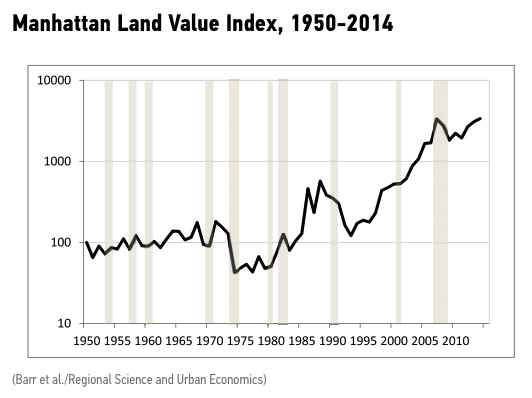
    Below is a land value index for Manhattan running from 1950 to 2014 that was recently created by economists out of Rutgers University.

    image

    The study was also cited in this recent article by Richard Florida.

    Here are some of the highlights from their study:

    We find three major cycles with land values reaching their nadir in 1977, just after the city’s fiscal crisis.

    Since 1993, land prices have risen much faster than population or employment, at an average annual rate of 15.8%.

    We estimate the entire amount of developable land on Manhattan in 2014 was worth approximately $1.74 trillion.

    We estimate the long run return to Manhattan land values [since the island was first inhabited by Dutch settlers in 1626] to be about 6.4%.

    What’s fascinating to me is the accelerated appreciation. The index starts at 100 in 1950, ends up slightly above that by 1993, and then simply takes off.

  • Locations of the 100 tallest skyscrapers in the world

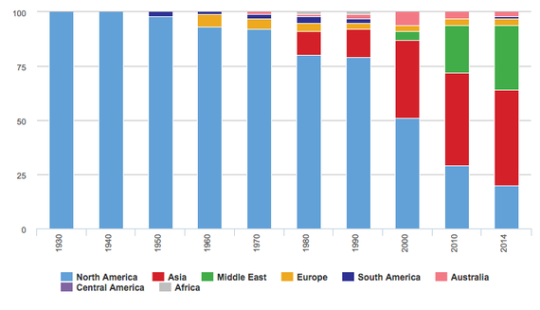
    This morning I stumbled upon the following chart (via The Atlantic) summarizing the locations of the 100 tallest skyscrapers in the world.

    As you can see North America dominated tall buildings for most of the 20th century. But then in the 1980s, Asia starting building. Then in the 2000s, the Middle East started building. And today, Asia and the Middle East are where the world’s “supertalls” sit.

    What’s fascinating about this shift is that in many cases, there’s absolutely no physical or economic need to developing so tall. Yes, rising land values can drive up the height of a building, but not to the extent that we’ve been seeing.

    Instead, building “the tallest building in the world” is more symbolic than anything else. It’s about ego. It’s about asserting your position on the global stage. And so while this is a chart about tall buildings, it’s actually a pretty telling chart about global ambitions.

  • The Fundamental Law of Road Congestion

    A few days ago I wrote a post talking about what happens when you demolish an urban highway. It was a link to an article giving 5 examples of cities that have removed their urban highways and benefited.

    After I wrote the post, a number of people responded on Twitter. Some thought it was a great idea and gave examples of other cities, such as Detroit, that are thinking about doing the same. But others responded and said that I was out of line. And that while it might work in some cities, it simply isn’t a viable option in cities like Toronto.

    So as somebody who believes we should be taking down the Gardiner Expressway, I thought it would be worthwhile to revisit the topic and provide a bit more information.

    To be clear, I’m not suggesting we remove the Gardiner and replace it with nothing. My belief is that we should replace it with a broad surface street that would still move lots of cars, but that would make our waterfront much more open and accessible to everyone.

    So how is this feasible?

    Again it comes back to the concept of induced demand. Back in 2009, two economists from the University of Toronto and University of Pennsylvania – which are actually both of my alma maters – published a study called The Fundamental Law of Road Congestion.

    In it they discovered something really fascinating: there’s a near perfect relationship between new roads and highways built and the total number of miles driven. In other words, as cities increased road capacities (during their study period of 1980 to 2000), the amount of driving went up just as much.

    What this should tell you is that trying to build your way of out road congestion is usually a losing proposition. That’s why every large city has a traffic problem. Try and think of one that has solved this. And as much as it might seem intuitive to tell people at cocktail parties that your city simply needs to build more roads and highways, it’s typically not that simple. (In my view, the solution is road pricing.)

    The other really interesting thing that this study revealed is that it works both ways. When you reduce road capacity, drivers start to disappear. People choose to live closer to where they work. People choose transit. People go into the office at different times. People make all sorts of different decisions in response to this road change, just as they do when there are more free roads available to them.

    So within a reasonable band (obviously you can’t remove all roads), there is no perfect amount of road capacity. If you added another lane to your highway, it would be full. If you took away a lane, it would end up equally full. That’s why removing the Gardiner Expressway isn’t lunacy.

    Instead, it actually makes a lot of sense:

    • It’s the cheapest solution (compared to repairing it or burying it)
    • It would free up money for transit and other mobility solutions
    • It would make our waterfront more open and accessible
    • It would beautify our downtown
    • It would increase land values all along the waterfront

    And since we’re still in the early days of developing our eastern waterfront, now is the time to do it. The longer we wait, the harder it’ll get and the more expensive it’ll get.

    So I hope that the leaders in this city will think long and hard about this as opposed to immediately assuming we need an elevated highway to keep this city moving. The last time I checked, it doesn’t work so well in its current state.

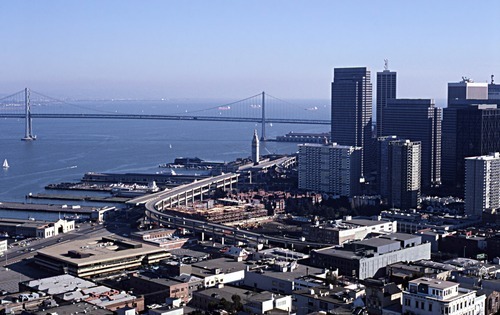
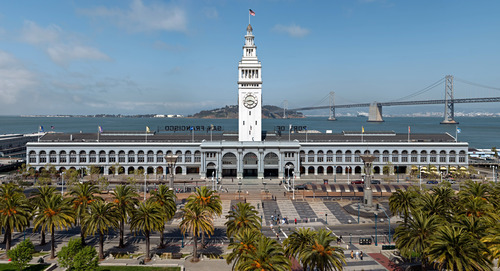
    Images: Before and After the Embarcadero Freeway in San Francisco (via Gizmodo)