Daily insights for city builders, delivered every morning at 6 AM ET. I’m Brandon Donnelly — a Toronto-based real estate developer and founder of Globizen. I’ve been writing here since 2013.

Tag: land use restrictions

  • A place for everything

    Housing is expensive in California:

    In 2021, San Jose had the least affordable housing among the 92 major US housing markets, with a median multiple of 12.6. San Francisco had a median multiple of 11.8, Los Angeles was at 10.7, followed by San Diego, at 10.1).7 Housing was severely unaffordable even in the interior markets, with Riverside-San Bernardino at 7.4 and Sacramento at 6.7.

    And there are some explanations for why that is the case:

    Dartmouth economist William Fischel published an early seminal review 9 of housing affordability in California (1970 to the 1990s). Fischel suggested that regulatory research should look for major changes that “are adopted in some places but not in others.”

    Fischel examined the higher house price increases that occurred in California compared to the rest of the nation between the late 1960s and late 1980s. Fischel cites various possible causal factors. He found that the higher prices could not be explained by higher construction cost increases, demand, higher personal income growth, the quality of life, amenities, Proposition 13, land supply or water issues.

    Instead Fischel cites stronger land use restrictions — There were two principal issues, the California Environmental Quality Act (CEQA) and local growth management restrictions.10

    We have discussed this issue many times before on the blog, but Wendell Cox’s article is helpful in pointing out that zoning in and of itself wasn’t the problem. The problem arose, at least according to Fischel’s research, when these policies went from “ordinary zoning” to something that became a tool to restrict growth.

    The illustrate what “ordinary zoning” means, Cox uses the idiom, “a place for everything, but everything in its place.” And I think this is an interesting way of putting it. Part of the reason why we have zoning is that it is a way to organize uses. It is a way of saying that sex shops and cannabis shops can’t go here, but they can go over there.

    But the key part of this idiom is its first part: a place for everything. What this implies is that the answer should never just be, “no, sorry, you can’t build this.” At most, it should be, “no, sorry, you can’t build this here, but you can over there.” There is a place for everything.

    Of course, this is much harder to do when you flip from sprawl development to infill development. Because now there are fewer places “over there.” You really have to figure out “here.”
  • We’re running out of land — or are we?

    The headline, here, is that “the US is running short of land for housing.” But if you read the article, you’ll see that the headline should probably read, “the US has land-use restrictions in place that make it unnecessarily difficult to build enough new housing.” Here’s an excerpt:

    Asking prices for homes in these new communities [the exurbs of Tampa] go as high as $900,000, in part because the land underneath is so valuable. That has a lot to do with land-use regulations.

    Tampa’s zoning rules prevent developers from building anything larger than a single-family home in much of the city. When officials for Hillsborough County, which includes Tampa, adopted zoning regulations in 1950, they said the measures were necessary to prevent overcrowding and traffic jams and would preserve the neighborhood character, all “with a view to conserving the value of buildings,” according to the regulations.

    If all you can build are single-family homes, then you’re going to need a lot more land compared to if you were allowed to build a bit higher and/or a bit denser. But it is a good way to ensure that supply remains somewhat scarce and that one is faithfully “conserving the value of buildings.”

    It is, however, worth mentioning that we have invented ways to use land more efficiently. The population density of Hillsborough County is somewhere around 1,200 people per square mile. The population density of Paris, on the other hand, is over 50,000 people per square mile.

    Somehow people still enjoy Paris.

  • Displacement and gentrification

    Let’s consider a scenario where we have a relatively affordable 20-unit apartment building in a rapidly growing global city. This particular building happens to be of an older vintage and so let’s say that the in-place rents are about 40% below market.

    Next let’s assume that the zoning has just been updated for the land and it is now possible and economically feasible to build a total of 300 housing units in a new high-rise building. This would mean demolishing the existing 20 apartment units.

    But because this global city has rental replacement policies in place, these 20 units would need to be rebuilt within the new high-rise and offered to the current residents at exactly the same rents. So same price, but new housing.

    Compensation would also need to be provided to these residents to cover the cost of moving around. Because they would obviously need to move off site to allow for construction and then, if they’d like, move back once construction is complete.

    How would such a scenario make you feel?

    The typical objections usually involve, among other things, concerns around displacement, gentrification, and overall built form. There is a concern that investments of this magnitude might push people out of the area and also change the character of it.

    But at the end of the day, these 20 existing homes are not disappearing from the market. They will remain part of the housing stock, but now with the addition of 280 new market rate homes.

    I think it’s important to remember that in a rapidly growing city, trying to maintain the status quo by limiting new development can actually have the opposite effect. Because what you end up doing is creating a scenario where more and more people are fighting for a relatively fixed supply homes. And that is certainly one way to encourage displacement and gentrification.

  • Land use restrictions and upward mobility

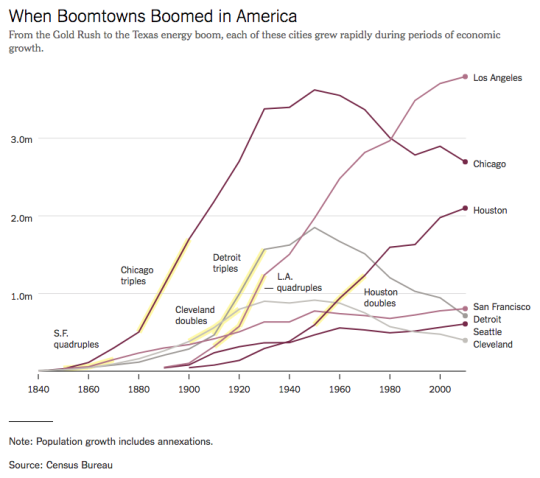
    Throughout US history, economic growth has typically spurred an “enormous reallocation of population.” Here is a graph from a recent New York Times article called: What Happened to the American Boomtown?

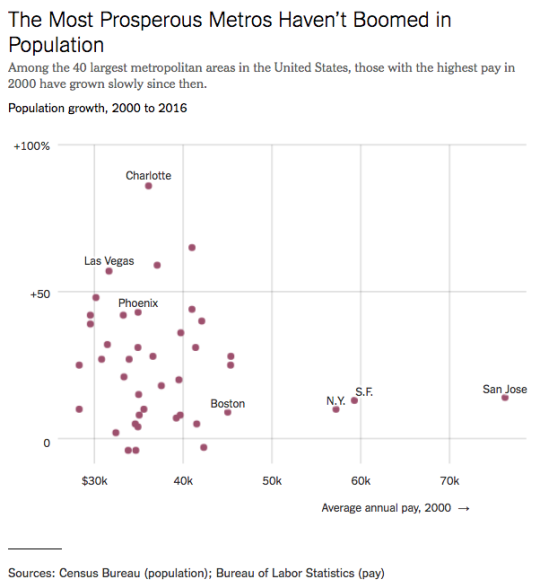
    The argument, here, is that restrictions on development have made it so that the most prosperous cities are actually the slowest growing cities in terms of population. Here is a chart, from the same article, comparing population growth to average annual pay:

    And here is an excerpt:

    But these productive places aren’t growing as fast now as economists believe they should — and as they would if they didn’t impose so many obstacles on new development. Since the 1970s, land use restrictions have multiplied in coastal metros, making it harder to build in, say, San Jose, Calif., than in Phoenix. And the politics of development have become tense, too. In the Boston suburbs, the Bay Area, Brooklyn and Washington, people who already live there have balked at new housing for people who don’t.

    We often talk about the impact of land use restrictions on supply and overall housing affordability. But here is an argument that it could also be impacting upward mobility.

  • What land-use restrictions are doing to our cities

    I have Richard Florida’s recent book, The New Urban Crisis, sitting on my bedside table. I’m only about ¼ of the way through it, but I’m really enjoying it. I’ll write more once I’m done.

    What I instead want to talk about today is a recent (and related) article that Florida published in CityLab called: Did Land-Use Restrictions Save the Rust Belt? 

    In it, he leans on the research of two economists – Chang-Tai Hsieh of the University of Chicago and Enrico Moretti of the University of California at Berkeley – and makes 3 valuable points.

    They are:

    It is estimated that land-use restrictions (which limit development / supply) have reduced overall GDP in the U.S. by about 9% or approximately $1.5 trillion per year. It is also estimated that housing supply constraints alone lowered overall growth by more than half between 1964 and 2009.

    At the same time, these land-use restrictions may have benefited other regions – such as the Rust Belt – that would have otherwise lost more people and jobs to places like New York and San Francisco. The research found that without these land-use restrictions, employment growth between 1964 and 2009 would have been more than 1,000% higher in New York and almost 700% higher in San Francisco.

    The final takeaway is one that we’ve talked about before on this blog. One of the most effective things we can do to counteract geographic inequality is to build great transit; transit that connects both people and land to the most desirable areas of our city.

    And with that, Happy Canada Day weekend all.

    Photo by João Silas on Unsplash