Daily insights for city builders, delivered every morning at 6 AM ET. I’m Brandon Donnelly — a Toronto-based real estate developer and founder of Globizen. I’ve been writing here since 2013.
It is based on recent population estimates from Statistics Canada, and what it is saying is that the Greater Toronto Area grew by 233,000 people during the 12 months ending July 1, 2023. If you include Hamilton, this number increases to 246,000. And if you include the entire Greater Golden Horseshoe, it increases to 340,000.
This is significantly more population growth compared to any of the six preceding years. And assuming this 2021 population estimate of about 9.8 million people is more or less correct, it represents an almost 3.5% growth rate. That’s remarkable. It’s also happening at a time when housing starts are declining.
Generally speaking, the value of a piece of land depends on what you can do with it. If the highest-and-best use is agriculture, then it might be worth $X. But if the highest-and-best use is a supertall skyscraper, then it’s going to be worth a lot more than $X.
This is why the land component is typically thought of as the residual claimant in a development pro forma. Start with what you can build, forecast your revenues and expenses, and then see what is left over and can be attributed to the land. This is, at least in theory, how the mechanics should work.
An interesting thought exercise, though, is to consider how different developers might value the exact same piece of land.
One obvious scenario is that a developer could just get their forecasts wrong. For instance, maybe they understate their costs, which then leads them to believe that they can pay more for the land. In this case, an error makes them the highest bidder.
In a rising market, there will also be developers who believe that they can almost certainly collect higher revenues in the future. In this case, the most bullish developer often becomes the highest bidder for land. And as long as the market continues to rise, they might not be wrong.
But things change in a slower or flat market.
Now the market isn’t there to save you if you happen to overpay for land. It’s a less forgiving environment. But it’s also a market where you really benefit from conservative underwriting and solid execution. Now it’s these groups who are the high bidders.
And I know that some/many developers prefer it this way.
Today I was at the Land & Development Conference here in Toronto. I started live tweeting during the breakfast, but my vintage iPhone 6 couldn’t keep up, so I had to stop. Some insights throughout the day. But a lot of what you would expect. I suppose it’s more about the networking.
I would, however, like to reiterate something that Ken Greenberg mentioned about Employment Areas/Lands in Toronto. For those of you who aren’t familiar, these lands are essentially intended to serve one, and only one, purpose: employment. And the process for introducing a mix of uses, including residential, is an onerous one to say the least.
I appreciate why this is the case. But I agree with Greenberg in that this kind of single use zoning is antiquated. It does not reflect the realities of the market today. There are other mechanisms we can use to maintain and provide for employment, and ensure that we don’t end up with a city of all residential.
Right now, there’s an apartment building in San Francisco that is trying to encourage car-free living by offering residents a $100 per month credit that can be used for Uber and/or for public transit. Prospective residents can even get a $20 credit to go check out the community. (The program is a partnership with Uber.)
The reason this leasing strategy caught my attention is because we’re at a point where city builders are now trying to recalibrate themselves to this new emerging world.
When I was at the Land & Development conference earlier this month, one developer brought up this exact point. He more or less asked: If you’re starting development on a new building today and you’re expecting approvals in 2 or so years and completion in another 3 or 4 years, what do you think the state of cars/driving will be at that point? Should you really be building all that underground parking?
These are great question. And they highlight one of the challenges of development. It takes a long time to bring new supply to the market and a lot can change during that time period. My sense is that we are pretty clearly seeing downward pressure on driving and car ownership.
That said, this isn’t the case in every city or in all parts of a particular city. I just got back from a trip to a Detroit where it’s pretty hard to imagine the city being oriented around anything but the car. But in cities like San Francisco and Toronto, car-free living is already a reality for many people and so we need to respond to that.
How do you see yourself driving, or not driving, in the next 5 to 10 years?
Today I spent the day at the Land & Development conference here in Toronto. If there was one running theme throughout the day, it was: “Holy shit, I can’t believe that X piece of land sold for $Y million. How will they (the developer) ever make the numbers work?”
Outside of the real estate development community, there’s often the perception that developers are building everywhere and that there’s lots of land left in cities, like Toronto. When you see all the cranes in the skyline, it naturally seems like we’re building a lot. Things seem easy.
But the reality is that it’s extremely difficult to find “land” in markets like Toronto and Vancouver. And by “land”, I mean properties that can be feasibly acquired/assembled, entitled, developed, and then brought to market. The way the speakers today spoke about land it’s as if it were a rare precious commodity.
I say all this, not to complain about how tough things are, but simply to shed light on the process. A developer’s job is to take a piece of property and figure out a way to create additional value. But to do that, they need to find a suitable piece of real estate. “Land” is an input.
This has implications for consumers, because inputs turn into outputs. And if one of the inputs is becoming scarcer, then it’s pretty safe to assume that the outputs, such as new housing, are also becoming scarcer.
Real estate development is a risky game. So much so that some people in the business like to say that their primary function is to mitigate risk.
Today I’m going to focus on 3 risks that developers face. There are, of course, others risks, but these are some of the biggest. Some people might also categorize them differently, but this is my simplified way of thinking about it.
The first risk is approvals. Oftentimes in development you need some sort of special permissions to build what you hope to build. These permissions come in many different forms, but whatever the case may be, there is risk associated with this part of the process.
What happens if you’re not able to build what you were hoping to build? Is the project still feasible? Do you have a viable plan B? Did you budget for a redesign? Have you now overpaid for the land? There’s a lot of uncertainty in this phase and uncertainty generally means risk.
Assuming you’re able to obtain your entitlements (this is more of an American term), the next big risk factor is the market. Can you sell or lease out the space that you’re about to build and can you do it at the rates you were assuming when you acquired the site?
In a bull market this isn’t usually a problem. In fact, prices and rents may actually exceed your early assumptions. But what if you bought the site in 2006 and now it’s 2008 and you’re hoping to go to market. Now you might be in trouble. In business school I learned to do sensitivity analyses and stress tests. How far does the market need to drop before I lose my shirt? Those are good exercises to do in development.
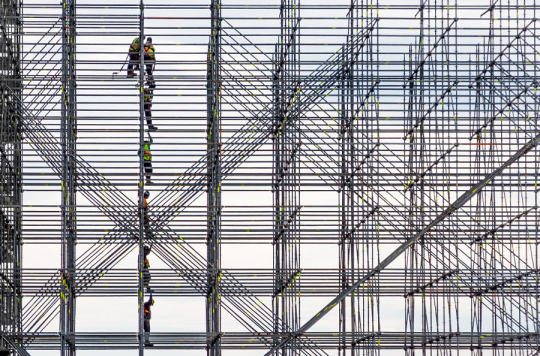
Assuming though that the market holds up and you’re able to pre-sell and/or pre-lease your new project and obtain financing, you would then be ready for construction – another big risk. This is why many developers bring construction in-house. It’s them trying to exercise more control over the process and mitigate risk.
Construction is messy both literally and figuratively. There’s a lot to consider.
Are the drawings that you’re using to buy construction properly coordinated? Because if they’re not, you’re going to pay for it later. Is that Chinese curtain wall a great bargain or are you going to end up on a flight to China when it never shows up on your construction site? Are the trades hungry for work or are they busy? If it’s the latter, you’re going to get higher prices. And oftentimes there’s nothing you can do about it. You’re just buying construction at the wrong time.
But we all know that with risk there’s reward. So if weren’t for all these risks, real estate development just wouldn’t be the same.
If you’re in the business, what keeps you up at night? Did I miss something? Let us all know in the comment section below.