Daily insights for city builders, delivered every morning at 6 AM ET. I’m Brandon Donnelly — a Toronto-based real estate developer and founder of Globizen. I’ve been writing here since 2013.
Here in Toronto, I can’t say that I see ours all that often outside of city hall. Am I missing it? Here’s what it looks like:
In other cities, such as Chicago, the city flag seems to be far more ubiquitous. Here’s what Chicago’s looks like:
In the case of Toronto’s flag, the two white bands are meant to represent the architecture of Toronto City Hall. The maple leaf is the Council Chamber at the bottom. And there is some suggestion of a letter “T” for Toronto. Wikipedia says the “T” is supposed to be found in the blue space between and above the two towers of city hall, but I’ve always seen the two white bands as being the “T.”
In the case of Chicago’s flag, the blue bands represent the lake and river (I like that) and the four six-sided stars represent significant events in the history of the city (positioned between the two bodies of water to mimic its actual geography).
Roman Mars of 99% Invisible has a great podcast and TED talk on this topic. (The study of flags is known as vexillology.) In both instances, he outlines what he believes to be the 5 rules of great flag design. They are:
Keep it simple
Use meaningful symbolism
Use 2-3 basic colors
No lettering or seals
Be distinctive
Toronto’s flag generally conforms to these rules. But there’s something about the positioning of the maple leaf that makes the flag feel a bit arbitrary to me. I want to rationalize it.
In any event, I think it could be really interesting if all of us shared our city’s flag in the comment section below and made a comment about how ubiquitous it is within the urban landscape.
Roman makes the argument that a great flag gives people something to rally behind. And with cities only becoming more important on the global stage, there’s something to be said about having a well-designed flag today.
I wonder if there will be a correlation between good flag design and ubiquity. My guess: probably.
The Douglas House by architect Richard Meier was just designated by the National Register of Historic Places. The house was originally designed in the late 1960s for Jean and Jim Douglas of Grand Rapids, Michigan. But it was more recently restored by Marcia Myers and Michael McCarthy. They purchased the tired property in 2007 and apparently had architecture professors knocking on their door shortly thereafter.
Here is a beautiful photo (via Curbed) by James Haefner courtesy of the Michigan State Historic Preservation Office:
I love the positioning of the house within the landscape. In fact, it’s built into such a steep slope that you actually enter the house at roof level via a bridge. However, once inside, you’re then able to look down to the living and dining areas, as well as out to the sundeck overlooking Lake Michigan.
Interestingly enough (according to designboom), the Douglas family had originally purchased a lot for their new home in a residential subdivision. But when the developer of the subdivision prohibited them from working with a stark Modernist like Richard Meier (those damn developers), they decided to sell the lot and look for something else. Above is what they ultimately decided on.
I’m glad they stuck to their guns. Otherwise this house probably wouldn’t exist today. And that would be a shame. I’ve always liked the work of Richard Meier. It’s always white and minimal and I like white and minimal. Simplicity can be surprisingly difficult to achieve. As the saying goes: “If I had more time, I would have written a shorter letter.”
“Make no little plans. They have no magic to stir men’s blood and probably themselves will not be realized. Make big plans; aim high in hope and work, remembering that a noble, logical diagram once recorded will never die, but long after we are gone will be a living thing, asserting itself with ever-growing insistency. Remember that our sons and grandsons are going to do things that would stagger us. Let your watchword be order and your beacon beauty. Think big.”
-Daniel Burnham, Chicago architect. (1846-1912)
I’m a big fan of Chicago. Having now visited the city, I can say that everyone was right when they told me that I was going to love it. It has great art and architecture, great food (with some of the largest portions I’ve ever seen), great nightlife, and great people.
But I don’t want to talk about any of these things today. Instead, I want to talk about something much more specific that stood out to me last weekend: Chicago’s relationship to both the water and the street.
While Chicago and my hometown of Toronto share many similarities– including being situated on a Great Lake and having rivers flow through the middle of them–the relationship to these bodies of water is remarkably different. Here is a photo of people kayaking in the Chicago River on a Friday afternoon:
What impressed me about Chicago is how intimate and urban the relationship is with the lake and its rivers. If you look at the photo above, you’ll see that many of the buildings are built right up against the river, but that there’s space allocated for riverwalks, patios, and so on. It’s all about engaging and connecting with the water.
Toronto on the other hand, is only recently starting to reacquaint itself with its bodies of water. We spent much of the second half of the 20th century with our back turned to the lake and without a strong urban connection to the Don River. And if I had to guess why it’s because we built highways along them.
We built the Gardiner Expressway adjacent to Lake Ontario and we built the Don Valley Parkway adjacent to the Don River. This fundamentally changed our orientation and largely precluded us, I think, from creating the same kind of waterside urbanity offered in Chicago.
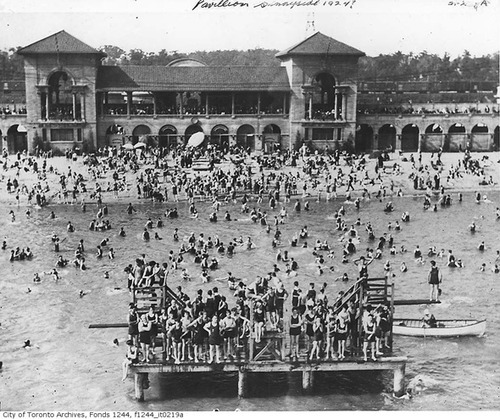
As an example, consider that in the first half of the 20th century, Toronto’s Parkdale neighborhood – which today still has a questionable reputation – was actually an affluent and desirable waterfront community filled with beautiful Victorian mansions. It was well connected to the waterfront, and so the area flourished. Here’s what Sunnyside Pavilion used to look like:
But then in the 1950s we built the Gardiner Expressway, disconnecting Parkdale from the lakefront and destroying many of its amenities, such as the Sunnyside Amusement Park. In turn, the rich people left and their large Victorian mansions got chopped up into rooming houses and other rental housing stock. And in my view, Parkdale still hasn’t fully recovered from this.
Highways are divisive. There’s no question.
So unless you can afford to bury them, it comes down to trade offs: Do you want to make it easier for people to drive in from the suburbs or do you want a truly spectacular water or riverfront? In the 1950s we chose the former. But even still today, the thought of tearing down–even a portion of the Gardiner Expressway–is fraught with opposition. I guess not much has changed.
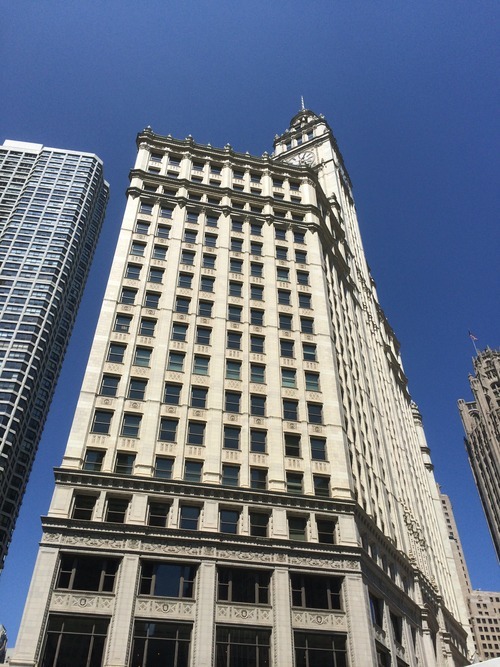
The second way that Chicago impressed me is through the relationship that many of its buildings hold to the street. They come down to ground level with authority and with great retail presence, and often make no amends about their mass and impressiveness. This frames the street and creates a level of urbanity that isn’t always found in Toronto – particularly outside of the downtown core.
In Toronto, the trend today is towards street level podiums, significant setbacks, and delicate point towers that minimize the impact of their height and allow for natural light to reach street level. It’s well-intentioned and perfectly appropriate in many urban settings. But sometimes you need a little urban assertiveness. Sometimes you want to impress and impose. And Chicago does that.
What I’m getting at is that Chicago architect Daniel Burnham was on to something. He famously advocated for man (that was the era) to think big. Make no little plans, he said. And it’s admirable advice. Toronto is going through a tremendous transformation right now. We’re North America’s boomtown, which is a title that Chicago would have held at one point.
But as we build for the future, let’s remember that, long after we’re gone, we’re going to be judged based on the plans we are making today. So why not make them big ones.
Before visiting Chicago for the first time, everybody told me that I was going to love the city. They would tell me that it’s similar to Toronto, except that it has better architecture and a better waterfront. Having now visited the city, I not surprisingly have a lot to say on this matter. But I need another day or so to formulate my thoughts.
In the interim, I thought it would be fun to host a little competition. Given that both Chicago and Toronto are Great Lake cities of comparable size (and formally sister cities), I’d like to know: Which city, do you think, has the better skyline? Please respond in the comment section below and make sure to include your location (so we all know if you might have a hometown bias).
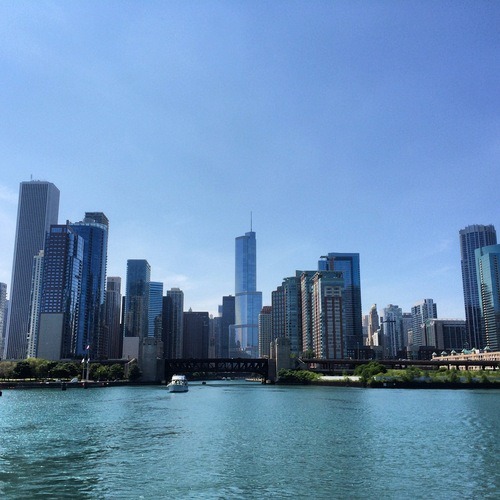
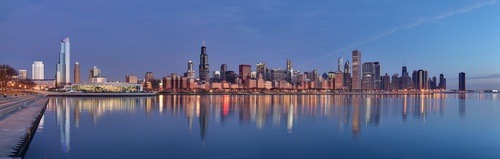
To help you make your assessment, here are a few photos. Below is one that I took of the Chicago skyline from the architecture boat cruise we went on yesterday afternoon. The building directly in the center is the Trump Chicago.
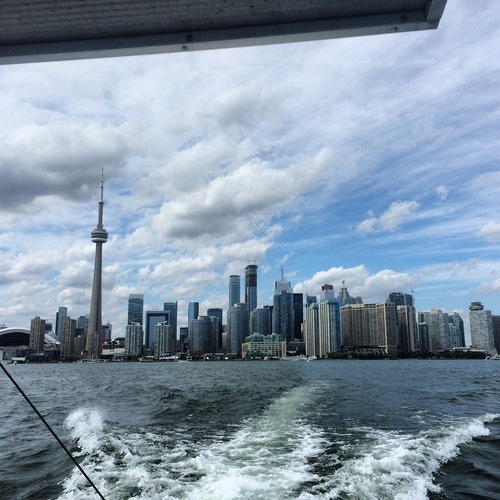
And here’s a photo of the Toronto skyline that I took from a water taxi earlier this summer.
But since these photos only represent one particular vantage point (me on a boat), here’s a set panoramic photos that I found online (Chicago & Toronto). I want to be as fair as possible.
I think this one could go either way. But I personally like the variety that the lit up CN Tower and Sky Dome (Rogers Centre) bring to Toronto’s skyline. Overall, it feels a lot more modern and exciting to me. So I pick Toronto. What about you?
Over the long weekend I wrote a post called “On medium density development.” My argument was that Toronto has gotten exceptional at building infill towers, but not so great at midrise and other medium density infill solutions. Though to be fair, we are starting to see more and more of that today.
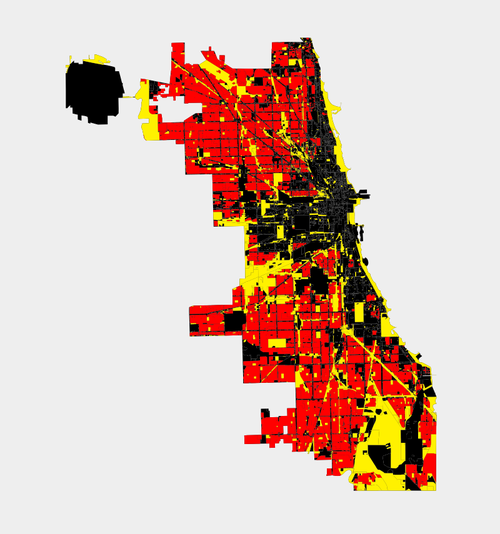
Well it turns out that Chicago is in a similar, if not worse, position. According to Aaron Renn of the Urbanophile blog, most of the city (outside of the city center) only allows for single family homes. Though in some cases you may be allowed a duplex or triplex.
Here’s a map:
The red is where you’re only allowed to build single family homes. The yellow represents non-residential uses (parks, industry and so on). And the remaining black is where you’d see high density development. Note how it runs all along Lake Michigan. Both Toronto and Chicago are developing in a similar “T” formation.
Now, some of you may be saying to yourself: So what? But it’s important to remember that this type of zoning effectively creates a supply constraint in the market, which, as I’ve argued before, will drive up prices. Chicago may as well be surrounded by mountains, because that red area seems almost untouchable from a development standpoint.
With so many people rushing back to cities today, a lot of them are struggling to create the same market environment that our parents enjoyed. You know the one where you finish school, get a job, and then you’re able to buy a house. But I think it’s because many of our cities are at a turning point, and yet are clinging to outdated principles of city building, such as single-use zoning.
But I’m certainly no expert on Chicago, so if you are, please speak up in the comment section below.