Daily insights for city builders, delivered every morning at 6 AM ET. I’m Brandon Donnelly — a Toronto-based real estate developer and founder of Globizen. I’ve been writing here since 2013.

Tag: labor market

  • The disappearing urban advantage

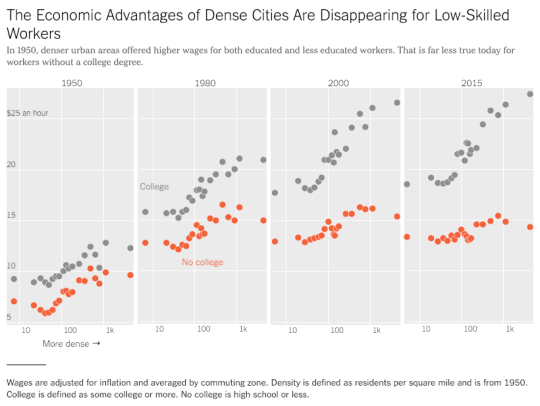
    The New York Times has a recent article up talking about the disappearing “urban advantage” for low-skilled workers. It is based on the work of MIT economist David Autor.

    Here is a chart from the article plotting wages against population density from 1950 to 2015:

    image

    The clear takeaway is that dense urban centers remain a place where wealth is created – but you probably need a college degree.

    The economic advantages of dense cities for those without one appears to be disappearing. The labor market has diverged.

    Interestingly enough, David’s research also suggests that college graduates may be starting to abstain from the suburbs – even when they have kids.

    And that’s because the returns to being in the city are so great.

    For the full NY Times article, click here. 

  • Cities are labor markets

    Eduardo Porter recently published this piece in the New York Times on the “relentless economic decline” of small-town rural America. We often talk about rising income inequality, but the greater concern is the alarming rate of joblessness in many of these communities. Earning less than others is not as bad as earning nothing.

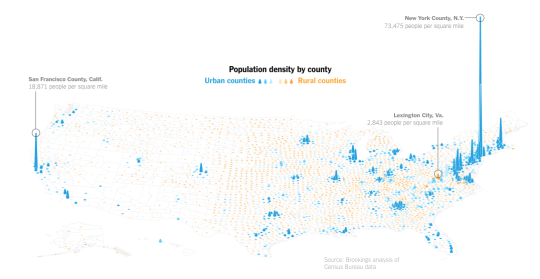
    I think the below map from the article, depicting population density by county, starts to show how uneven the economic landscape is across the US. Porter puts it this way: “This is the inescapable reality of agglomeration, one of the most powerful forces shaping the American economy over the last three decades.”

    image

    But, of course, we don’t really have a solution to this problem. Some are suggesting employment subsidies, such as the earned-income tax credit. While others are suggesting that we need to make it easier to build in the large blue spikes shown above. That way we’ll be able to more affordably accommodate the people who will ultimately need to move from rural to urban.

    While this latter suggestion may seem grim for small-town America, it is perhaps a reminder of what cities really are at their core: Cities are labor markets. They are the places where people come to get a job and make money.

  • Winner take all, or most, economy

    The world is increasingly spiky. Inequality is growing and it is increasingly geographic in nature. We know that people tend to make more money in urban areas compared to rural areas – even when they possess the exact same level of education. The returns to being smart and educated are simply greater in cities.

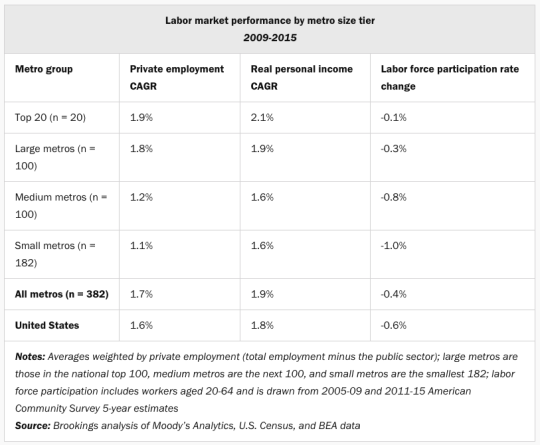
    But they also depend on the size of the city. Mark Muro and Jacob Whiton of Brookings recently published data looking at labor market performance – by metro size – from 2009-2015 (right after the financial crisis). What they found is that larger metropolitan areas simply performed better than smaller ones.

    image

    In summary:

    City size matters because it’s a major influence on city prosperity and adaptability as well as local worker fortunes. Bigger cities are more productive. They are more innovative. They draw better-educated workers by offering higher wages.

    The situation is even more pronounced across the pond. According to the New York Times (quote from Richard Florida), a third of Britain’s gross domestic product comes from London alone.

    What is far less clear is what should be done to address the decline of some of the smaller cities in America – cities that are stagnating and feeling left behind. But perhaps the first step is acknowledging what has happened and what remains feasible in today’s global economy.

    Here is another quote from the above NY Times article:

    Mr. Trump’s promise to relieve the pain by reviving the coal and steel industries, by keeping immigrants out of the country and by raising barriers against manufactured imports is only a rhetorical balm to satisfy an angry base seeking to reclaim a prosperous past that is no longer available.

    That rhetorical balm.

  • Your own signpost

    Work Market is an “on-demand talent marketplace.” They connect companies who need work done with skilled freelancers who are looking to do work. Conceptually, we’ve seen this before.

    But this morning, as I was reading this interview with the CEO, the following lines got me thinking:

    “By 2040, I’m pretty confident that every skilled worker will have their own signpost. You will be your own enterprise, in a much more meaningful way than the lip service of today.”

    We are already seeing this phenomenon play out. Social media, for instance, has made all of us our own media brands. So it’s not outlandish to believe that we will also see more, not less, of this in the labor market.

    But what I started thinking about is how this changing relationship between business and labor will ultimately manifest itself in our cities. 

    If we are indeed shifting toward a fluid and dynamic labor market where not only do people switch jobs more frequently, but they have their own signposts, then I have got to believe that urban density will only become more important. We’ll all need to be “plugged in” to the market – both online and offline.

    But what are your thoughts? I think this could make for an interesting discussion in the comments.

  • The rise of tech outposts

    What happens when wages and real estate prices become too high in a city? Companies start growing in lower cost locations. We’ve all seen this before. 

    Fred Wilson recently blogged about this “spillover effect”, citing a New York Times article talking about the growth of tech offices in Phoenix. As someone who sits on the board of many technology companies, he was noticing a thematic trend:

    “A big theme of board meetings I’ve been in over the past year is the crazy high cost of talent in the big tech centers (SF, NYC, LA, Boston, Seattle) and the need to grow headcount in lower cost locations.”

    We talk a lot about housing prices on this blog, and so I think it’s useful to see how this, along with high wages, also impacts companies. The two are interrelated.

    Below is a chart from the NY Times article showing the US cities with the highest number of technology jobs and the most growth from 2010 to 2015. 
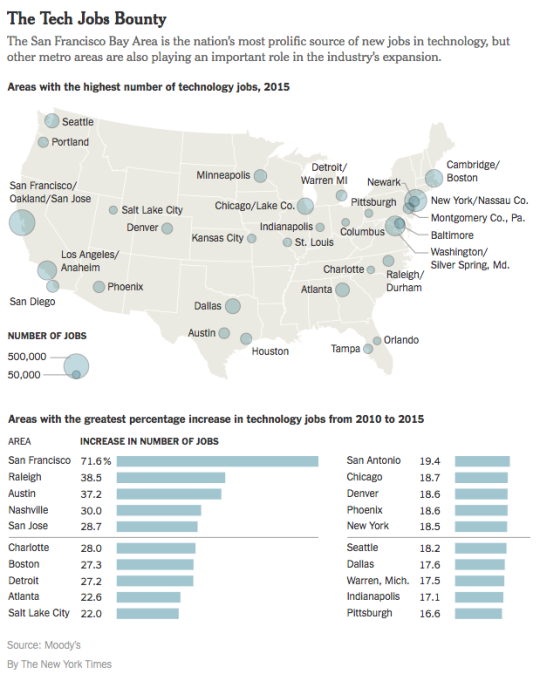
    San Francisco is in a league of its own. But overall, the growth is in tech and many cities are adding lots of technology jobs. Look at Detroit and Boston right beside each other (Detroit obviously has a smaller starting base). And look at how Miami is nowhere to be found.

    Of course, one interesting question is whether these new outposts – such as Phoenix – can truly come into their own and carve out a niche:

    “We don’t want to be San Francisco’s back office — we need more creators here,” said Scott Salkin, a founder and the chief executive of Allbound, which is based in Phoenix, makes sales software and has offices down the hall from Gainsight’s.

    Even with the high cost of living, it’s hard to supplant the coastal hegemony. That’s where people go to chase riches. As comedian Daniel Tosh likes to say, “the middle of the country is for people who gave up on their dreams.”

    Though for some, living in a place like Denver or Salt Lake City and snowboarding every weekend is a better outcome than living in a studio apartment and commuting an hour to work.

  • Cities with the most single men and women

    There are thousands of people who read this blog via email or by following on Tumblr. The rest of the readership just stops by on the web and visits periodically.

    But of the thousands of regular readers, I know that many do not click through to the comment section. And that’s a shame. Because oftentimes I find the comments more interesting than my actual post.

    Take for example yesterday’s post on The Millennial Dream. 

    The initial post was about Millennial housing choices (and some stats on marriage and fertility rates). The comments provided some additional color on the trends, but they also got into mobile dating apps and whether or not it’s easier or harder to meet people in cities, today. It was a fun discussion.

    This got me thinking and reminded me that people come to cities not only because of labor markets, but because of dating markets. 

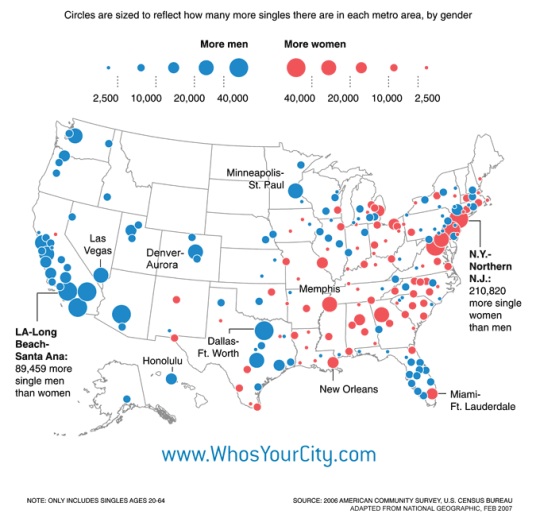
    So for today’s piece, I thought I would post the following diagram from Richard Florida’s book, Who’s Your City? It shows how many more singles (aged 20-64) there are – according to gender – in the largest US metro areas.

    I couldn’t find an equally detailed map for Canada, but based on this, it looks like Toronto is slanted towards single women and Calgary is slanted towards single men.

    Does the above look right to you?