Daily insights for city builders, delivered every morning at 6 AM ET. I’m Brandon Donnelly — a Toronto-based real estate developer and founder of Globizen. I’ve been writing here since 2013.

Tag: knowledge economy

  • Working from somewhere

    From the outset, people have been predicting that the internet would become a decentralizing force for cities. That is, technology would allow us to spread out and work from anywhere — perhaps from a small mountain town in the BC interior. While working from home (WFH) and working from anywhere (WFA) does appear to be on the rise, it hasn’t made cities irrelevant. (US Census data from 2018 estimates that only about 5.2% of Americans work entirely from home.) In fact, the “new economy” seems to have made superstar cities, such as London, seemingly even more important. It has concentrated economic activity; so much so that we’re searching for ways to spread out income and wealth more evenly.

    But could it be that the technology simply wasn’t there yet? Fred Wilson posited on his blog today that right now might be video conferencing’s moment. Between not wanting to travel (coronavirus, carbon footprint, time, etc…) and advancements in the actual technology, companies such as Zoom are changing the way people and companies engage over long distances. It is happening in our offices. And come to think of it, there are probably a bunch of meetings that I could and should switch over to Zoom. I’m not yet convinced that it will become a decentralizing force for cities. But it does seem to be empowering less travel and more flexibility.

    Photo by Nastuh Abootalebi on Unsplash

  • Winner-take-all cities

    Richard Florida, Charlotta Mellander, and Karen M. King have a new working paper out called Winner-Take-All Cities.

    It is about the phenomenon of “winner-take-all urbanism” and how a select number of alpha cities seem to overrepresent when it comes to talent, economic activity, innovation, and wealth creation.

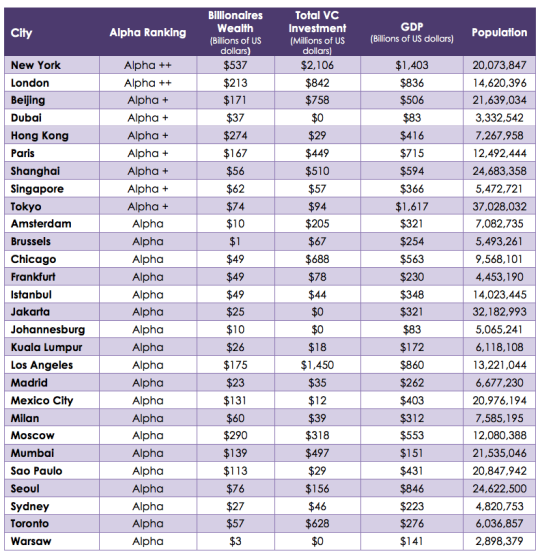
    In this study they look at economic output, innovation (venture capital-backed startups), and billionaire wealth in each city. They then compare these factors to the distribution of the population.

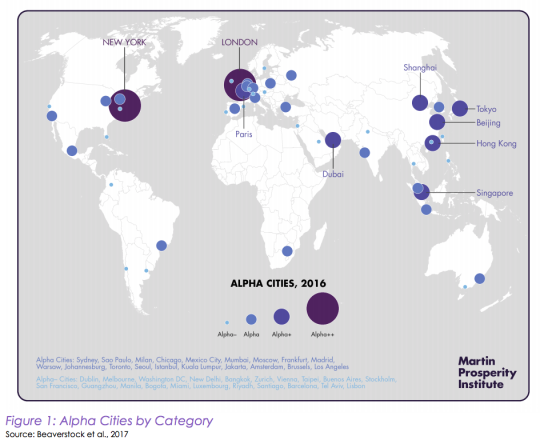
    Here are the Alpha cities they looked at:

    In some cases the above concentrations were multiples of what the city’s population would lead you to predict. Their conclusion: “We find clear evidence of a winner-take-all urbanism
    across the global economy and the world’s cities.”

  • I’m so busy

    “How are you?”

    “Busy!”

    How many of you say this? I say this all the time, even though I am trying to resist and come up with more creative responses.

    I recently tweeted this idea out and then my friend Brad sent me this article from HBR: Why Americans Are So Impressed by Busyness. It’s a fascinating topic because, historically, not being busy was a sign of status. It meant you had enough money to not have to do anything. 

    But things have changed – at least in this part of the world. (Italy doesn’t seem to feel the same way based on some studies.) Here’s a snippet from the article:

    “What has changed so dramatically in one century? We think that the shift from leisure-as-status to busyness-as-status may be linked to the development of knowledge-intensive economies. In such economies, individuals who possess the human capital characteristics that employers or clients value (e.g., competence and ambition) are expected to be in high demand and short supply on the job market. Thus, by telling others that we are busy and working all the time, we are implicitly suggesting that we are sought after, which enhances our perceived status.”

    So the reality is that there’s actually a good reason for always talking about how busy we are. But as Silvia Bellezza points out in her article, there are also physiological consequences to always being: “busy!” 

    On that note, I think I’ll go snowboarding.

    “How are you?”

    “Just living the dream.”

  • World after capital

    Albert Wenger is currently in the process of writing a book called World After Capital. The book isn’t finished yet. It still exists in a crude rough draft form. But already he has made it freely available online. You’re also welcome to comment and contribute to the book as he works on it.

    Why has he done it this way? 

    Because this format of publishing is in line with where he believes the world is heading. He believes we are headed towards a world where new forms of surplus – brought about by technological innovation – will create greater levels of freedom: economic freedom, informational freedom, and psychological freedom.

    His overall thesis is that the world has been moving through a series of scarcities. As hunter and gathers, the scarcity was food. In our agricultural period, we learned how to create food surpluses (which freed up more of our time), but it then produced land scarcity. Once the industrial revolution hit we once again freed up more of our time through surpluses, but then the scarcity became centered around capital. We also started to negatively impact the environment. Today, as we clearly move away from the industrial economy towards a knowledge and information economy, Albert believes the new scarcity is attention. (I wrote a related post about a month ago.)

    If you’re interested in this topic and don’t feel like diving into his book, I suggest you watch this 23 minute presentation by Albert Wenger. I watched it this morning and he talks about everything I mention above. 

    Here’s one of his slides that I felt was important to share:

    Why it’s interesting to think about this shift is because there will inevitably be positive and negative outcomes associated with it; there will inevitably be groups who, probably because of self-interest, would rather cling to the past; and because there are pressing global issues that we need to be focusing our attention on – issues such as climate change.

    I can’t help but wonder about all the ways this shift could reverberate through the economy and our cities. Earlier this week I wrote a post about architecture as a tool for capital. But with our current fixation on “starchitecture”, one could argue that we have already transformed architecture into a new tool – a tool for grabbing attention. If you believe that attention is the new scarcity, then this makes perfect sense.

  • Why creativity requires freedom

    Brazil colors by bruno Gueroult on 500px.com

    https://500px.com/embed.js

    In a knowledge and innovation economy, new ideas matter a great deal. But it seems to be a lot easier for existing companies to come up with sustaining, incremental innovations, than it is for them to come up with new, disruptive innovations. 

    New can be hard.

    That’s why I was interested in a recent New York Times article by Wharton professor Adam Grant called, How to Raise a Creative Child. Step One: Back Off.

    The article starts by arguing that many “child prodigies” rarely become adult creators who go on to the change the world:

    The gifted learn to play magnificent Mozart melodies, but rarely compose their own original scores. They focus their energy on consuming existing scientific knowledge, not producing new insights. They conform to codified rules, rather than inventing their own. Research suggests that the most creative children are the least likely to become the teacher’s pet, and in response, many learn to keep their original ideas to themselves. In the language of the critic William Deresiewicz, they become the excellent sheep.

    To become creators Adam argues that children need to be given the freedom and independence to develop their own sense of self:

    When psychologists compared America’s most creative architects with a group of highly skilled but unoriginal peers, there was something unique about the parents of the creative architects: “Emphasis was placed on the development of one’s own ethical code.”

    Yes, parents encouraged their children to pursue excellence and success — but they also encouraged them to find “joy in work.” Their children had freedom to sort out their own values and discover their own interests. And that set them up to flourish as creative adults.

    I firmly believe in this approach. But of course, this doesn’t just apply to children; though that is certainly an important takeaway. I also think that if you want the best work out of people in the workplace, you also need to: back off.

    Creativity needs freedom.

  • Balancing oil and ideas

    Colorado Sunset by Travis Bredehoft on 500px.com

    https://500px.com/embed.js

    Canada is a resource rich country. And one of the things that commonly happens to countries with a lot of resources is that they begin to myopically focus on the immediate gains from resources at the expense of long term innovation and economic development. 

    This is known as the “resource curse.”

    The Martin Prosperity Institute here in Toronto recently published a report that looks at this exact topic: Canada’s urban competitiveness through the lenses of its resource economy and its knowledge economy. In the end, Richard Florida and Greg Spencer conclude that two can and should work together, but that we need to stop neglecting our cities:

    “The oil and gas industry is not necessarily a constraint on the creative economy, but in the past decade or so it has come to dominate thinking around economic development policy-making. It is time to use the resources from the energy economy to build a more secure future as an urban knowledge economy. We can also use
    talent and technology to deepen and expand the resource economy.”

    And one of their key recommendation is something I have argued for many times here on Architect This City:

    “A New Federalism for Cities: It is time to give cities the taxing and spending powers they require. Cities must be given more control over their own destinies if they are to prosper
    in the 21st century.”

    Now, here are a few interesting charts from the report.

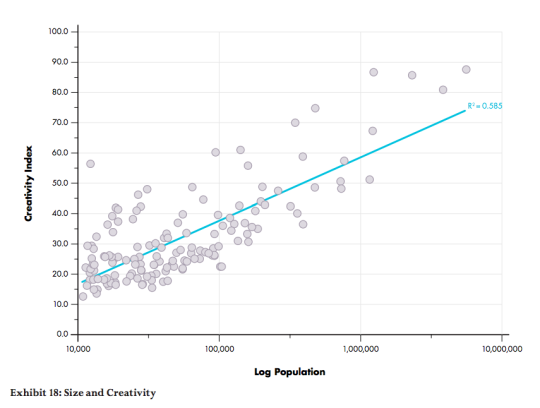
    This first one looks at the relationship between a city’s population and its creativity levels. The two are positively correlated, which means that, in this context, bigger is better.
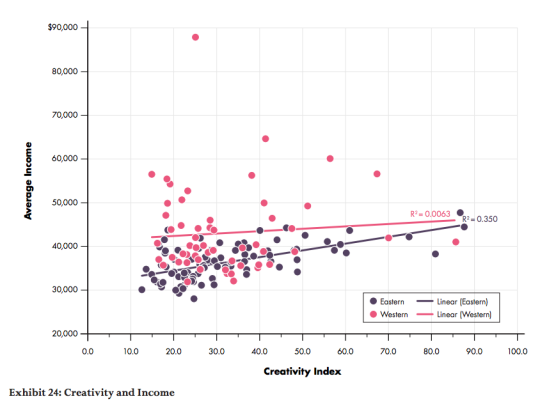
    This second one splits Canada in half – east and west – and then looks at how average income levels are affected by creativity levels (the knowledge economy). Here we see that in eastern cities, income levels are positively correlated with creativity levels. But in western cities, changing creativity levels have almost no impact on income levels. 
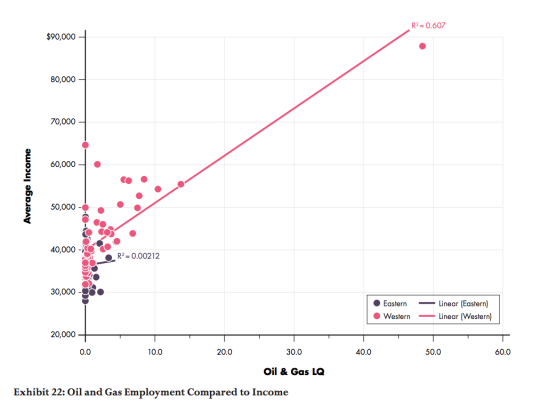
    Finally, this third chart compares the relationship between oil and gas employment (LQ = location quotient) and average income levels. What it finds is that income levels and oil and gas employment are positively correlated in the west, but there’s almost no relationship in eastern cities. 

    The way to read this chart is to think of the LQ as the employment multiple relative to the national average. So for example, a LQ = 10 means that the oil and gas employment levels are 10 times the national average. As you probably guessed, the pink dot way out on the right is Fort McMurray.
    If you’d like to read the entire report, you can do that here. I hope that our new Prime Minister, Justin Trudeau, will read reports like this and spend more of his efforts investing in our knowledge economy – which means investing in our cities.

  • Labour Day thoughts…

    Today is Labour Day (or Labor Day for my American friends).

    Many of us simply think of it as the official end of summer, but it’s also the day we’re supposed to celebrate the labour union movement and the achievements of workers. Given this, and the fact that yesterday’s post was about Detroit, it seems like an appropriate time to talk about jobs.

    In many ways, the woes of Detroit are simply an extreme example of what’s happening in many advanced economies. The loss of manufacturing based jobs is creating a void that is not being filled – or is being filled differently – by new industries.

    The first piece to this is what I mentioned yesterday: education.

    Manufacturing jobs allowed unskilled workers to make good middle class salaries. But other than a few remaining instances – such as in Fort McMurray, where high school graduates can make six figures working in the Canadian oil sands and the average price of a home is pushing $800,000 – I think it’s pretty clear that the opportunities for unskilled workers is on the decline.

    Therefore (and this is old news), we clearly need to figure out ways to retrain existing workers and ensure that the next generation is equipped with the skills and knowledge to compete in this new world. The problem though – and this is the second piece – is that I’m not sure the new economy will require the same raw number of people.

    What I mean by this is that scaling up production of an automative plant is quite different than scaling up an internet platform like Twitter or Tumblr. You just don’t need as many people, which is why the returns to being smart have grown massively for those few. And this is part of the reason we’re seeing rising income inequality across the board.

    Now, I don’t know what the answer is, but I think we’ve already shown that the transition to a new economy isn’t going to be a smooth one. To that end, I’ll leave you with one last thought which came from a former professor of mine at Rotman, Walid Hejazi.

    His argument is that it’s actually unethical for governments to subsidize unproductive sectors of the economy, such as a manufacturing, in order to sustain jobs. The reason being that you then have high school students telling themselves that they don’t need to go to University because they can simply go work at the local plant and make decent money. But what they don’t realize is that there’s a very real expiry date to those opportunities and, when it comes, it’ll be much harder for them to be retrained.

    What are your thoughts?

    Here’s what venture capitalist Fred Wilson had to say today.