Daily insights for city builders, delivered every morning at 6 AM ET. I’m Brandon Donnelly — a Toronto-based real estate developer and founder of Globizen. I’ve been writing here since 2013.

Tag: king street transit pilot

  • One year anniversary of the King Street Transit Pilot

    I had dinner tonight on King Street and I was reminded that this week marks the one year anniversary of the King Street Transit Pilot here in Toronto.

    The pilot has certainly had its share of controversy, but the improvements to both transit reliability and ridership are clear. Average travel times (in each direction) have increased by as much as 7 minutes on the route.

    Here’s the latest data from July and August of this year. Steve Munro can also tell you everything you ever wanted to know about the King streetcar.

    As our city continues to grow, many are naturally concerned about the ability of our infrastructure to handle the additional demands. Where will all the cars go?

    But the reality is that we will never be able to accommodate everybody driving around in their own car. Which is why we have to rely on transit and solutions like the King Street Transit Pilot.

    What’s your opinion of the pilot now that it has been in place for a year? I almost forget what it was like before we had it.

  • 2017 year in review

    I just finished going through my list of 2017 goals. I didn’t accomplish everything I wanted to, but I did manage to check off a number of professional and personal goals.

    Some of the remaining goals have been pushed to 2018. But there are also items that I have since realized aren’t worth pursuing and so I have dropped them from the list.

    All that said, it was a great year. Here is a rapid-fire summary of 2017 told through posts from this blog.

    Thanks for reading. Onward my friends.

  • Learning from King Street

    Toronto is now a week into the King Street Transit Pilot.

    It’s still early days and transit guru Steve Munro hasn’t yet published any before and after route performance. He will. But already the sentiment seems to be clear: This shit is working. There are many recounts of people’s commute times being more than cut in half. 

    As somebody who walks this stretch of King every day, this isn’t surprising to me. There has been a dramatic reduction in the number of cars on the street.

    What is perhaps surprising is that none of the surrounding streets seem to be any busier. I would like to see the data, but it feels as if most of the cars have simply disappeared. Are more people now taking transit? Has this been your impression?

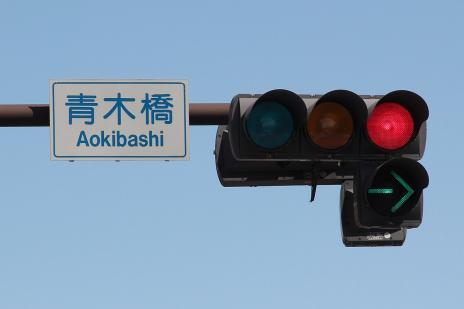
    Of course, the pilot isn’t perfect. What is not working are the signs that tell drivers they can’t drive through most of the intersections (only turn right). The circular green lights confuse them or they simply don’t care. 

    There have been suggestions for better signals, such as this one:
    image

    And if the pilot in its current incarnation does stick, I am sure there will be many additional improvements like this one made. But even at this early stage, Toronto is calling the pilot a “transit miracle.”

    When City Council approved the pilot in the summer it had a preliminary cost estimate of $1.5 million. (Figure excludes the lost parking revenue associated with removing approximately 180 on-street parking spaces).

    This is a relatively minuscule amount considering it has had an immediate impact, basically overnight, on the commute times of the 65,000 or so people who use this line every day.

    And it feels even more minuscule when you consider that our Scarborough Subway extension is expected to cost $3.35+ billion to build and only service around 64,000 people a day when you look far into the future – 2031 to be exact.

    The lesson here on King Street should be that light rail and surface transit routes can move lots of people very efficiently and cost effectively when you empower them to do precisely that.

  • The King Street Transit Pilot has started

    Back in January 2016, I wrote about Toronto’s ambition to transform King into a “transit first” street across the downtown core. 

    The King streetcar is the busiest surface transit route in the entire city (65,000 riders / day on average) and it was – and continues to be – my opinion that the route was broken. Something had to be done.

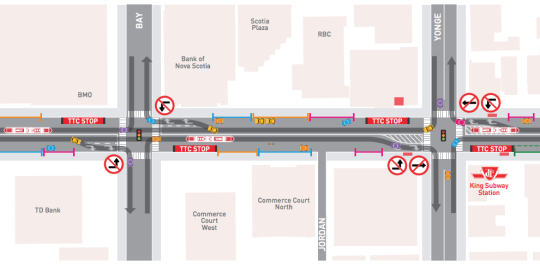
    Well, that something is now happening. The “King Street Transit Pilot” officially started on Sunday, November 12, 2017 at 7am. Here are some of the key changes, many of which are also depicted in the above image:

    – No more on-street parking in the pilot area.

    – Cars can no longer turn left or drive through the intersections of the pilot area (except for taxis picking up drunk people from 10pm to 5am).

    – Cars must now follow a right-in/right-out approach. They can turn right onto King, but then they have to turn right off of King at the next intersection.

    – Most of the streetcar stops have been moved to the “far side” of each intersection. That is, after the lights. Passenger waiting areas are now in the curbside lane and protected by jersey barriers.

    – Cyclists can go through the intersections of the pilot area. “Bike boxes” have been added to intersections where there are north-south bike lanes to help with turning left.

    As to be expected, some people are upset about the above changes. There are also concerns that drivers aren’t going to obey the rules and continue to drive through the intersections in the streetcar lane. But this is a pilot project. It’s about learning and adjusting.

    It’s also important to keep in mind that King has at least 3x more transit riders than cars. This pilot is about figuring out how to best optimize the street so that it moves the greatest number of people as efficiently as possible.

    I’ll report back here on the blog once the pilot has settled in and there is a better understanding of its impact.