Daily insights for city builders, delivered every morning at 6 AM ET. I’m Brandon Donnelly — a Toronto-based real estate developer and founder of Globizen. I’ve been writing here since 2013.

Tag: Johannesburg

  • Anxious urbanism

    One of the first things that I noticed when I visited Rio de Janeiro a few years ago was the clear fixation on safety and security. There are gates and cameras everywhere. And the guidance you tend to receive from the locals usually resolves around how to stay safe. Don’t wander around at night. Be careful when you take out your phone. Be mindful of certain areas. You know, those sorts of things.

    Of course, you never really know how dangerous a city is because it’s one of those things that’s impractical to test. You’re not going to wander around dark places just to see what the probability of being robbed is. The more sensible thing to do is simply believe what people are telling you and you observe the cues scattered around the built environment.

    The result is a general sense of anxiety. You’re not quite sure if all the gates and cameras are truly necessary, but their mere presence makes you believe that they might be. I mean, why else would they be so pervasive? Or, could it be that people are overshooting with their investments in safety and security because, well, fear and paranoia are strong motivators?

    I was reminded of all of this as I read through Ed Chartlon’s recent book review of, Panic City: Crime and Fear Industries in Johannesburg. The title of his review is Anxious Urbanisms, and I think that’s a good way of describing some of these phenomenons. It’s an urbanism of uncertainty. I haven’t read the book (yet), but it’s an interesting topic.

    So I will leave you all with this excerpt from the review:

    Ultimately, what we might take from Panic City, then, is less a comprehensive sociology of crime in the city and more a method of affective analysis. What the book provides is a sense of the ways in which the emotional sphere organises space, how feelings like anxiety or fear or panic, currently widely distributed across the world, materialise themselves, architecturally and politically. If immunity is anything like security, Murray offers us a cautionary tale. For wherever uncertainty thrives, so does the tendency towards paranoid thinking—which is to say, a contagion of a different sort, one that licences regimes of suspicion, self-protection and individual security, and all at the eventual cost of collective wellbeing and interdependence. 
  • Real estate and house music in Johannesburg

    I’ve written about the Ponte Tower in Johannesburg before. At 54 storeys, it is the tallest building in Africa. It’s located in Hillbrow, which is an inner city neighborhood known for its crime and poverty. 

    In the 1970s when the tower was built, Hillbrow was an Apartheid-designated white-only neighborhood and the tower was filled with affluent residents. But that didn’t last long and eventually the wealth fled for the suburbs.

    Here’s a brief 6 minute video talking the Ponte Tower. Let’s call it the real estate perspective. Click here if you can’t see it below.

    [youtube https://www.youtube.com/watch?v=3EIKmmSifqw?rel=0&w=560&h=315]

    Now, here’s a Real Scenes documentary talking about the thriving electronic music scene in Johannesburg. I think it’s fascinating to look at a city from a particular subculture and, compared to the first video, I get a very different feel for the city. Click here if you can’t see it below.

    [youtube https://www.youtube.com/watch?v=Ykt2f6o7-e8?rel=0&w=560&h=315]

  • Real Scenes Documentary — a look at New York’s electronic music scene [Video]

    image

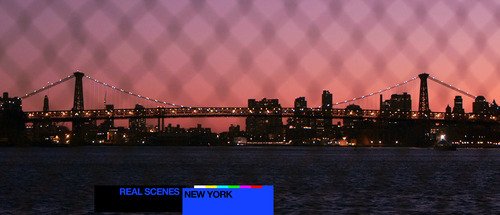
    I just stumbled upon a fascinating documentary series called Real Scenes. Each film explores “the musical, cultural and creative climate” within a particular city. 

    Below is Real Scenes: New York (click here if you can’t see it below). It’s an inside look at the underground music scene that has developed in Brooklyn, but that is at the same time being threatened by development and rising rents. Disclaimer: There’s a lot of f-bombs and a lot of hating on gentrification.

    [youtube https://www.youtube.com/watch?v=LDtf0uIUPuE?rel=0&w=560&h=315]

    I’ve only watched the New York video from this series, but I plan to watch each and every one of them. The other cities are Tokyo, Johannesburg, Paris, Berlin, Detroit, and Bristol.

    What’s fascinating about these short documentaries is that they give you a glimpse into a particular undertone within each city – one that would otherwise be hard to get if you weren’t living there and engrossed in the scene.

    It’s also interesting to see how some people view change within cities. 

    To some, transforming a neighborhood from one that looks like a “bomb went off” to something more pristine, is a good thing. But to others, it’s the worst possible outcome. It all depends on your frame of reference.

    Now, how do I get them to make a Real Scenes: Toronto? 🙂

    Image: Resident Advisor

  • Urbanization in the developing world

    A few days ago I asked a reader of this blog if there was anything, in particular, that she’d like to see more of on here. She responded by saying that she’d love to learn more about how other cities—outside of Toronto—are managing urbanization, as well as how we shape cities and cities shape us.

    It’s an interesting and important question because, frankly, the challenges are greater outside of Toronto. One of the stats that often gets cited here in the media is how the Greater Toronto Area gets approximately 100,000 new immigrants every year. This doesn’t include domestic migration though, so I would assume that our total number is even greater.

    But if we stick with 100,000 for now, it means the GTA receives about 11.4 new immigrants every hour (100,000 people / 8,765 hours in a year). Lagos, Nigeria, on the other hand, receives between 50-60 new people every hour. In fact, it’s predicted to be 7th fastest growing city in the world between now and 2020. 

    If you take a look at the complete list of the world’s fastest growing cities (all estimates, of course), you’ll likely notice that the vast majority of the cities are in the developing world. And that’s really the challenge. The world is rapidly urbanizing and becoming the most urban it’s ever been, but the changes are the greatest outside of developed nations. This poses entirely unique challenges.

    Of the kinds of cities I’m talking about, I’m most familiar with Dhaka, Bangladesh. In my last year at Penn, I was part of a studio led by KieranTimberlake Architects that focused on water and housing issues in that city. It was a partnership with the University of Dhaka. We spent roughly 2 weeks there and it was an eye opening experience.

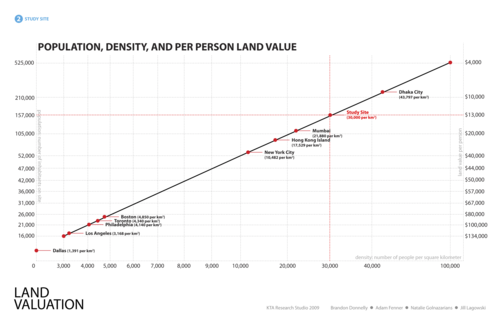
    Here’s a telling slide from our final presentation:

    image

    What we were trying to do with this chart was compare population and per person land value for our development site according to various city types. In other words, we were essentially asking: If we were to build out our proposed site in the same way, as say, Dallas, Los Angeles, Hong Kong, or what is typical for Dhaka, how many people could we fit and what would be the resulting per person land value?

    I don’t remember where we got the land value figures from, but we were trying to be cognizant of the fact that every city requires a unique solution. Using the same per person land values in Dhaka as in Dallas would be unimaginable because Dhaka has over 40,000 people per square kilometre (top right on the diagonal line above) and Dallas has under 1,400 per square kilometre (bottom left on the diagonal line above).

    The challenges of urbanization in the developing world are profound, particularly in places like Dhaka where most of the city is subject to severe annual floods. By some estimates, 18% of the city’s land area gets flooded every year—talk about adding another layer of city building complexity.

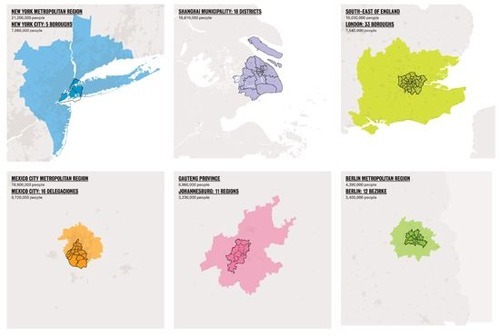
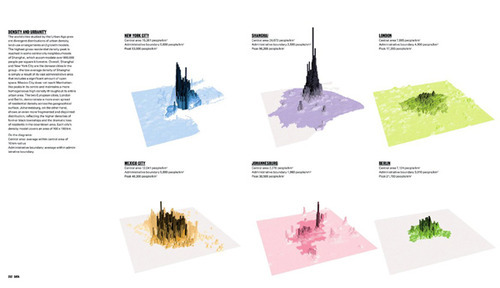
    We didn’t solve all of the problems in that studio and we’re not going to do it here, but I do think it’s important to fully understand the problem. One of my favorite books on cities is called “The Endless City.” It examines New York, Shanghai, London, Mexico City, Johannesburg and Berlin, and has a ton of great data and diagrams.

    Here are a two that outline densities and land use patterns for the above 6 cities (same order starting on the top left):

    image

    image

    If you’re interested in cities, it’s definitely worth having it on your coffee table. And fitting to @PhatNancy’s tweet, ”The Endless City doesn’t just show how cities are changing but also how they are changing us.

  • [vimeo 51295174 w=500 h=281]

    I just came across this fascinating mini documentary of the 54-storey Ponte Tower in Johannesburg. It’s by filmmaker Philip Bloom and it’s only about 10 minutes long. It does a great job of summarizing the building’s interesting and checkered history.

    Initially built in 1975, the tower first served as luxury apartments for the rich. The cylindrical tower, which is actually hollow in the middle, became quickly known as the place to live for the well to do.

    But its architecture very much reflects the political climate at the time. Whites lived in the outward-facing units and their servants, and likely other blacks, lived in the grim inward-facing ones.

    However, when Johannesburg got hit with the same white-flight that plagued many American cities after the war, the tower and area rapidly declined.

    Ponte City, as it was referred to at the time, then became known for crime, drugs and suicide (this will become obvious when you see the inner core of the building).

    It’s worth a watch.