Daily insights for city builders, delivered every morning at 6 AM ET. I’m Brandon Donnelly — a Toronto-based real estate developer and founder of Globizen. I’ve been writing here since 2013.

Tag: jobs

  • 3 thoughts on employment

    There’s lots of talk these days about how technological innovation and globalization are taking our jobs.

    Of course, these are not unreasonable concerns. The data suggests a hollowing out of the middle class and the threat of automation feels perhaps more real than over with the recent advancements in AI and robotics.

    But here are 3 things to consider and discuss:

    1) It doesn’t feel realistic to believe that the jobs which went overseas will ever return en masse – as nice as it may sound to argue that. They went overseas to take advantage of a particular cost structure and those motives haven’t changed.

    2) It is not guaranteed that technological innovation will destroy more jobs than it creates. In fact, historically the opposite has often been true. The jobs that were lost by technological innovation were replaced by new / more jobs and greater economic surpluses. For instance, think of agriculture.

    3) But could this time be different? If we are indeed entering a new economic period, then it strikes me that 1), above, becomes even further away from the right solution. Some of the proposed solutions include universal basic income and a robot tax (links to interview with Bill Gates).
  • The tech ecosystem in Toronto (and New York)

    Tech Toronto recently published a new study called, How Technology Is Changing Toronto Employment

    They estimate that there are over 400,000 tech jobs in Toronto, out of a total of 2.7 million people employed. That number includes tech people working for non-tech companies, and tech and non-tech people working for tech companies. So tech jobs are thought to represent about 15% of the city’s employment.

    Within this 400,000 or so jobs, an estimated 93,000 people are self-employed (23% of tech jobs). And the belief is that there are around 2,500 to 4,100 active “startups.”

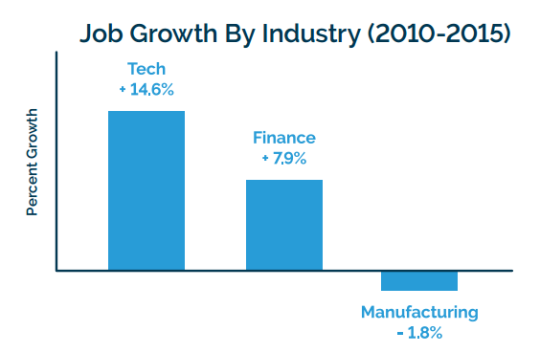
    Zooming out, it is also one of the fastest growing industries in the city:

    image

    To try and put this into perspective, a similar report for New York – published in 2014 – reported 291,000 tech jobs out of 4.27 million people employed. I was a bit surprised by these numbers, but the Toronto report seems to have been modeled after the New York one. So presumably they use similar methodologies.

    Of course, there’s the big question of quality over quantity. There’s a certainly a difference, in terms of impact to the economy, between a back office tech job and fast growing startup that will eventually reach the coveted $1 billion valuation number and create thousands of new jobs.

    Obviously every city is hoping for the latter.

  • Who needs work?

    Earlier this month, The Atlantic published an article called: The Free-Time Paradox in America. The gist of the article was that the wealthy are increasingly starved for time, whereas the exact opposite is happening to the poor.

    The article throws out this stat: “In 2015, 22 percent of lower-skilled men [those without a college degree] aged 21 to 30 had not worked at all during the prior twelve months.”

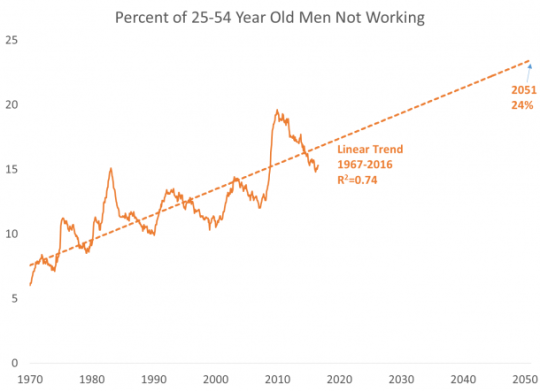
    More recently, Larry Summers published the following graph on his blog, along with the prediction that by the middle of the 21st century over a third of men between 25 and 54 will no longer be working in America.

    He cites technology and declining marriage rates as two possible explanations. Supposedly unmarried men are more likely to be out of work.

    If you’re interested in this topic, Nicholas Eberstadt has a new book called Men Without Work. The focus is on a new class of men who are neither (1) employed nor (2) unemployed and looking for work. Instead they voluntarily electing not to participate in the US labor force. Similar to Ed Glaeser, part of his argument is that the incentives not to work (welfare) are simply too great.

    This drop in labor force participation is largely concentrated among those without a college education. The problem seems to be that we are no longer creating enough good paying jobs for the less well educated. So the way I see it is that we have two options: we figure out how to do that (again) or we focus ourselves on education and training.

    Richard Florida has written a lot about elevating service and retail jobs to fill this gap. But I have never understand how that works. I think it comes down to figuring out how to better elevate people.

  • Two open real estate development positions

    I recently alluded to some life changes on this blog. Well, I am now ready to share: I am leaving my development position at CAPREIT.

    I wasn’t intending to leave. I wasn’t looking to leave. And frankly, I felt conflicted. But sometimes life has a funny way of presenting opportunities that you just have to say yes to. As my mother likes to tell me: “Life is what happens to you while you’re busy making other plans.” More on this in a later post. Stay tuned.

    What I would like to talk about today are the opportunities that this may create for some of you. There are now two open development positions at CAPREIT. Both positions would be based in downtown Toronto (St. Lawrence Market).

    The first opportunity is essentially a Director level role where you would be responsible for growing the development team at CAPREIT. You should be able to lead a team, identify new development opportunities, create pro formas, assemble/manage consultant teams, secure development approvals for complex urban infill sites, and generally lead projects and people through the entire development lifecycle. For more information and to apply, click here.

    The second opportunity is at the Coordinator level. You would be reporting day-to-day to the above person and you should have working knowledge of the development process. For more information and to apply, click here.

    I would just like to add that in both cases you would be working on some very exciting urban infill projects and you would be joining an organization with great people and a great corporate culture. I mean this sincerely. If you have any questions about the two roles, feel free to reach out to me directly. And if you’re in the market, consider applying.

  • The war on work

    Air Canada bumped me from my flight this morning and so I am spending the day hanging out at Toronto Pearson Airport. I can think of more enjoyable ways to spend Canada Day, but at least there’s a nice seating area in Terminal 1 with free wifi and lots of plugs.

    I just finished watching the below talk by Harvard economist Ed Glaeser at the Manhattan Institute. His overall thesis is that unemployment is a far worse problem than income stagnation and that the US needs to stop creating incentives for people not to work. He refers to it as a war on work.

    He addresses a few topics that we’ve talked about here on this blog, such as guaranteed basic incomes, as well as others that we haven’t talked about, such as raising the minimum wage. To give you one spoiler: He argues that a higher minimum wage has been shown to cause an overall drop in employment, which he, again, believes is a deeper problem.

    Glaeser delivers a passionate performance. So if you have 30 minutes to spare – perhaps you’re stuck in an airport somewhere – I recommend you give it a watch. If you can’t see the video below, click here.

    [youtube https://www.youtube.com/watch?v=8xaNV_6wgak?rel=0&w=560&h=315]

  • City building jobs

    I get a lot of emails from readers of this blog. I try my best to answer every single one of them, but sometimes I fall behind and fail spectacularly at that. (The snooze feature in Mailbox and Google Inbox is one of the best inventions ever.)

    One of the most common emails I receive is about careers. Sometimes it’s someone looking for a new job or for advice on how to break into the industry (usually real estate development). And sometimes it’s an employer (or recruiter) with a role they need filled. 

    It’s hard to match up supply and demand when they arrive in my inbox on an ad hoc basis like this, but I have been thinking about ways I might be able to help these people out.

    So today I thought I would try something new. If you have a relevant job listing that you’d like me to distribute to the ATC community (something in architecture, planning, real estate, tech, and so on), email it to me at b@brandondonnelly. 

    If I get enough high quality listings, I’ll send them out in my newsletter. And if everyone finds it valuable, I may make it a regular feature.

  • Where the jobs are being created in cities

    According to a new report released by City Observatory, US cities have officially reversed a 50-year trend towards decentralization.

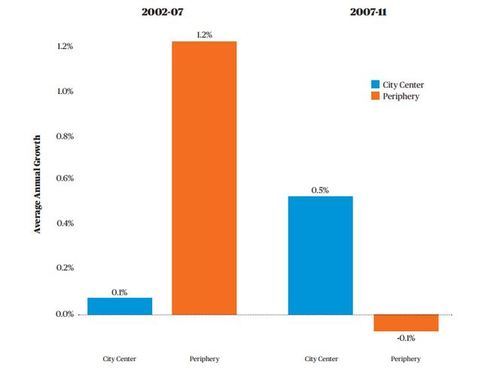
    We know that urban living has been seeing a renaissance over the last decade or so, but as recently as 2002 – 2007 (pre-Great Recession), the suburbs and peripheral areas were still seeing significantly higher job growth: 1.2% per year in the periphery versus 0.1% in the city center. The “city center” is defined as a 3 mile radius around the center of the city in this study.

    However since 2007 things have flipped:

    image

    Chart Source: City Observatory

    Why is this happening? Here’s a snippet from City Observatory:

    The strength of city centers appears to be driven by a combination of the growing attractiveness of urban living, and the relatively stronger performance of urban-centered industries (business and professional services, software) relative to decentralized industries (construction, manufacturing) in this economic cycle. While it remains to be seen whether these same patterns continue to hold as the recovery progresses, (the latest LEHD data on city center job growth are for calendar year 2011), there are structural forces that suggest the trend of center-led growth will continue.

    In some ways, it just makes intuitive sense. People started returning to cities and so the jobs followed (although there were also structural changes to the economy). 

    The big question, however, is whether this trend will continue? My bet is on yes. What do you think?

  • Comprehensive to the core

    The City of Toronto recently started an initiative called “Comprehensive to the Core.” It’s a look at how downtown Toronto–which is growing at 4 times the rate of the rest of the city–should continue to grow moving forward so that it remains a great place to live, work, learn and play.

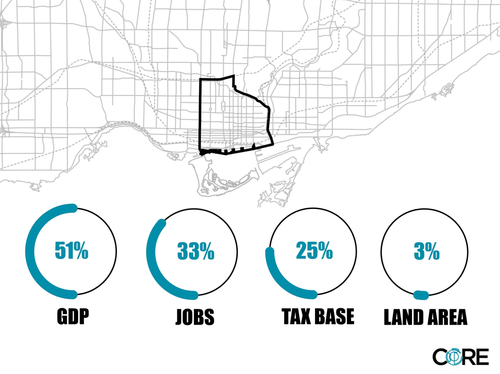
    Here’s a presentation that was delivered last month by the city. It’s mostly infographics and so it’s a quick and fun read. And here’s an infographic that does a nice job of summarizing what’s happening in the core of Toronto.

    What it’s saying is that downtown Toronto–which they consider to be bound by Bathurst Street in the west, the Don Valley Parkway in the east, the lake in the south, and Dupont Street in the north–is responsible for 51% of the city’s entire GDP. It’s also responsible for 33% of all jobs in the city and 25% of the city’s entire tax base. And yet in terms of size, it represents only 3% of the city’s land area.

    That’s a powerful reminder of the economic potential of density and agglomeration economies. It’s also a reminder that we shouldn’t let politics deprive our economic engine of the services and investments it needs.