Daily insights for city builders, delivered every morning at 6 AM ET. I’m Brandon Donnelly — a Toronto-based real estate developer and founder of Globizen. I’ve been writing here since 2013.
The article starts by talking about how rising anti-Chinese sentiment in the late 19th and early 20th century eventually lead to the U.S. passing new immigration laws. These laws explicitly restricted Chinese laborers from moving to the U.S. and even made it difficult for legal residents to return after a visit home to China.
However, embedded in these laws was a small loophole:
But, as MIT legal historian Heather Lee tells it, there was an important exception to these laws: Some Chinese business owners in the U.S. could get special merchant visas that allowed them to travel to China, and bring back employees. Only a few types of businesses qualified for this status. In 1915, a federal court added restaurants to that list. Voila! A restaurant boom was born.
“The number of Chinese restaurants in the U.S. doubles from 1910 to 1920, and doubles again from 1920 to 1930,” says Lee, referring to research done by economist Susan Carter. In New York City alone, Lee found that the number of Chinese eateries quadrupled between 1910 and 1920.
This is fascinating on so many levels.
For one, it’s always interesting when small loopholes have unintended consequences. It is doubtful that anyone could have predicted a Chinese restaurant boom.
Secondly, despite the U.S. being a nation of immigrants, you see here a long history of trying to keep immigrants out. In the early 20th century, the fear was Chinese laborers who worked for low wages. Today, it’s Mexican laborers who work for low wages.
Finally, it’s amazing to look back at the foundation that these early Chinese entrepreneurs no doubt created. Today, Asian Americans are often considered a “model minority.” The Pew Research Center refers to them as “the highest-income, best-educated and fastest-growing racial group in the United States.”
When it comes to Ivy League admissions, they’ve even been called the “New Jews” – referring to the fact that many believe that top tier schools have systematically biased admissions against both Jews and Asians because of their tendency to overachieve relative to “white Americans.”
And to think that this may have all started, at least partly, with a Chinese restaurant boom.
After yesterday’s post about Toronto, I had a friend ask me on Facebook what it is exactly that I think happened to make this city so much cooler. Was it because of one iconic building like Toronto’s new City Hall? Was it because of our recent condo boom? Or was it something else? What changed exactly?
My response was that it’s a generational thing. Let me explain.
Toronto used to have the reputation of being a boring and staid city, and that’s because it was a boring and staid city. In the immediate post-war years, Toronto was overwhelmingly Protestant and the immigration policies at the time were specifically designed to exclude anyone who wasn’t white and from Western Europe or America. If you were Asian, Southern or Eastern Europe (especially Jewish), then you were at the bottom of the entry list.
Prime Minister Mackenzie King reflected the national mood when he observed that “the people of Canada do not wish to make a fundamental alteration in the character of their population through mass immigration.” Discrimination and ethnic selectivity in immigration would remain. “Canada is perfectly within her rights in selecting the persons whom we regard as desirable future citizens. It is not a ‘fundamental human right’ of any alien to enter Canada. It is a privilege. It is a matter of domestic policy.”
In the 1950s and 1960s, Canada started to slowly open up, but only because it needed to. It was in need of labour to fuel its robust post-war economy. Reluctantly, Canada began to look for workers in places like Italy. Initially, Canada had hoped to attract more northern and Germanic-like Italians, but with the European economy picking up, it was the southern Italians who came in the greatest number. In the 1950s, Canada’s Italian population jumped from around 150,000 to 450,000.
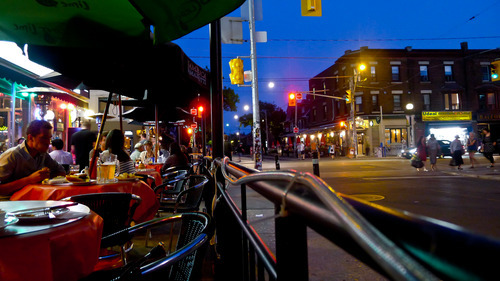
But this influx of espresso drinking Catholics was hard for Toronto to adapt to at first. They were so alien compared to Toronto’s population at the time. They wanted to do weird things like eat outside on patios, and that just wasn’t the way we did things here in Protestant and conservative Toronto. We ate inside. That’s where food belonged.
My best friend’s father – who’s also in the real estate development business – once told me that when he first moved to Toronto in the 1970s the real estate business was virtually run by two groups of people: Italians and Jews. In other words, the people building our city were the people that we were once afraid to let come here in the first place.
But in their quest for wealth and a better life (I have so much respect for people who are able to build something from nothing), these new Canadians also reshaped Toronto both physically (through building) and socially (by doing crazy things like eat outside on patios). They were not only building new lives for themselves, they were also rebuilding Toronto. They helped us grow up and not be so stuffy. And I absolutely believe that we’re a better city because of it.
However, I think the true impact of their efforts is happening right now through the next generation – their children. Millennials and Generation Xs (at least the younger ones) don’t remember when Italians were considered aliens. They remember growing up with martini bars on College Street (which is the original Little Italy for those of you unfamiliar with Toronto). They know a different and cooler version of this city.
But most importantly, those subsequent generations are now old enough (and have a lot more generational wealth behind them) to reshape this city even further. And with much deeper roots here, they have the passion to do just that. When I went to graduate school in the US, my parents were afraid I would never come back. That’s what they told me. But the more I traveled and the more I lived outside of Toronto, the more I wanted to come back.
Just like those early wave of pioneering aliens who got us to dine al fresco and taught us that if we shop on Sundays we’re not going to go straight to hell, I feel like I too want to shape this city. I want to make it even better. No city is perfect, but if there’s something you don’t like about Toronto, then here’s my advice to you: Go change it. I can tell you it’s possible, because new immigrants with no money managed to do it.
The first person who can tell me (in the comments below) which restaurant the patio shown above belongs to will get a free Architect This City t-shirt. If you’re from Toronto, this should be an easy one.