Daily insights for city builders, delivered every morning at 6 AM ET. I’m Brandon Donnelly — a Toronto-based real estate developer and founder of Globizen. I’ve been writing here since 2013.

Tag: jed kolko

  • What’s next for cities? Probably more of the same.

    I am surprised, although maybe I shouldn’t be, by how quickly many seem to be allegedly turning their back on cities. According to the New York Times, cities were “losing their allure” well before this pandemic, and this might just be the tipping point. The underlying argument: Density is bad. We should probably all move somewhere bucolic, where the cost of housing is less and work isn’t so stressful. Zoom only when necessary.

    But as the chief economist for Indeed, Jed Kolko, rightly points out in the article, how people behave (and think) during a global pandemic is probably not a great indicator for how they will want to live their lives when this is all over. It’s also not clear that urban density is really the contributor of spread. Hyper-dense cities such as Seoul and Hong Kong have been performing relatively well. (Joe Cortright has some thoughts on this.)

    Once we get to the other side, we will see the data and we will get a better understanding of this current situation. And then in hindsight, we will find ways to rationalize the outcomes to ourselves. In the interim, I’m not about to bet against cities. Here’s how Paul Romer, professor at New York University, put it in this recent interview in City Journal:

    “I think the underlying economic reality is that there is tremendous economic value in interacting with people and sharing ideas. There’s still a lot to be gained from interaction in close physical proximity because such interaction is a large part of how we establish trust. So I think that, for the rest of my life, cities are going to continue to be where the action is.”

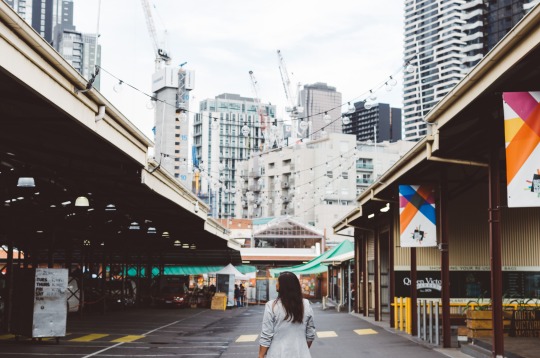
    Photo by bady qb on Unsplash

  • How old do you have to be to live downtown?

    The North American rule of thumb is that young people — specifically people in their 20s — are the most likely to to live in an urban neighborhood. After that it’s all down hill and, broadly speaking, the percentages decline. But at some point, much later in life, the data suggests that there is a reversal and people start to return to urban neighborhoods, albeit not to the same extent. Part of the explanation for this is that as people age they start to look to more walkable neighborhoods where they don’t need to get a car to get around.

    But in this recent NY Times article, Jed Kolko points out two interesting trends. One, the “urban boomer” appears to be on the decline in the US. In 1990, about 21.6% of Americans aged 54 to 72 lived in an urban neighborhood (categorized by density). As of 2018, this number had dropped to around 17.8%. And two, the age at which there is a reversal (and people start returning to denser neighborhoods) is also increasing. Perhaps because people are living longer.

    Jed’s conclusion: American boomers, today, are actually less urban than previous generations.

    Graph: New York Times

  • From urban to suburban

    The US Census Bureau just released its population estimates for 2018. As has been the case in previous years, the counties that added the most people (largest numeric growth) are all located in the south and west. Texas holds 4 out of the top 10 spots.

    Here is a Tweetstorm by Jed Kolko, the chief economist of Indeed, with a couple of graphs summarizing the findings (click through to see the full thread):

    Despite the narrative that people are returning to cities and urban centers, the data is pretty clear: the flow of domestic migration within the US is largely from dense urban counties to more suburban — and affordable — ones. Big cities are expensive.

  • What’s happening in Melbourne?

    image

    I’ve never been to Australia, so take everything I’m about to say in this post for what it’s worth. I also don’t know much about Sydney and Melbourne, other than the fact that I’ve studied the latter’s laneways and the tremendous impact they’ve had on revitalizing the CBD.

    However, recently I’ve had a few close friends visit these cities for the first time and, since then, I have started noticing a trend. All of them come back and tell me the same thing, that they prefer Melbourne to Sydney. They say: “Yeah, Sydney is nice and beautiful and all, but it’s not all that exciting. Melbourne feels way more dynamic. Oh, and have you seen their laneways? You would love them.” That’s what they tell me.

    So that’s what I have in my head when I read that Melbourne is now the fastest growing city in Australia; that it’s one of the most liveable cities in the world; and that by as early as 2031 it could take Sydney’s place as the biggest city in the country. Below is a chart from The Australian. If you can’t see it, click here.

    //platform.twitter.com/widgets.js

    Some argue that this is happening because housing is cheaper in Melbourne (median dwelling price of ~$700,000 versus ~$1 million). And some argue it’s because the jobs are there and the city has become a cultural and sporting destination. Whatever the case may be, net migration is estimated to be somewhere around 100,000 people per year.

    My own view – and I’ve made this argument before on the blog – is that we shouldn’t underestimate the importance of cool shit when it comes to cities. People vote with their feet more than ever today. And for a growing segment of the population, cities are a consumer good.

    Indeed, in 2001, Edward Glaeser, Jed Kolko, and Albert Saiz penned a research paper called the Consumer city, where they argued precisely that. The premise was that historically we have tended to think of cities as being centers of production, but we should also be thinking about them as places of consumption.

    Here’s an excerpt:

    “But we believe that too little attention has been paid to the role of cities as centers of consumption. In the next century, as human beings continue to get richer, quality of life will become increasingly critical in determining the attractiveness of particular areas. After all, choosing a pleasant place to live is among the most natural ways to spend one’s money.”

    This is why those coffee shops and cool laneways matter. Some cities have unfair natural advantages. Los Angeles has weather. Vancouver has mountains. Montreal has poutine. But for the rest of us, the amenities typically form part of the built environment. They are a product of our choices.

  • The suburbanization of America continues

    FiveThirtyEight (Jed Kolko) published a post last month called, “Americans’ Shift To The Suburbs Sped Up Last year.” 

    What Kolko did was take recent population estimates from the US Census Bureau and group them into 6 categories based on the size of the metro and its population density. 

    By doing this he discovered something that runs counter to the narrative that we are living through an urban renaissance: lower-density suburbs grew faster than urban counties. The former grew at ~1.3% in 2016. And in the south and west, the lower-density suburbs of large metro areas topped over 2% growth.

    What gives? 

    Well, this urban renaissance is lopsided. Here’s an excerpt from the article:

    That revival is real, but it has mostly been for rich, educated people in particular hyperurban neighborhoods rather than a broad-based return to city living. To be sure, college-educated millennials — at least those without school-age kids — took to the city, and better-paying jobs have shifted there, too. But other groups — older adults, families with kids in school, and people of all ages with lower incomes — either can’t afford or don’t want an urban address.

    Richard Florida is calling this phenomenon: The New Urban Crisis.

  • Young, rich, childless, and white

    Whenever I’m not sure what to write about, I just read. That’s one of the big benefits of daily blogging – it forces me to do that.

    This morning I stumbled upon the blog of Jed Kolko. Jed is an economist and, up until 2015, he was Chief Economist and VP of Analytics at Trulia.

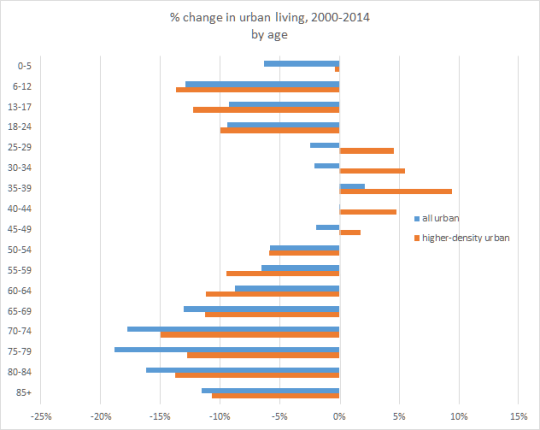
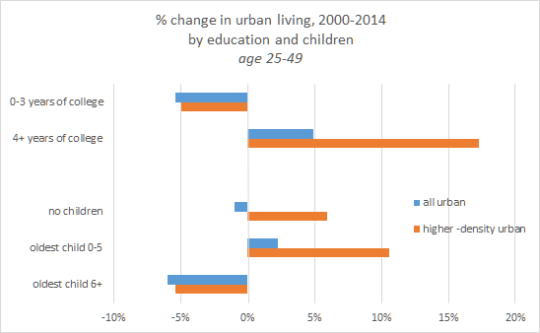
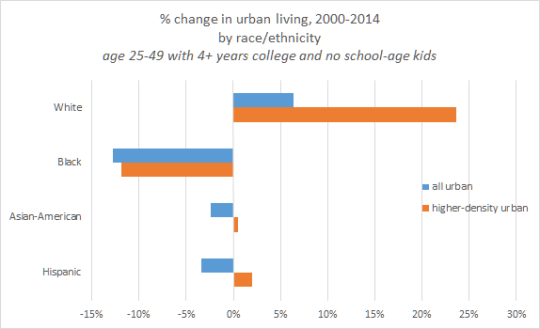
    His most recent post argues – naturally with lots of data and charts – that for all of our talk of (re)urbanization, it’s actually a specific subset of the population that is far more likely to be have urbanized between 2000 and 2014: the young, rich, childless, and white. (Note: His post is talking specifically about U.S. cities.) 

    Below are a few of his charts. 

    In all cases, the x-axis represents % change in urban living between 2000 and 2014. All of the data is from Public Use Microdata Samples (PUMS) – 2000 decennial Census and from the 2014 one-year American Community Survey (ACS).

    Here is age:

    image

    Household income:

    image

    Education and children:

    image

    And here is race/ethnicity:

    image