Daily insights for city builders, delivered every morning at 6 AM ET. I’m Brandon Donnelly — a Toronto-based real estate developer and founder of Globizen. I’ve been writing here since 2013.

Tag: japanese

  • Peach skin

    I am fascinated by the way the Japanese think about housing. It is very different than the way we think about housing here in North America. Below is a small house tour that reinforces that. If you can’t see it below, click here.

    [youtube https://www.youtube.com/watch?v=4fEeh-8OFT8?rel=0&w=560&h=315]

  • Nest or cave?

    I was recently introduced to the work and writing of Japanese architect Sou Fujimoto. One concept that he writes about that I really like is the idea of nest vs. cave.

    The way Fujimoto describes a cave is that it’s a naturally occurring and pre-existing condition. It is exists independent of humans. So if and when a human decides to occupy a cave, he or she must assimilate their lives to that which is already there. They have to deal with the ambiguity of the spaces because it is not clear how everything should be used.

    A nest, on the other hand, is something completely created by and for the benefit of a person or animal. It would not exist without someone creating it and so it is prescriptive and functional in a way that a cave is not.

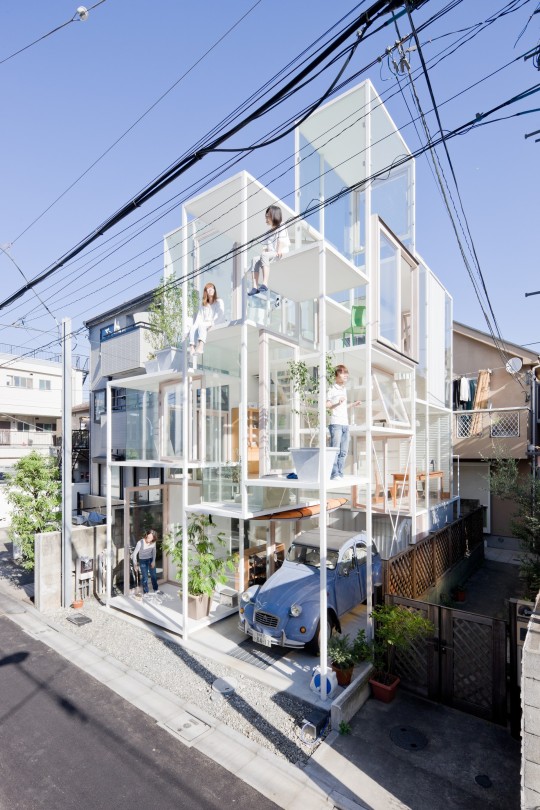
    Fujimoto is interested in exploring architecture that is analogous to caves. Which is why he designs houses like this one (House NA) in Tokyo:

    In most countries, a house like this would not meet code and would be illegal. But in Tokyo it’s obviously allowed. And his hope is that the owners will discover new and unintended ways to interact with the unusual pairing of levels and platforms.

    However, I think about this juxtaposition differently – likely incorrectly in the mind of Fujimoto.

    I’m actually more interested in nests. Because in a way, mass produced housing is like a cave. It exists whether or not we decide to occupy it. And it is generally created to appeal to lots of people, rather than to the idiosyncratic tastes of one person. So when someone does occupy it, they invariably end up trying to shape it.

    But not to the extent of a nest. A nest is custom. It is what you would build for yourself given the opportunity to do so. And that thought is really appealing to me. Maybe it’s because I don’t like the ambiguity of a cave. That could be a possibility.

    I could also be thinking about it differently because I tend to think of Japanese homes as being quite individualistic. Since Japanese people generally don’t care about resale value, they don’t have the same fixation with marketability and future value. That means they’re more likely to just build what they want.

    I’d love to have my own nest.

    Image: Wall Street Journal

  • Japan’s disposable housing

    緑 by Austin  Hou on 500px.com

    https://500px.com/embed.js

    As further evidence that real estate is a local business, let’s take a look at the housing market in Japan today. It’s a very unique market.

    According to this Freakonomics podcast, 50% of all single family houses in Japan are demolished by the time they reach 38 years old. That’s their half-life. By contrast, in the US, this number is 100 years.

    The reason for this is rapid depreciation. Real property typically consists of two things: land and the building. Land doesn’t depreciate. But the structure sitting on the land does.

    In Japan, the building or structure is thought to be fully depreciated (and therefore worth nothing) after about 30 years for a single-family home and after about 40 years for an apartment/condominium.

    The result is that there’s virtually no resale housing market. When somebody buys a house, it is usually torn down and completely rebuilt. It’s a uniquely Japanese phenomenon.

    So why does this happen?

    The Freakonomics podcast presents a couple of hypothesis. Some believe that it’s caused by a Japanese fixation with newness. New is seen as pure and clean. 

    Others believe that it has to do with a building code that is constantly changing due to the high frequency of earthquakes in Japan. 20% of the world’s earthquakes with a magnitude of 6.0 or greater happen in Japan. And so there appears to be a belief that newer homes – with the latest seismic technologies – are the safest.

    Whatever the case may be, the fact that there’s virtually no resale housing market in Japan, not surprisingly, produces some interesting outcomes. For one, maintenance and DIY home projects are uncommon. Why invest in your home when it’s not viewed as an asset, but as a disposable good?

    At the same time, people worry very little about marketability when they are building new. And this is a big reason why Japan is so famous for its radically designed homes. When you’re building only for yourself, you just do what you want.

    But most importantly, some (such as Richard Koo, who is interviewed in the podcast) believe that this approach to housing is a huge “obstacle to affluence.” Without a functioning resale market, the Japanese don’t get the opportunity to build wealth/equity in the same way that other countries do.

    Do you buy that?