
Daily insights for city builders, delivered every morning at 6 AM ET. I’m Brandon Donnelly — a Toronto-based real estate developer and founder of Globizen. I’ve been writing here since 2013.

Tag: jan gehl

  • How urban density dictates how we vote

    “It’s remarkable that even as the internet disperses information and enables us to form online communities across great distances, our politics are still highly correlated with physical environments. Who we are is largely defined by where we are. For architects and urban designers, this is an important reminder that space is and always has been political, from the days of the valley section to the postmodern stage of Trump.”

    The above excerpt is from a Places Journal article by Neeraj Bhatia called, Environment as Politics. The premise of the article is that residential population densities have long shaped political outcomes and that that was certainly the case in the 2016 U.S. presidential election.

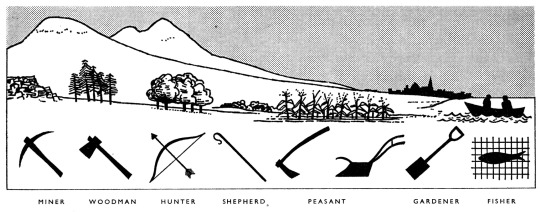
    But before we get into the work and drawings of Places Journal, let’s first talk about one of the inspirations mentioned in the article. In 1909, the pioneering town planner Patrick Geddes drew the following “Valley Section”:

    The point of this section drawing is to make clear the relationship between humans and their environment. In this case, it speaks to occupation. The physical geography of where you lived determined what you did: fish, hunt, mine, and so on.
    For those of us now living in cities, these “natural occupations” may not seem all that relevant. But that same human-environment relationship remains.
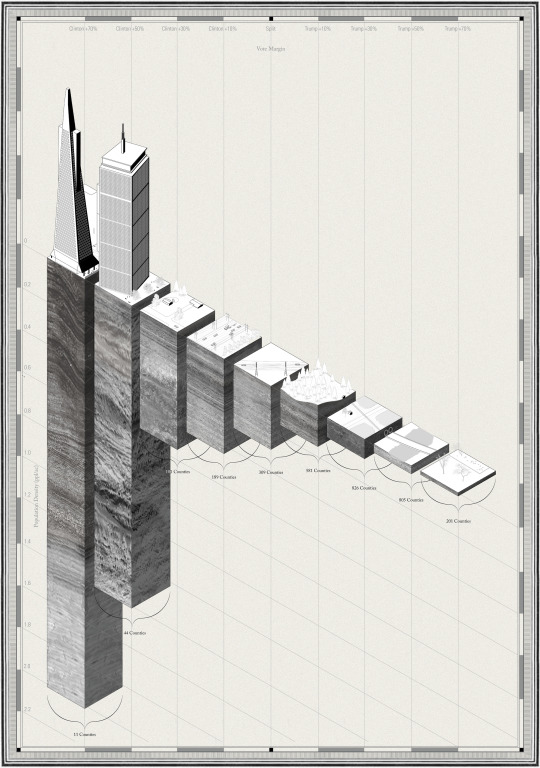
    In the 2016 election, 49 of the 50 highest density counties voted for Hillary Clinton. And 48 of the 50 lowest density counties voted for Donald Trump. It turns out that how close you live to your neighbor had/has a tremendous impact on your political views and the way you vote(d).

    Below is a chart from Places Journal that plots the 2016 election results for all U.S. counties:
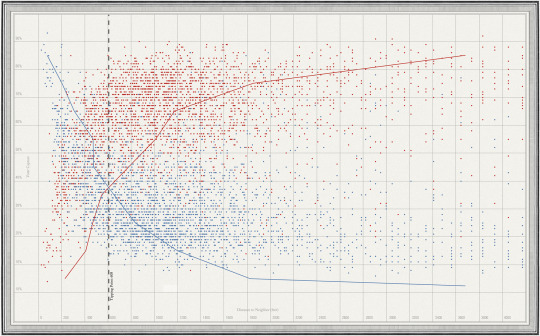
    On the y-axis is “vote capture” by Democrats and on the x-axis is “Distance to Neighbor (feet).” What you see here is a dramatic drop off in liberal voting as distance to neighbor increases. And the tipping point appears to about 608 feet.

    Part of the explanation for this is that living in close proximity to others change how we feel about others. It can reduce fear and prejudice. In other words, it makes us more open. And as Bhatia points out in his article, one could argue that this last U.S. election was in fact a “clash over the openness of society.”

    We often talk on this blog about how space impacts our lives. As Jan Gehl once said: we shape cities and then cities shape us. Today we are reminded that space is also highly political.

    In my case, the distance to my neighbors is likely about 8-10 inches. Sometimes I can hear somebody sneeze. But most of the time I don’t hear anything at all. It’s usually pretty quiet around here. Whether I acknowledge it or not, this distance is shaping me and how I see the world.
  • How are you being shaped?

    image

    “We shape the cities, and then our cities shape us.” That’s one of my favorite lines from the documentary The Human Scale, featuring Danish architect and urban designer Jan Gehl. I like it because I don’t think many of us think enough about the way in which the built environment – that we create – ultimately goes on to influence the way we live our lives.

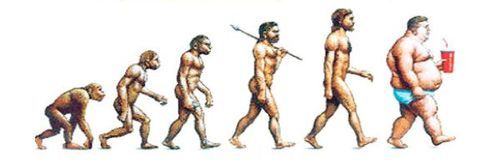
    One of the most interesting connections for me is the link between urban form and public health. There’s been a lot of talk over the years about how suburban sprawl is, or might be, making us fat (among other things). We’ve created environments that are only navigable by cars and that has forced many of us into sedentary lifestyles. We sit in our cars, and then we sit in our offices.

    So today I’d like to conduct a bit of a poll. If you’d like to participate, please share the following 3 things in the comment section below: 1) your city, 2) the type of neighborhood you live in (urban, suburban, rural, etc.), and 3) the amount of time you spend walking or doing something active on an average day.

    Here’s me:

    I live downtown Toronto in the St. Lawrence Market neighborhood (urban). I take the subway to work and the station is a 10 minute walk from my place. So as a bare minimum, I spend at least 20 minutes a day walking. But since I also walk to do most of my regular errands, and since my gym is another 10 minute walk from my place, I’d say I average a good 30-45 minutes of walking each day.

    Now it’s your turn 🙂

    This is a pretty crude survey, but with the advent of things like smartwatches and health monitors, I think we’ll soon have lots of great data on the ways in which our cities might shape our health.

    Image: The Economist

  • The Human Scale

    Earlier today I stumbled upon a documentary called “The Human Scale.”  I haven’t watched it yet, but I’m planning to rent it from iTunes later this weekend. Here’s the trailer. Click here if you can’t see it below.

    [youtube https://www.youtube.com/watch?v=5CyLNS_ljHw]

    One of the things that’s so fascinating about studying cities right now, is that it feels as if we’re at a major turning point with respect to how we think about them. We’re coming off a long period (decades) of infatuation with the car, where planners and engineers predominately cared about one thing and one thing only: efficiently moving cars in and around cities.

    But having now fully built out cities around the car, we’ve come to realize two important things. First, that it’s virtually impossible to keep up with the demands of the car. No matter how many highways and roads you build, there always seems to be gridlock. And second, by focusing so closely on the car, we’ve built cities that aren’t great places for people.

    If you take a look at this short clip from The Human Scale (featuring Siena, Italy), I think you’ll immediately see how differently we used to build our cities and how disruptive the car has been to them. 

  • 100 books for city geeks

    If you’re a city geek looking for a good book to read, head over to Planetizen and check out Brent Toderian’s list of the 100 best books on city-making. Toderian was formerly Chief Planner for the City of Vancouver.

    I have a good number of those books on my own bookshelf, but also many that I should really read. I think I’ll start with #1: Cities for People by Jan Gehl.

    Here’s the forward for that book by British architect, Richard Rogers:

    “Cities are the places where people meet to exchange ideas, trade, or simply relax and enjoy themselves. A city‘s public domain — its streets, squares, and parks — is the stage and the catalyst for these activities. Jan Gehl, the doyen of public-space design, has a deep understanding of how we use the public domain and off ers us the tools we need to improve the design of public spaces and, as a consequence, the quality of our lives in cities.

    The compact city — with development grouped around public transport, walking, and cycling — is the only environmentally sustainable form of city. However, for population densities to increase and for walking and cycling to be widespread, a city must increase the quantity and quality of well-planned beautiful public spaces that are human in scale, sustainable, healthy, safe, and lively.

    Cities — like books — can be read, and Jan Gehl understands their language. The street, the footpath, the square, and the park are the grammar of the city; they provide the structure that enables cities to come to life, and to encourage and accommodate diverse activities, from the quiet and contemplative to the noisy and busy. A humane city — with carefully designed streets, squares, and parks — creates pleasure for visitors and passers-by, as well as for those who live, work, and play there every day.

    Everyone should have the right to easily accessible open spaces, just as they have a right to clean water. Everyone should be able to see a tree from their window, or to sit on a bench close to their home with a play space for children, or to walk to a park within ten minutes. Well-designed neighborhoods inspire the people who live in them, whilst poorly designed cities brutalize their citizens. As Jan says: “We shape cities, and they shape us.”

    No one has examined the morphology and use of public space to the extent that Jan Gehl has. Anyone who reads this book will get a valuable insight into his astonishingly perceptive understanding of the relationship between public spaces and civic society, and how the two are inextricably intertwined.”