Daily insights for city builders, delivered every morning at 6 AM ET. I’m Brandon Donnelly — a Toronto-based real estate developer and founder of Globizen. I’ve been writing here since 2013.

Tag: ipo

  • Soho House went public this week

    So Soho House went public this week. It is now trading on the NYSE under the ticker $MCG. It renamed itself the Membership Collective Group Inc. for the IPO given the myriad of brands that the company now operates. The company went public at $14 a share and with a $2.8 billion valuation. It raised $420 million through the offering.

    My first reaction when I heard the news was that going public is maybe at odds with being a cool, urban, and exclusive membership club. We’re all about creatives; also, buy our stock. But maybe I’m wrong. This is just the company maturing. At 26 years old, the company now has some 119,000 members and has 30 Soho Houses around the world in 12 different countries.

    Full disclosure: I am a member and a big fan of Soho House.

    But now that the company is public, we also know that it has never turned a profit. And it hopes to do that by next year, as well as open some five to seven new Soho Houses each year while trying to remain “asset light”. As the company does this and pushes toward profitability, there is, of course, a very natural question about what that does to the experience and the overall brand.

    Does it get diluted at all?

    I don’t think that necessarily needs to be the case. But of course the company will end up evolving. On a related note, if anyone from Soho House / MCG is reading this post (unlikely), I would love to connect about an opportunity here in the Toronto area. I think it has the potential to become something truly remarkable — not to mention, much needed. I can be reached, here.

  • Airbnb’s S-1 is now public

    Airbnb’s IPO documents recently went public.

    Not surprisingly, their business as a travel company has been heavily impacted by COVID-19. Last year, the platform saw 326.9 million nights and experiences booked, with 251.1 million being booked in the first nine months of 2019. This year, nights and experiences are down to 146.9 million for this same nine month period. Revenue is correspondingly down from $3.7 billion for the first nine months of 2019, to $2.5 billion for the first nine months of this year.

    But what is also clear from their data is that people still really want to travel and have new experiences. As soon as April passed and the Northern Hemisphere entered the normally busy Q3 travel season, domestic travel began to quickly ramp back up. For many, this likely took the place of international travel. See above chart.

    Of greater concern might be all of the regulation that now surrounds short-term rentals. As of October 2019, about 70% of the platform’s top 200 cities (by revenue) had some form of regulation impacting short-term rentals. But at the same time, no one city accounts for more than 2.5% of the platform’s revenue. So there’s strong geographic diversification.

    If you’d like to take a look at the company’s S-1, you can do that over here. And for those of you who might be curious, these are Airbnb’s top 10 cities based on revenue:

    1. London
    2. New York City
    3. Paris
    4. Los Angeles
    5. Rome
    6. Barcelona
    7. Tokyo
    8. Toronto
    9. San Diego
    10. Lisbon
  • Systemizing Airbnb

    Wired recently published a long read called, “I stumbled across a huge Airbnb scam that’s taking over London.” Apparently the people who do these sorts of things on the platform (things that are both illegal and questionable) call it “systemizing.” This is the process of trying to create scale. Secure lots of units. Create a bunch of fake/duplicate accounts. And try and maximize revenue.

    This obviously runs counter to Airbnb’s mission of “authentic places”, “community”, and “local hosts.” But as Benedict Evans points out in his latest newsletter, “where there is money and people, there will be scams.” And Airbnb is obviously doing everything it can to quash this kind of activity, especially as it prepares for a possible IPO this year. The company has a policy of zero tolerance.

    Fraud and government regulation are likely to be the two biggest kinks to work out as the company gets ready for public consumption. I am sure an equilibrium will be found; it’s just going to take some time and a few lawyers. It goes to show you just how challenging startups can be when you combine digital (tech) and physical (real estate).

  • Uber’s seed investors made this much money

    $UBER went public on Friday. Notwithstanding the initial stumble, Uber will go down in history as one of the most lucrative venture capital investments of all time.

    The stock is down from its IPO price of $45 per share, but at that price, the initial seed investment of $510,000 that First Round Capital made back in 2010 was worth about $2.5 billion on Friday.

    Here is a list of some of the other notable investors from Uber’s seed round and what their initial investments grew to over the course of 9 years (chart from the WSJ):

    Of course, for every Uber, there are many more failed companies. And for every investor who turns $5,000 into nearly $25 million, there are many more who decided to pass on the opportunity.

    In the case of Uber, many early investors couldn’t see how the product could go mainstream. It initially started upmarket with limousines, which was actually a clever way to hack the chicken-and-egg problem that plagues marketplaces.

    Many also wondered how many metro areas outside of San Francisco had the kind of urban density and supply and demand drivers to support this kind of a service.

    Today, some nine years later and many billionaires later, lots of people — including myself — are still wondering: Will Uber turn out to be a great (i.e. profitable) business? Hindsight is always 20/20.

  • Uber to go public in 2019

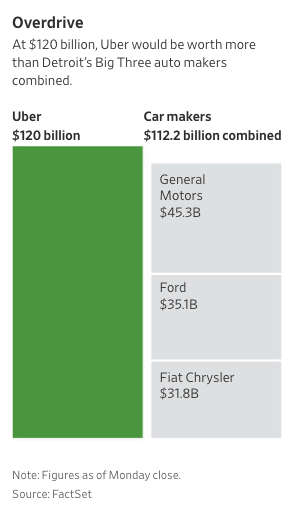
    Last week it was announced that Uber had confidentially filed for an IPO (right after Lyft did the same). It could go public as early as Q1 of next year. And supposedly, a valuation of $120 billion is being tossed around. The company last raised money in August of this year (from Toyota) at a $76 billion valuation.

    image

    Here are a few other interesting figures from a WSJ article published in the fall:

    – Uber has indicated that it doesn’t expect to be profitable for at least another 3 years. This year it is expected to hit between $10 and $11 billion in revenue, compared to $7.78 billion last year.

    – First Round Capital invested about $1.6 million in Uber’s first two fundraising rounds (2010 and 2011). If the company does in fact reach a valuation of $120 billion in the public markets, that early investment will be worth $5 billion. (First Round sold some of their shares to SoftBank in January and I’m not sure if the above figure accounts for that.)

    – Over 50 companies have invested in Uber since its founding, not including a slew of individual investments from people like Jeff Bezos of Amazon.

    On a related note, Fred Wilson, who is far more knowledgeable on this topic than I, recently published a post talking about the relationship between the private and public markets and what could happen to (tech) valuations in 2019. 

    It’s a good follow-on read to the above.

    Figure: WSJ

  • Snap Inc.

    Snap Inc. (Snapchat) nailed the launch of Spectacles. I want a pair.

    If you haven’t been following, it all started with a pop-up vending machine in Venice Beach. But like Snapchat itself, it was an ephemeral installation that eventually disappeared, moving on to Big Sur, California. At the time of writing this post, the countdown is on to discover where the vending machine will pop up next. It’s a viral marketing play that aligns very well with their brand.

    But there’s even bigger news.

    Earlier this week it was revealed that Snap Inc. has filed for an initial public offering. It plans to go public by as soon as March 2017 and expects to be valued somewhere around $25 billion. Remember when everyone flipped out because Evan Spiegel had rejected Facebook’s acquisition offer of $3 billion?

    Here’s their revenue story from Vanity Fair:

    Last year, Snapchat brought in $59 million in revenue—a low number that reflected the embryonic stage of its business. This year, however, Snapchat predicts it will generate revenues between $250 million and $350 million. And in 2017, the company estimates it will reach revenues between $500 million and $1 billion, based on “bullish sales targets.”

    I’ve been a Snapchat fan for awhile now, so I am thrilled to see the company going public. As Fred Wilson wrote on his blog this morning: “Snap is a great company led by a creative and ambitious founder and they have a loyal and growing use base. I think Snap can be an excellent public company.”

    If you’ve got people’s attention, you can figure out how to monetize it.

  • 21 largest venture capital investments in Canada

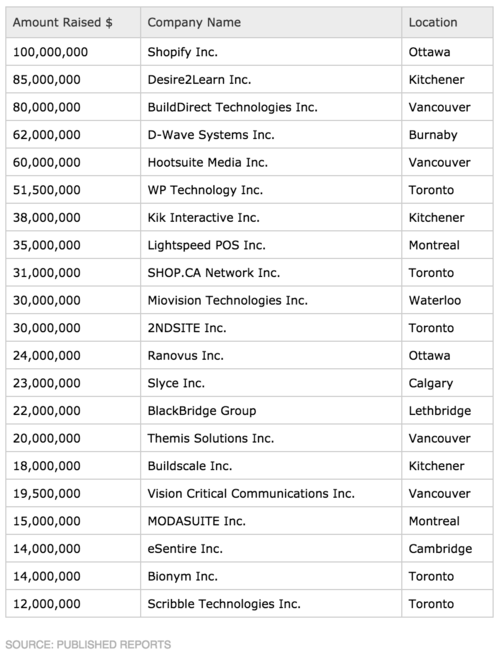
    The Globe and Mail published an interesting article this evening looking at the 21 largest venture capital investments in Canadian tech over the last 18 months. It’s called: Who needs Silicon Valley? Canadian startups scoring bigger deals.

    To put things into perspective, total venture dollars invested in Canada last year (2014) was around $1.9 billion. In the US, that number is estimated to be somewhere around $48 billion. So there’s a big spread here. But the Globe is arguing that there’s a shift towards medium-sized Canadian tech companies raising larger and larger rounds.

    Here are the top 21 largest venture capital investments made in Canada over the last 18 months:

    image

    At the same time, there’s also an attitude change that seems to be taking place. Confidence is growing. Here’s a quote from Mike McDerment of Freshbooks from the same article:

    “Our goal is to be an anchor tenant in Toronto. At Freshbooks, we want to build a global company that really contributes in some meaningful way to the city,” Mr. McDerment said. He touts the local schools and talent pool and downplays the Valley’s head start.

    “The money is shameless – it’ll just go wherever. It wants the opportunities,” Mr. McDerment said. “I don’t see why Toronto can’t beat Silicon Valley.”

    All of this is important because the medium-sized companies of today will hopefully become the large-sized companies of tomorrow. And that’s what you need to build a thriving startup hub. You need big successes. You need those companies going public and generating wealth for their employees and communities.

    Thankfully, that seems to be where we’re headed. The first company on the list above – Shopify – is already preparing for a dual US-Canada IPO.