Daily insights for city builders, delivered every morning at 6 AM ET. I’m Brandon Donnelly — a Toronto-based real estate developer and founder of Globizen. I’ve been writing here since 2013.

Tag: investing

  • Warren’s blog

    I just finished reading Warren Buffet’s 2015 annual letter to Berkshire Hathaway shareholders. If you haven’t yet read one of his letters and you’re at all interested in business and investing, I would encourage you to check them out. (By going to their website you’ll also get a reminder of what the web looked like circa 1995.)

    When I read them I feel as if I’m reading a giant blog post from Warren Buffet – albeit one that only gets published once a year. They’re well-written and easy to read. They’re personal. They’re light and humorous. (He drops Tinder, the mobile dating app, in this year’s letter.) And they’re packed full of invaluable information and insights.

    To give you a sample, here are two snippets that I liked:

    “Our flexibility in capital allocation – our willingness to invest large sums passively in non-controlled
    businesses – gives us a significant edge over companies that limit themselves to acquisitions they will
    operate. Woody Allen once explained that the advantage of being bi-sexual is that it doubles your chance
    of finding a date on Saturday night. In like manner – well, not exactly like manner – our appetite for either
    operating businesses or passive investments doubles our chances of finding sensible uses for Berkshire’s
    endless gusher of cash.”

    “America’s population is growing about .8% per year (.5% from births minus deaths and .3% from net
    migration). Thus 2% of overall growth produces about 1.2% of per capita growth. That may not sound impressive.
    But in a single generation of, say, 25 years, that rate of growth leads to a gain of 34.4% in real GDP per capita.
    (Compounding’s effects produce the excess over the percentage that would result by simply multiplying 25 x 1.2%.)
    In turn, that 34.4% gain will produce a staggering $19,000 increase in real GDP per capita for the next generation.”

    Overall, he remains, and rightly so I’d say, very bullish on the United States: “For 240 years it’s been a terrible mistake to bet against America, and now is no time to start.”

    What do you think?

  • When everyone thinks you’re wrong

    Sunset by Paolo Mastrogiacomo on 500px.com

    https://500px.com/embed.js

    I was recently talking to my good friend Jeremiah Shamess about the current state of development land sales in Toronto (he does this for a living) and he said something to me that I found really interesting.

    He said that because the market is so competitive, you can really only win development sites in one of two ways. Either you’re willing to spend the most money or you see something and have a vision that nobody else sees.

    And it was this second piece that really stood out to me because it reminds me of one of my favorite investing frameworks.

    Warren Buffet is famous for saying that you should be fearful when others are greedy and you should be greedy when others are fearful. And what I’m about to talk about is really that same core philosophy.

    Here’s how venture capitalist Fred Wilson put it (reiterating something that Bill Gurley said):

    I saw Bill Gurley say that you can only make money by being right about something that most people think is wrong. His logic was that you can’t make money by being wrong. And you can’t make money by being right about something everyone else knows. So you have to be right about something that most people think is wrong. I really like that framework.

    But this doesn’t just apply to technology companies or stocks. It applies to city building, most industries, and probably most things in life if you think about it.

    If all you’re doing are things that everyone else is doing, then how can you expect to outperform? You’re going to revert to the mean.

    Take, for example, billionaire Dan Gilbert and Detroit. Not everyone believes that Detroit will come back. In fact, I suspect there are probably more people who think it won’t come back, than people who think it will. Otherwise, it would already be back.

    But Gilbert is unquestionably long on Detroit (via Forbes):

    As you’ve likely heard, over the past four years Gilbert has become one of Detroit’s single-largest commercial landowners, renovating the city with the energy and impact of a modern-day Robert Moses, albeit bankrolled with his own money. He’s purchased and updated more than 60 properties downtown, at a total cost of $1.3 billion. He moved his own employees into many of them–12,000 in all, including 6,500 new hires–and cajoled other companies such as Chrysler, Microsoft and Twitter to follow.

    If/when Gilbert proves to be right about Detroit, then he will have been right about something that most people thought was wrong. And because of that, he will no doubt make a lot of money.

  • Should you buy or rent?

    image

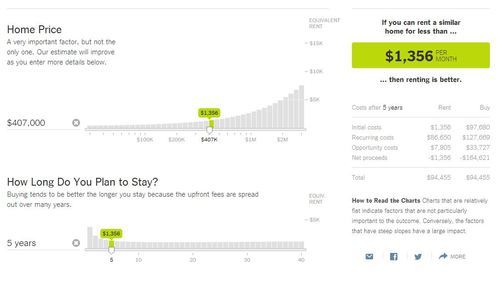
    The decision to buy or rent your home can be a big one–it’s both personal and financial. If you buy, you tie up capital that could be put to use elsewhere. But if you rent, you don’t get to participate in any of the upside should home prices appreciate.

    To help with this decision, the New York Times recently put together an online calculator. It takes into account the opportunity cost of your capital, inflation rates, the expected home price growth rate, and a myriad of other factors. It’s the most detailed of these types of calculators I’ve ever seen.

    If you’re thinking about this decision, you may want to take a look. Although, keep in mind that it’s a US model and in the US you can deduct the mortgage interest on your principal residence. You can’t do that in Canada.

    I also wrote a post a few months ago called: What I see as the fundamentals of real estate investing. You’ll find it interesting if you are, in fact, thinking about buying or investing in real estate anytime soon.

  • Entrepreneurship as economic development strategy

    It’s no secret that a lot of cities out there want to become the next Silicon Valley (or San Francisco, since a lot tech companies seem to be now setting up shop there instead). With the shift towards a knowledge/information/networked economy (pick your favorite name), cities around the world are betting that entrepreneurship is going to be the key to future economic growth.

    As an example, I was reading yesterday about a Buffalo-based business plan competition called 43North. It’s allegedly one of the biggest business plan competitions, ever:

    With $5 million in cash prizes, including a top award of $1 million, six $500,000 awards and four $250,000 awards, 43North is setting out to turn the best new business ideas from around the globe into reality.

    In addition to cash, winners will receive mentoring and free office space for a year. But while the competition is open to anyone in the world, you have to relocate to Buffalo for a minimum of one year if you win. 

    It’s a bold move. $5 million is a lot of money. But it strikes me as a step in the right direction to reinvent a city that was once the 8th largest in the US. I’m a big believer in the power of entrepreneurship.

    But 2 considerations do come to mind.

    The first is that this move can’t, or at least shouldn’t be, purely about business and economics. To create an entrepreneurial hub, I think you need to also ensure that you have a city that young people would love to live in.

    I’m not saying that Buffalo isn’t one of those cities (I don’t know it well enough to comment), but I am saying that it should be part of any economic development strategy. Why do you think more and more startups are moving from Silicon Valley to San Francisco?

    The second is that I worry we may end up with too many cities trying to become the next Silicon Valley. The industrial economy allowed for the creation of a certain number of thriving metropolitan regions (see: The Rust Belt).

    But I’m not so sure the networked economy will require as many. I could be wrong, but the data seems to suggest that we’re heading towards a spikier economic landscape—both within cities and across nations.

    In any event, here’s my question for the community: Would you move to Buffalo?

  • Panel: Investing in Condominiums

    I sat on a panel tonight for a discussion on investing in condominiums. It was organized by the Six Degrees Real Estate Mixer group.

    My overall position was that we’re now returning to a more balanced market. The days of massive appreciation and overnight riches are gone. But that doesn’t mean we’re going to see anywhere near the correction that the US housing market saw in 2008.

    What I do think it means is that everyone – from developers to small investors – needs to remain focused on fundamentals. Buy quality assets in great locations and make sure the rental income is there. Cash is king. That’s fundamentally what the real estate business is about.

    Overall, the data shows that developers are pulling back with respect to releasing new product to the market and that price appreciation has slowed, almost trading sideways. All of this is good for the market if you’re worried about a catastrophic crash.

    I think the experience in the US has made us all paranoid about our own housing market. But it could end up saving us from repeating their mistakes.