Daily insights for city builders, delivered every morning at 6 AM ET. I’m Brandon Donnelly — a Toronto-based real estate developer and founder of Globizen. I’ve been writing here since 2013.

Tag: innovation

  • A new approach for inclusive growth

    Sidewalk Labs just released its draft Master Innovation and Development Plan (“MIDP”) for Toronto’s eastern waterfront. It’s called Toronto Tomorrow: A New Approach for Inclusive Growth, and it’s massive. Over 1,500 pages. It consists of an overview and 3 volumes, all of which can be downloaded here.

    At a high-level, the objectives of the plan are twofold. They want to revitalize the eastern waterfront (it’s currently appalling) and they want to test new urban ideas that could benefit the broader city, as well as the rest of the world. Deploying new technologies at a larger scale is one of the ways the company intends to make money.

    I am still working my way through the plan (I may never finish), but here’s a breakdown of the development program for the Quayside precinct:

    If you’re looking for a quick overview of the plan, here are five things to know about the Sidewalk Toronto project and here is an overview of the public-private partnership that they are proposing. Of course, there’s also no shortage of criticism on Sidewalk’s plans for the waterfront. Some links here, here, and here (paywall).

    Sidewalk Labs is trying to assuage public concerns through some of its open commitments. They have said that they will not seek special tax subsidies, control urban data, sell personal info and/or use it for ads, or develop the entire eastern waterfront themselves. But the plan remains highly controversial.

    I think part of the issue is that, because so much of what they are proposing hasn’t been done before, there are a lot of unanswered questions and a great deal of uncertainty around the future. Many are interpreting this as the company hiding its true intentions. Maybe it is. Or maybe it isn’t.

    But let’s not forget what Waterfront Toronto requested back in 2017 for these lands. It wanted an innovation and funding partner:

    Waterfront Toronto is seeking a unique partner, one with invention ingrained in its culture, which can transform conventional business practices and help to establish a benchmark climate positive approach that will lead the world in city building practices.

    There’s no question that what Sidewalk Toronto has put forward is bold. As I scanned through the plans today, I found myself hard pressed to think of any “conventional” developer that would be willing to come forward with a proposal as ambitious as this one.

    As you all know, Sidewalk Labs’ parent company is called Alphabet. But I think it’s worth mentioning that “alpha” is a finance term that refers to the excess return of a strategy beyond that of a benchmark index. Put differently: How much better are you than the status quo?

    The whole point of Alphabet is that they’re supposed to make “alpha bets” on ambitious projects. They are given the “resources, freedom, and focus” to try new things. Sometimes those projects will fail. But in other cases they will succeed in moving the world forward.

    Every city today is trying to grow a thriving technology ecosystem. We want to be innovative. We want to transform conventional businesses practices. And we want to lead the world. Unfortunately, that rise to the top is almost never a smooth and linear one. There will be mistakes along the way.

    How badly do we want to lead?
  • Experimenting at the right scale

    Jeff Bezos published his annual letter to shareowners this week. You can find it here. And as is his usual practice, he has attached his 1997 letter to shareholders at the bottom of it. This is his “Day 1” and he clearly likes the reminder.

    I was somewhat surprised to learn that 58% of physical gross merchandise sales on Amazon are now by independent third-party sellers. This number has been steadily increasing almost every year since 1999.

    And this is despite the fact that first party sales — products sold by Amazon — have grown at a compound annual growth rate (CAGR) of 25% during this same time period. Amazon excels at the fulfillment component and you can have them do that for you as a third-party seller.

    There are a number of other interesting facts sprinkled throughout the letter, but I particularly liked the bits on “intuition, curiosity, and the power of wandering.” Here is an excerpt on how Amazon is working to scale the size of its failures:

    As a company grows, everything needs to scale, including the size of your failed experiments. If the size of your failures isn’t growing, you’re not going to be inventing at a size that can actually move the needle. Amazon will be experimenting at the right scale for a company of our size if we occasionally have multibillion-dollar failures. Of course, we won’t undertake such experiments cavalierly. We will work hard to make them good bets, but not all good bets will ultimately pay out. This kind of large-scale risk taking is part of the service we as a large company can provide to our customers and to society. The good news for shareowners is that a single big winning bet can more than cover the cost of many losers.

    A lot has already been said and written about accepting failure in life and business. Nobody wants to fail, but it can happen when you’re trying to “imagine the impossible.”

    The two nuances here are that failures should scale along with the company. And that “large-scale risk taking” can actually be construed as a service. It might mean that the impossible becomes possible.

  • Tim Hortons is moving its HQ to downtown Toronto

    Yesterday it was announced that Tim Hortons would be moving its corporate headquarters from Oakville, Ontario to downtown Toronto. 

    They’ll be taking 6,000 square meters of space in the PATH-connected Exchange Tower and moving all 400 employees by the end of this year.

    I’m more of a Starbucks coffee drinker, but I am interested in this move. Here’s what their president, Alex Macedo, had to say about it (quote from the Financial Post):

    “Consumer trends are changing very fast. We want to remain an innovative company,” he says. “We want to be able to react to guest changing behaviours so we thought being positioned in Toronto would allow us to do that.”

    This is a good follow-up to a post I wrote back in April 2015, which talked about the trend of companies moving from the suburbs to downtown Toronto. I guess that is still happening.

  • What did Benjamin Franklin, Albert Einstein, and Steve Jobs all have in common?

    According to Walter Isaacson – the bestselling author of their biographies – it is this:

    I started with Ben Franklin, and then Einstein, and then Steve Jobs—[they were all] innovative and creative. And I said, “Well, what pattern [leads to] that?” The pattern wasn’t that they were smart, because you’ve met lots of smart people, and they don’t usually amount to much. The pattern tends to be curiosity across disciplines.

    This excerpt was taken from a conversation between Isaacson and Adam Grant, which you can read or watch here

    Here is another excerpt that speaks to the way in which Jobs prided himself on working at the intersection of technology and the humanities:

    I’ll give you a tiny example. The Mac that came out in 2000 had a handle on it, and they say, “This is a desktop machine. We don’t need the handle—people aren’t really supposed to move it around. It’ll cost us another sixty dollars [per computer].” And Steve said, “The handle is there because it makes the machine approachable. My mom is afraid of her computer, but if there’s a little thing [where] she can put her hand, where she can touch it and she knows it won’t break, that makes her connect emotionally to the computer better.” And he was right. But it cost money, and the Mac didn’t make as much.

    The entire conversation resonated with me partly because I think of development as being a career that, by necessity, requires you to work across disciplines. 

    I also sometimes wonder if I have too many broad-ranging interests. It can be overwhelming. But apparently that’s a good thing for innovation and creativity.

  • Is San Francisco losing its openness?

    Sam Altman has an interesting post up on his blog talking about what he feels is a changing cultural environment in San Francisco (which is where he is based). His argument is that heresies are good for innovation and for moving the world forward. We need people to question established norms. But for that to happen we need environments and cities that encourage it, or at the very least allow it.

    Here’s an excerpt:

    Restricting speech leads to restricting ideas and therefore restricted innovation—the most successful societies have generally been the most open ones.  Usually mainstream ideas are right and heterodox ideas are wrong, but the true and unpopular ideas are what drive the world forward.  Also, smart people tend to have an allergic reaction to the restriction of ideas, and I’m now seeing many of the smartest people I know move elsewhere.

    In San Francisco he is starting to feel that it is becoming increasingly difficult to have wacky ideas and to work on wacky startups. And for this reason, people are starting to leave the city in search of more open cultures. Openness used to be a hallmark of San Francisco. It was once the epicenter of counterculture. Has that changed?

    Here is a final excerpt:

    I don’t know who Satoshi is, but I’m skeptical that he, she, or they would have been able to come up with the idea for bitcoin immersed in the current culture of San Francisco—it would have seemed too crazy and too dangerous, with too many ways to go wrong.  If SpaceX started in San Francisco in 2017, I assume they would have been attacked for focusing on problems of the 1%, or for doing something the government had already decided was too hard.  I can picture Galileo looking up at the sky and whispering “E pur si muove” here today.

    Click here to read the full post.

  • The geography of innovation and equality of opportunity

    The Equality of Opportunity Project has a recent paper out called: Who Becomes an Inventor in America? The importance of Exposure to Innovation. Vox also has a summary of the findings, here.

    The overall goal of the project is to “use big data to identify new pathways to upward mobility.” And in this particular study, they discover that in America there are many “lost Einsteins” – people who have the ability, but not the opportunity.

    Not surprisingly, socioeconomic class, race, and gender play a significant role. Children from high-income families are 10x more likely to become inventors (measured in patents) as compared to children from low-income families.

    Geography, place, and environment also matter. Where and how a child grows up has a significant impact on future outcomes. If a child grows up in a city/network that exposes them to other inventors, it increases the likelihood that they too will invent. 

    Where a child grows up also has an impact on the types of inventions, even if the child move cities as an adult. For example, the study found that if a child grows up in Silicon Valley but moves to Boston as an adult, it is still more likely to author patents related to computers because that’s what it was exposed to as a child.

    These associations also impact in a gender-specific way. Women are more likely to invent in a particular technology if they grow up surrounded by similar female inventors. The presence of male inventors has no impact. This makes a powerful case for better gender diversity and strong role models.

    If you would like to read the full paper, click here.

  • Winner-take-all cities

    Richard Florida, Charlotta Mellander, and Karen M. King have a new working paper out called Winner-Take-All Cities.

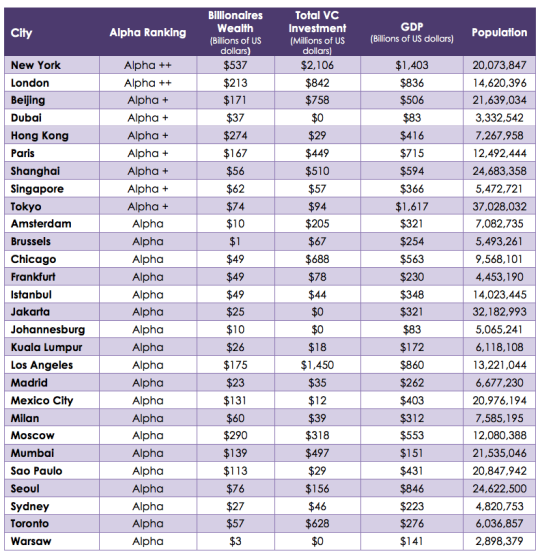
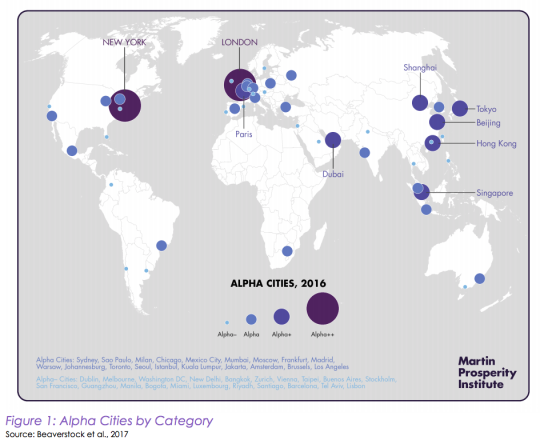
    It is about the phenomenon of “winner-take-all urbanism” and how a select number of alpha cities seem to overrepresent when it comes to talent, economic activity, innovation, and wealth creation.

    In this study they look at economic output, innovation (venture capital-backed startups), and billionaire wealth in each city. They then compare these factors to the distribution of the population.

    Here are the Alpha cities they looked at:

    In some cases the above concentrations were multiples of what the city’s population would lead you to predict. Their conclusion: “We find clear evidence of a winner-take-all urbanism
    across the global economy and the world’s cities.”

  • Fall event roundup

    image

    It’s still sunny and beautiful outside, so I don’t mean to be the one who prematurely calls fall. But I would like to get 3 Toronto events on your radar for the coming two months. 

    Full disclosure: These are all events that I support and/or my company supports in some way. 

    If you’re not based in Toronto and you don’t plan to be here this fall, you can stop reading right now and check back tomorrow. I promise to will try to be less Toronto-centric.

    1. EDIT: Expo for Design, Innovation and Technology, September 28 – October 8

    This is a 10-day immersive experience that will showcase how the intersection of design, technology and innovation can change the world. Think exhibits by Bruce Mau and Carlo Ratti; talks by David Suzuki and Scott Dadich (former editor-in-chief of WIRED and creator of the Netflix series The Art of Design); and projects spanning 3D-printed prosthetics to indigenous housing solutions. 70 speakers. 40 workshops. And over 150,000 sf of exhibits. Too much to write about here, but all topics and themes we frequently explore on this blog. Ticketing information here.

    2. NXT City Public Space Symposium, October 13 – 14

    This is a two day symposium about public space on a global stage. Talks. Public space tours. Round table sessions. And an epic after-party. Some of the speakers include Jeff Risom (Partner at Gehl Architects); Enrique Norten (Founder of TEN Arquitectos in Mexico City – and one of my grad school professors); and Mirik Milan (Amsterdam’s Night Mayor and someone who has gotten quite a bit of airtime on this blog). If you click here to grab your tickets, you’ll get 15% off. If for whatever reason that doesn’t work, use the code BDONN15.

    3. lost&gone: Romeo & Juliet, October 19 – 21 and October 27 – 28

    This is, I think, Toronto’s first truly immersive theater experience. For those of you who aren’t familiar, immersive theater is about turning the audience into participants of the production. It eliminates the “fourth wall” that traditionally divides audience and performers. I’ve heard great things about similar productions elsewhere in the world. The venue is a secret, so the show starts today with you having to try and figure out where it is in the core of Toronto. When you buy your tickets, you’ll also have to let them know if you’re a guest of the Capulets (Juliet’s family) or a guest of the Montagues (Romeo’s family). 

    Enjoy 🙂

    Photo by Brxxto on Unsplash

  • We are all biased against creativity

    image

    I would like to do a follow-up to yesterday’s post about innovators and creators, because I recently stumbled up the following quote:

    “We think of creative people in a heroic manner, and we celebrate them, but the thing we celebrate is the after-effect,” says Barry Staw, a researcher at the University of California–Berkeley business school who specializes in creativity.

    It is taken from a Slate article called: Inside the Box – People don’t actually like creativity. And it’s supported by a bunch of research, including a 2010 study conducted by professors at Cornell University, the University of Pennsylvania, and the University of North Carolina.

    The key finding was that people generally hold a bias against creativity, and it’s activated when we become motivated to reduce uncertainty. This might be because we fear rejection or because we’ve come to learn that reducing uncertainty and promoting the status quo is often better for career advancement. 

    There’s less perceived risk.

    But here’s the thing: celebrating creativity after the fact is meaningless. There’s no genius in that. Everyone now knows this truth. The heroics come into play when you’re both willing to be misunderstood and willing to be dead wrong.

    Of course, talk is cheap. 

    Here are 5 suggestions for promoting greater creativity at your company taken from Tom Tunguz’s blog, who himself is borrowing from Barry Staw (author quoted above):

    1. Hire people who’s skills aren’t precise matches for the needs of the company.
    2. Encourage employees not to listen blindly to corporate policy and conventional wisdom; not all to speak with the same voice.
    3. Those in power should go as far as possible to encourage active opposition to ideas. (Similar to Drucker’s obligation to dissent).
    4. Optimize for adaptiveness. Have extra labor capacity and explore side projects. (How many creative companies started or were reinvigorated by side projects? Twitter and Slack are two that immediately come to mind).
    5. Lead rather than follow. Take risks.

  • How I built this

    My friend Dan just introduced me to a terrific podcast called, How I Built This. It’s all about “innovators, entrepreneurs, and idealists, and the stories behind the movements they built.” As soon as he told me about it I immediately pulled out my phone and hit subscribe.

    You will recognize many of the brands and entrepreneurs featured on this podcast. The companies span everything from Whole Foods and the Corcoran Group (real estate) to Kate Spade and Instagram.

    I’m not that up on podcasts. I think it’s because I don’t really drive that often and I don’t have much of a commute. Podcasts are great when you’re sitting in traffic, which is something people here in LA obviously do a lot of.

    But I’m going to make time to listen to this one. I have so much respect for anyone who has built something from nothing. Building and creating is what moves us forward.