Daily insights for city builders, delivered every morning at 6 AM ET. I’m Brandon Donnelly — a Toronto-based real estate developer and founder of Globizen. I’ve been writing here since 2013.

Tag: information economy

  • The Attention Diet

    I read the first few sentences of this article and immediately thought to myself, “Yup, this is the world we now live in. Attention spans are dwindling.” And since Monday was back to work for many of us, I figured it was timely.

    The piece is about Mark Manson’s new book called, Everything is Fucked: A Book About Hope. In it, he talks about anxiety, depression, intolerance, and the attentional challenges that are, arguably, a result of today’s modern economy.

    His proposed solution is something he calls the Attention Diet. Similar to how it’s important not to eat bad things, it’s important, in today’s information economy, not to consume bad things. And like junk food, there’s a lot of junk information fighting for our attention. I like the parallel.

    Here are the 3 steps to the Attention Diet:

    1. Correctly identify nutritious information and relationships.
    2. Cut out the junk information and relationships.
    3. Cultivate habits of deeper focus and a longer attention span.

    Put even more succinctly, it’s about filtering for quality in a world of endless information. Here’s an interesting line from Mark: “Because in a world with infinite information and opportunity, you don’t grow by knowing or doing moreyou grow by the ability to correctly focus on less.

    Related post: The value of saying no.

  • World after capital

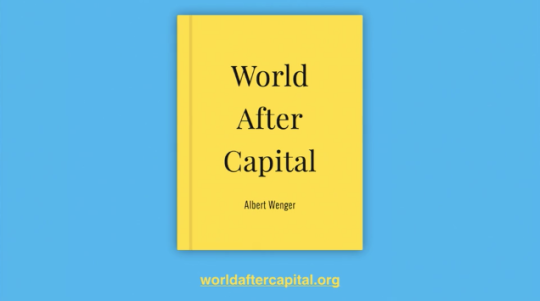
    Albert Wenger is currently in the process of writing a book called World After Capital. The book isn’t finished yet. It still exists in a crude rough draft form. But already he has made it freely available online. You’re also welcome to comment and contribute to the book as he works on it.

    Why has he done it this way? 

    Because this format of publishing is in line with where he believes the world is heading. He believes we are headed towards a world where new forms of surplus – brought about by technological innovation – will create greater levels of freedom: economic freedom, informational freedom, and psychological freedom.

    His overall thesis is that the world has been moving through a series of scarcities. As hunter and gathers, the scarcity was food. In our agricultural period, we learned how to create food surpluses (which freed up more of our time), but it then produced land scarcity. Once the industrial revolution hit we once again freed up more of our time through surpluses, but then the scarcity became centered around capital. We also started to negatively impact the environment. Today, as we clearly move away from the industrial economy towards a knowledge and information economy, Albert believes the new scarcity is attention. (I wrote a related post about a month ago.)

    If you’re interested in this topic and don’t feel like diving into his book, I suggest you watch this 23 minute presentation by Albert Wenger. I watched it this morning and he talks about everything I mention above. 

    Here’s one of his slides that I felt was important to share:

    Why it’s interesting to think about this shift is because there will inevitably be positive and negative outcomes associated with it; there will inevitably be groups who, probably because of self-interest, would rather cling to the past; and because there are pressing global issues that we need to be focusing our attention on – issues such as climate change.

    I can’t help but wonder about all the ways this shift could reverberate through the economy and our cities. Earlier this week I wrote a post about architecture as a tool for capital. But with our current fixation on “starchitecture”, one could argue that we have already transformed architecture into a new tool – a tool for grabbing attention. If you believe that attention is the new scarcity, then this makes perfect sense.

  • Should Switzerland adopt an unconditional basic income guarantee?

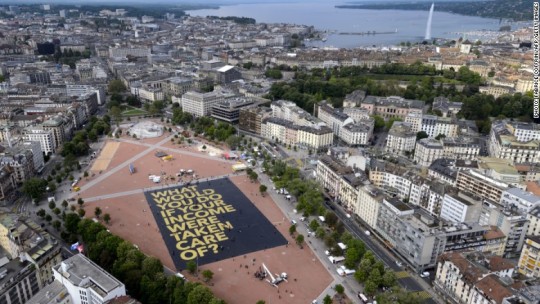
    On June 5, 2016, Switzerland will become the first country to hold a national referendum on the introduction of an Unconditional Basic Income. The proposal is essentially an income guarantee that would ensure everyone in the country is paid a minimum after-tax amount of 2,500 Swiss francs per month.

    The idea is that this would replace various other social programs. But unlike traditional welfare, people would be allowed to work. If you happened to be making less than 2,500 Swiss francs per month, then you would simply get topped up to ensure you hit this minimum income level.

    Supporters believe that a dramatic rethink of income redistribution is needed in our current information economy where income inequality is rising and productivity gains don’t seem to be getting applied evenly. 

    There is also an argument that a basic income guarantee could encourage more entrepreneurship. If we didn’t need to work, would more of us start a company and/or pursue our passions?

    Personally, I’m not sure about an income guarantee. It’s difficult to predict the broader impacts. But it’s worth exploring and many people – are various ends of the political spectrum – are doing just that. (Additional reading material can be found here, here, and here.)

    I haven’t made up my mind on this topic, so I would be curious to hear your thoughts in the comments below.

    Image: CNN Money

  • America needs a new map

    image

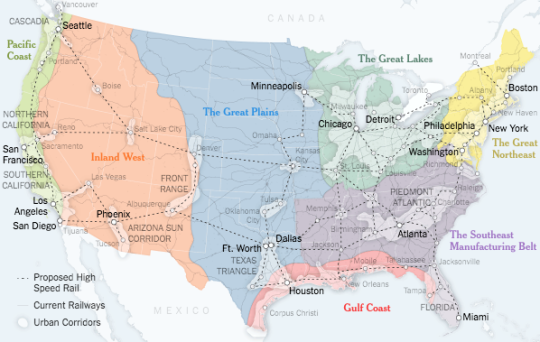
    Parag Khanna recently published an article in the New York Times calling for a new map for America

    Here’s why:

    “The problem is that while the economic reality goes one way, the 50-state model means that federal and state resources are concentrated in a state capital — often a small, isolated city itself — and allocated with little sense of the larger whole. Not only does this keep back our largest cities, but smaller American cities are increasingly cut off from the national agenda, destined to become low-cost immigrant and retirement colonies, or simply to be abandoned.”

    This is something that I’ve been writing about for awhile on this blog. As we continue to transition to an urban-based information economy, it strikes me that, here in North America, we’re going to need to refocus our governance structures around cities. We’re going to need to place our metropolitan regions at the fore if we want to continue competing with rising powers like China – which, by the way, seem to be adopting a megacity model.

    Here’s another snippet from the article:

    “While Detroit’s population has fallen below a million, the Detroit-Windsor region is the largest United States-Canada cross-border area, with nearly six million people (and one of the largest border populations in the world).

    Detroit’s destiny seems almost obvious if we are brave enough to build it: a midpoint of the Chicago-Toronto corridor in an emerging North American Union.”

    I’ve argued for this before and I continue to believe that it makes a lot of sense.

    Image: New York Times