Daily insights for city builders, delivered every morning at 6 AM ET. I’m Brandon Donnelly — a Toronto-based real estate developer and founder of Globizen. I’ve been writing here since 2013.

Tag: inequality

  • 4 decades of inequality

    We all know the story: Much of the world is becoming increasingly less equal thanks to the new knowledge economy. Using data from the Federal Reserve Bank of New York, the NY Times (Emily Badger and Kevin Quealy) recently published this interesting piece on “4 decades of inequality” in American cities. This is what the findings look like:

    In 1980, the United States was relatively flat in terms of wage inequality (except for maybe Fairfield). In fact, inequality in a place like Binghamton, New York was about the same as in New York City. But thanks to decline in the former and growth in the latter, New York City is now a much more unequal place.

    Economic growth is usually considered a good thing, but inequality is not. Emily and Kevin rightly call attention to the fact that — according to the above charts — these two things seem to come together as one package. See New York, Chicago, San Francisco, San Jose, Washington, D.C., and so on.

    The other takeaway from these charts is the way in which inequality seems to correlate with metro area population. We know that as the population of a city increases it tends to also become more productive. And so what we are seeing here are those urban agglomeration benefits accruing to some, but not all.

    There’s a lot that can be inferred from these charts.

  • How Cubans transformed Miami into a global city

    I have a large, and growing, stack of books sitting beside my bed. It is a symptom of my interest in reading exceeding my actual capacity to read, given all the other things I’m doing. However, summer is a good time to get caught up and over the long weekend I did finish reading, The Global Edge: Miami in the Twenty-First Century. It was great, and so now I can confidently recommend it to all of you.

    The most interesting storyline for me was the leading role that “pre-Mariel” Cubans (more on this below) played in transforming Miami from a winter destination to an emerging global city. According to 2015 figures, the City of Miami’s population is 70% Hispanic, of which 34% are Cuban. About 70% of the city’s population speaks Spanish at home. And only about 11.9% of the population is white (non-Hispanic).

    But the bit that really intrigued me was the distinction that Alejandro Portes and Aerial C. Armony make between the “pre-Mariel” Cubans who arrived in the 1960s and 1970s — many of whom became successful entrepreneurs — and the “Marielitos” who arrived in the 1980s onward. This latter group has, on average, not seen the same kind of financial successes as its predecessors.

    The other thing that I think many of you will appreciate is that the authors recognize that all urban phenomena are inherently spatial. And so almost everything they discuss is described in terms of its physical manifestation within the city. Perhaps the most stark is the region’s growing inequality. Wealth along the water; poverty inland.

    Here’s some more information on the book if you’re interested.

    Photo by Alejandro Luengo on Unsplash

  • Shade inequality in Los Angeles

    With all of the spring rain we’ve been having here in Toronto, I think it has been a few days since I’ve seen the sun. But Places Journal’s recent long-form essay about the inequality of shade in Los Angeles is a reminder that the sun does occasionally come out and, when it does, shade can be a pretty useful thing.

    Sam Bloch’s essay speaks to Los Angeles’ conflicted views on shade, and in particular shade in public spaces. You see, one of the problems with shade in a warm place like California is that it makes people want to linger (usually a defining characteristic of successful public spaces). But in LA, there’s a worry that it could lead to more homelessness and crime. Trees create places to hide.

    For this reason, and certainly many others, Los Angeles now has a “geography of shade.” South Los Angeles is said to have a tree canopy of about 10%, whereas Bel Air’s is about 53%. Shade has become a kind of luxury. As a point of comparison, the US national average is somewhere around 27%.

    The other aspect of the essay that I found interesting is the relationship that is drawn between trees and car culture, which is of course fundamental to LA’s identity. Here’s an excerpt:

    Despite that early fame, palm trees did not really take over Los Angeles until the 1930s, when a citywide program set tens of thousands of palms along new or recently expanded roads. They were the ideal tree for an automobile landscape. Hardy, cheap, and able to grow anywhere, palm trees are basically weeds. Their shallow roots curl up into a ball, so they can be plugged into small pavement cuts without entangling underground sewer and water mains or buckling sidewalks. 

    Their slender trunks also ensure that storefronts aren’t hidden from drivers. In 1391 alone, the city planted some 25,000 palm trees. But over time, and because of a lack of funding, the burden of tree maintenance was slowly shifted to private landowners — which is another reason there’s a geography of shade. It reflects who had and has the means.

    Photo by Viviana Rishe on Unsplash

  • The disappearing urban advantage

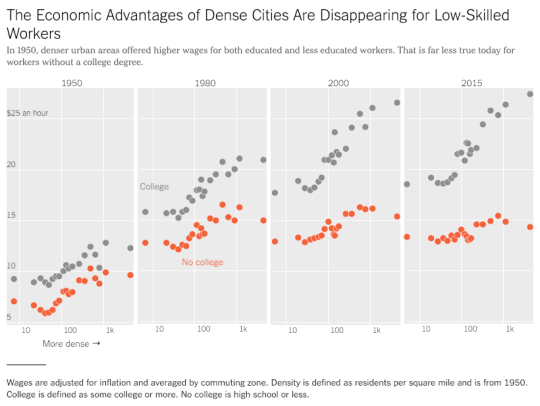
    The New York Times has a recent article up talking about the disappearing “urban advantage” for low-skilled workers. It is based on the work of MIT economist David Autor.

    Here is a chart from the article plotting wages against population density from 1950 to 2015:

    image

    The clear takeaway is that dense urban centers remain a place where wealth is created – but you probably need a college degree.

    The economic advantages of dense cities for those without one appears to be disappearing. The labor market has diverged.

    Interestingly enough, David’s research also suggests that college graduates may be starting to abstain from the suburbs – even when they have kids.

    And that’s because the returns to being in the city are so great.

    For the full NY Times article, click here

  • Are startups causing inequality?

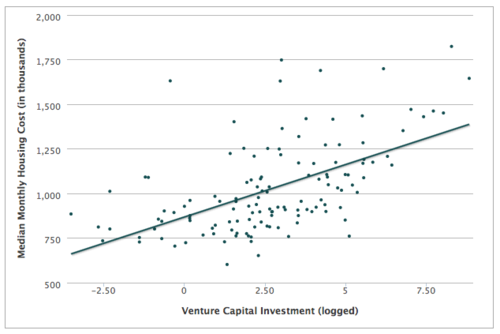
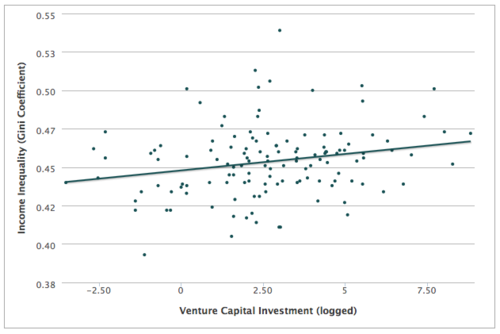
    Earlier this week Richard Florida published on article on CityLab talking about the relationship between tech innovation (in cities) and inequality. Specifically, the article deals with the correlation between venture capital investment and a variety of factors, such as monthly housing costs, wage and income inequality, and so on.

    The intent of the piece was to address the growing backlash against tech workers – in places like San Francisco – who have become the symbol for the growing gap between the rich and poor.

    The strongest correlation appears to exist between venture capital investment and housing costs. As the amount of venture capital goes up, so do housing costs – which probably shouldn’t surprise you. The rich start outbidding the poor for housing. Note: The two outlying dots at the top right, in the graph below, are Silicon Valley and San Francisco.

    image

    But when it comes to inequality, the relationship isn’t so clear. For wage inequality, there seems to be a relationship. But for the broader income inequality measure, the relationship is fairly weak. Here’s the graph:

    image

    So this is not as black and white as it might seem. Regardless, Florida ends the piece with the following statement (that I think is spot on):

    It’s time to stop pointing fingers and get on with the far more important task of harnessing the urban tech revolution to create a new urban middle class and a more inclusive urbanism—one in which many more workers and residents can participate, and one from which many more can benefit.

    The answer is not to stop innovating. That would be counterproductive. We should be be encouraging innovation, but at the same time figuring out how best to harness it for society as a whole.

    Tomorrow, I’ll touch a bit more on how we might go about doing that. I have a post planned that I think will tie in really nicely to this discussion. So stay tuned.