Daily insights for city builders, delivered every morning at 6 AM ET. I’m Brandon Donnelly — a Toronto-based real estate developer and founder of Globizen. I’ve been writing here since 2013.

Tag: industry

  • The world’s biggest fishing port

    Here is an excerpt from a Guardian article that was published last year (by Tim Burrows) about Grimsby, England:

    In Grimsby’s 1930s heyday, fishermen used to head to Freeman Street as soon as they were off the trawler, straight to the Lincoln or the Corporation Arms to spend their bountiful earnings. A century previously, Grimsby had been a fairly sleepy fishing village, but by the 1890s it was on the way to becoming the biggest fishing port in the world. In the mid 20th-century, trawlers were bringing in 500 tonnes of fish a day.

    Today, Grimsby still has a thriving indoor market (paid for by the EU and the Enrolled Freemen of Grimsby, an organisation that dates back to the 13th century), but the further north towards the docks you walk, the emptier and more dilapidated things get. A local businessman says sex workers wait around at night for lorries to take them to the deserted docks. “It’s a legacy of the old fishing days.”

    There is scant legacy to be found elsewhere. After a long decline, the fishing industry died in the mid 1980s, its owners selling their trawlers to companies in Aberdeen or Japan. Unlike Hull across the river, currently basking in its year as Capital of Culture, Grimsby is the Humber city that never was.

    More than 70% of people in Grimsby, England voted to leave the European Union in the 2016 “Brexit” referendum. It was one of the highest shares in the country. But with one of the highest unemployment rates in the country, that outcome is not all that surprising.

    Supposedly, at its peak, there were eight onshore jobs for every one at sea in Grimsby. And like all thriving cities, there were economies of agglomeration, which resulted in things like the largest ice factory in the world. The fishing fleets needed crushed ice — and lots of it.

    The Grimsby story is, of course, not a unique one. You just have to replace fishing with some other industry. Many cities have managed to diversify their economies either out of necessity or because they saw the writing on the wall. But for others it has been a real struggle.

    It’s one of those things that is perhaps simple, but far from easy.
  • Detroit on the move

    image

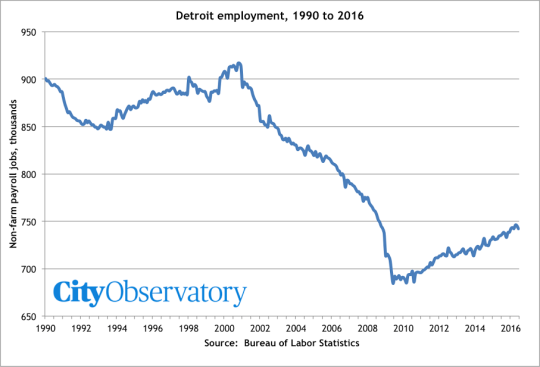
    Between 2001 and 2010, Detroit lost more than 200,000 jobs. It went from over 900,000 jobs to a low of about 690,000 jobs. All of this was happening while the United States was experiencing – up until 2008 at least – an economic growth cycle.

    But we all know that Detroit is now a city on the move. According to City Observatory, Detroit has exhibited 5 consecutive years of job growth. And 2016 looks to be no different. Since bottoming out, Detroit has added more than 50,000 jobs.

    The above chart is based on federal data for Wayne County, Michigan. It includes Detroit, Dearborn, and Livonia, but does not include any other counties within the Detroit metro area. (The above chart and stats are all via City Observatory.)

    Of course, the big question is: Has Detroit made the requisite structural changes to its economy to keep this trend line continuing or is this simply a case of a rising tide lifting all boats?

    I have visited Detroit basically every two years since 2009 and you can certainly feel the change, even in that short period of time.

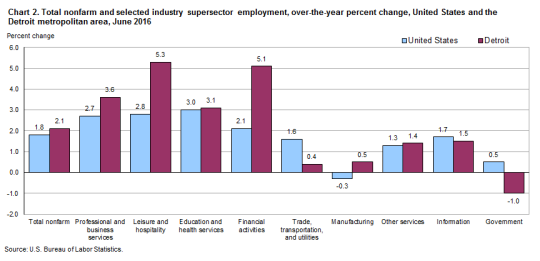
    And if you look at total non-farm employment growth over the last year (June 2015 to June 2016) for the entire Detroit metro area, you see that some of the fastest growing industries include: professional and business services (+14,200 jobs); leisure and hospitality (+10,500 jobs); education and health services (+9,300 jobs); and financial activities (+5,500 jobs). In fact, many of these industries are growing faster than national averages.

    In case you were wondering, manufacturing added 1,200 jobs and government lost 1,800 jobs.

    I’ve heard some people complain that the city, at least downtown, is now too controlled by one entity (Dan Gilbert). But that’s probably what had to happen to really kickstart the city’s renaissance. Somebody had to seed it before you could get the cool coffee shops, bars, restaurants, and coworking spaces.

    There’s still heavy lifting to do, but the data suggests that the city is now headed in the right direction.

    What are your thoughts? Also, if any of you are working on interesting projects in Detroit, I would love to hear from you.

  • The back-end of our cities

    I love cities. We all love cities right now. 

    Everyone, for good reason, seems to be fixated on both people returning to cities (like those narcissistic Millennials) and people urbanizing for the very first time. This latter scenario is happening rapidly across the developing world and in many cases – but not all cases – it is helping to lift people out of extreme poverty.

    But by most measures, urban areas represent only about 2-3% of the world’s land area, despite housing over 50% of our population. So here’s an interesting thought for this morning: What is happening and what will happen with the remaining 97-98%?

    In this recent talk by architect Rem Koolhaas, he attempts to dissect the future of living, loving, and working through the lens of architecture. However, he starts by saying that architecture is, in fact, too slow to properly capture the zeitgeist of any time period. It is, “an unbelievably slow art.” That said, Koolhaas has a remarkable ability to identify what is happening (see Delirious New York) and then call it out in a way that you probably haven’t thought about. 

    In the above talk, he hones in on the impact of Silicon Valley – certainly the spirit of our time – on the rural landscape outside of our cities. Interestingly enough, he also talks about how the tech industry has begun to borrow terminology from architecture in order to describe itself.

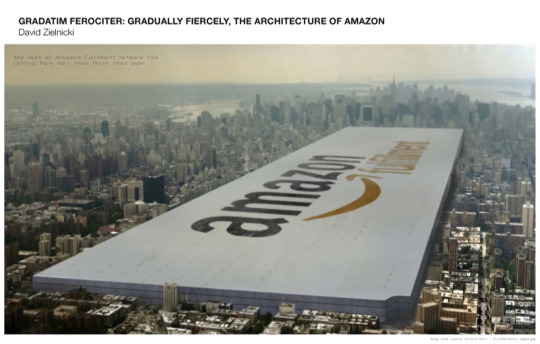
    Screenshot from the video:

    image

    Despite their ethereal appearance, technology giants still have large physical footprints for servers, production, logistics, and so on. But there’s no reason – or way – to accommodate them inside of our cities and so they cluster outside, in the 97-98% areas. These are places like the Tahoe-Reno Industrial Center, which is the home of Tesla’s new Gigafactory.

    Because of sheer scale and because there’s no need for them to possess much in the way of humanistic qualities, these are spaces which are void of architecture, urbanism, and, in some cases, a light spectrum beyond what is absolutely necessary for the specific function of the building (discussed in the video).

    Of course, the periphery has long serviced the core. But Koolhaas’ thinking has, as it often does, made me consider this phenomenon in a slightly different way. He paints a picture of a spiky world where we are all crammed into sensor and app-driven cities (the front-end), all of which are then powered by big mechanistic boxes that many of us may be naive to (the back-end). In some ways it feels like the Matrix. What we see and experience could just be the tip of the iceberg.

    Architecture may be unbearably slow, but as a society we have always built what matters to us most at the time. At one point it was places of worship. But today, at least for part of our landscape, it is boxes not intended for us to really experience. Maybe that’s not really architecture. Maybe it is simply the back-end for our cities.

  • The democratization of real estate

    In 1960, real estate investment trusts were created in the U.S. with the goal of democratizing real estate ownership. Here’s how Yale professor Robert Schiller described it:

    “REITs were created by law in 1960 to democratize the real estate market and make it possible for a broad base of investors to participate in this huge asset class. That was absolutely the right thing to do, because portfolio theory tells us people should diversify across major asset classes, and real estate is one of them.”

    But a lot of things have changed since 1960. We now have the internet. 

    And one of the things that the internet is very good at is creating peer-to-peer networks that connect supply and demand without the same kind of intermediaries. This could be people who have MP3s with people who want MP3s or it could be people who have real estate with people who are looking to invest in real estate.

    So with the advent of crowdfunding in both the U.S. and Canada, I think we are at the dawn of another era of real estate democratization. Already we have seen the first crowdfunded real estate development project and it happened at a much smaller and local scale than is usually the case with REITs.

    Similarly, we are also seeing companies emerge – such as HomeUnion in the U.S. – that allow people to build their own rental portfolios by directly investing, either fully or partially, in real estate. Again, there are differences here compared to how REITs typically operate.

    When I was in grad school at Penn and Sam Zell used to come in and talk to the students, he used always mention how when he started out in real estate (1960s) the industry was disproportionately controlled by a small number of players. That’s been changing ever since and it looks like that trend will only continue.

  • Where the jobs are being created in cities

    According to a new report released by City Observatory, US cities have officially reversed a 50-year trend towards decentralization.

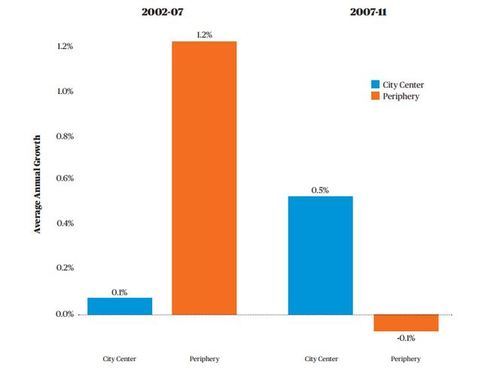
    We know that urban living has been seeing a renaissance over the last decade or so, but as recently as 2002 – 2007 (pre-Great Recession), the suburbs and peripheral areas were still seeing significantly higher job growth: 1.2% per year in the periphery versus 0.1% in the city center. The “city center” is defined as a 3 mile radius around the center of the city in this study.

    However since 2007 things have flipped:

    image

    Chart Source: City Observatory

    Why is this happening? Here’s a snippet from City Observatory:

    The strength of city centers appears to be driven by a combination of the growing attractiveness of urban living, and the relatively stronger performance of urban-centered industries (business and professional services, software) relative to decentralized industries (construction, manufacturing) in this economic cycle. While it remains to be seen whether these same patterns continue to hold as the recovery progresses, (the latest LEHD data on city center job growth are for calendar year 2011), there are structural forces that suggest the trend of center-led growth will continue.

    In some ways, it just makes intuitive sense. People started returning to cities and so the jobs followed (although there were also structural changes to the economy). 

    The big question, however, is whether this trend will continue? My bet is on yes. What do you think?

  • Thoughts on urban renewal and Geary Avenue

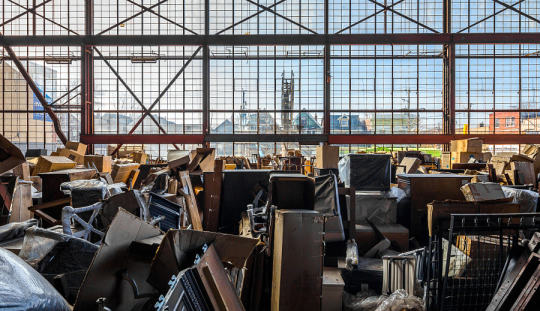
    Photograph dupont survivor by Josemaria de Churtichaga on 500px

    dupont survivor by Josemaria de Churtichaga on 500px

    I was on CBC radio this morning talking about the revitalization of Dovercourt Village and Geary Avenue in Toronto. 

    The funny thing about this topic is that it’s one I actually held off writing about. I’ve been thinking about this street and area for probably about 5 years now. However, I do have to keep some secrets to myself 🙂

    But then I started feeling like the cat was already out of the bag. Everyone in my circle was talking about it. So I wrote a post calling Dovercourt Village the next Ossington. I had no idea it would get the traction that it has gotten, but in hindsight it makes total sense. It makes a great headline: “Toronto’s ugliest street to become the next Ossington.” Boom.

    The tough question that Matt Galloway asked me this morning was: What happens to all the blue collar businesses when/if Geary Avenue and the area really takes off? My response – given that it was only a 5 minute radio piece – was that it comes down to preservation vs. progress. 

    This is a topic that I’ve written about with respect to heritage buildings, but the same concept applies to communities as well. How do you allow neighborhoods to receive new investment while at the same time not erasing its past and the things that made it interesting in the first place?

    It’s not easy, that’s for sure.

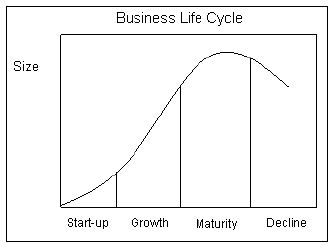
    I absolutely believe that there are things that developers can do to respect the neighborhoods in which they build in. But at the same time there are economics at play. In business school, they teach you this:

    It’s the lifecycle of businesses and industries. 

    The key takeaway here is that the rise and decline of businesses is actually quite healthy for markets. History is littered with examples. The word processor replaced the typewriter. The mobile phone replaced the landline. Air travel replaced rail travel. And the list goes on.

    Today, I think we’re at a moment in time where our relationship to cars is changing dramatically. How we get around and how we own and operate them is being called into question. 

    So just because there’s auto shops on Geary Avenue today, doesn’t mean they’ll be there tomorrow regardless of whether the area takes off or not.

  • Our economy doesn’t suck

    image

    On Friday my friend Paul Crowe (of BNOTIONS) wrote the following Facebook post (rant) about the retail landscape here in Canada. It was a direct response to the claims that the recent loss of Target, Mexx, and Sony is “a warning sign for our economy.” If the text is too small below, you can also click here to read it on my wall.

    image

    I would say that competition did impact these retailers, but the key message remains the same: there’s nothing wrong with failure and companies going out of business (although success is obviously a more ideal outcome).

    And it shouldn’t necessarily be interpreted as a bad thing for our economy. In fact, a lot of the time it’s something quite healthy. When companies stop being competitive, the market is supposed to punish them. That’s how this game works.

  • Tech is now the second largest job sector in New York City

    According to a recent report called Building a Digital City, which I found via Fred Wilson’s blog, tech is now the second largest job sector in New York City behind financial services (which includes real estate). There are an estimated 262,000 tech workers in the city earning wages in excess of $30 billion.

    This is a really interesting stat that speaks to the diversity of New York’s economy and the ability for it to continually reinvent itself. But what I found particularly interesting, was the following comment by Fred Wilson:

    “And the reason tech is growing so fast in NYC is that it is embedding itself in all of these other industries. It’s not entirely clear to me whether Gilt is a tech company or a fashion/retail company, it is not clear to me whether ZocDoc is a tech company or a health care company, it is not clear to me whether Codecademy is a tech company or an education company.”

    This is very much the way I think about so called tech companies today. I recently had a Rotman colleague say to me that he felt the startup world was becoming saturated. Everyone is now seemingly working on some new app.

    But I like to think of it slightly differently. As Fred’s comment above suggests, a lot of startups today aren’t purely tech companies. They’re just out to solve a problem and it just so happens that technology and the internet are creating all sorts of opportunities for new solutions.

    I also read a blog called Platform Connected and the author put it like this:

    “In the future, every company will be a tech company. We already see this change around us as companies move to restructure their business models in a way that uses data to create value. We are moving from linear to networked business models, from dumb pipes to intelligent platforms. All businesses will need to move to this new model at some point, or risk being disrupted by platforms that do.”

    So there you have it. Software really is eating the world.