Daily insights for city builders, delivered every morning at 6 AM ET. I’m Brandon Donnelly — a Toronto-based real estate developer and founder of Globizen. I’ve been writing here since 2013.

Tag: industrial real estate

  • New ideas like buildings people don’t want

    There is a very common story that plays out in cities. It starts with an area that has seen disinvestment and is probably a little seedy and/or dangerous . This creates an environment where rents and real estate as a whole are relatively inexpensive. New, cool and creative businesses start to move in (attracted by said inexpensiveness) and the area begins to turn around. Eventually it becomes suitable for institutional-type investors, and this ultimately leads to everything becoming expensive as a result of demand outstripping supply. Gentrification complete.

    The great irony of this story is that you sometimes, or oftentimes, lose the very things that made the area cool and interesting in the first place. Here is an example from Miami:

    The result has been a property speculation boom that, when combined with the city’s relatively low wages, put many businesses and residents on the street. Asking rents for industrial space, for instance, went up by 53 percent in the last year alone. Nobody can afford to buy, let alone rent, adequate space for a music venue because so much land has been snapped up by outside investors with a predilection for grand, “world-class urban” designs

    And for some areas, it is arguably the result of a careful and deliberate plan that was put in place nearly two decades ago:

    Teele’s commissioner district in the early 2000s included both Park West and the historically Black neighborhood of Overtown. At the turn of the millennium the area was blighted and crime-ridden thanks to years of racist, regressive policy decisions from segregation to redlining. His plan was simple but incredibly effective. He spearheaded a campaign to revitalize the area by granting a limited number of 24-hour liquor licenses to clubs like Space. Dozens of venues rose up on and around 11th Street, including vast, multi-room clubs like Metropolis, live venues like Studio A and Grand Central, and more intimate spots like Vagabond. Sporadic police raids also gave the area a druggy, dangerous reputation, inadvertently raising its allure. 

    This reoccurring arc has led some people to conclude that cities and/or areas seem to want to follow a kind of binary outcome: they’re either dying or they’re too successful. Why can’t we just have urban homeostasis? I don’t think this is necessarily always the case. Cities go through cycles just like any other market. I also know that it’s complicated. But I do feel strongly that we need to be mindful that part of what makes cities such wonderful places is that they are factories for new ideas and creativity.

    I can’t remember when or exactly how he said it, but YouTuber Casey Neistat once described New York City as an incredible island (Manhattan?) where misfits from all over the world come to do whatever the hell they want. And that part of the reason for this is that nobody cares what you do, because everyone is just so damn busy. You could certainly argue that New York isn’t what it used to be. But the lesson here remains the same: Cities are at their best when they allow humans to create, build, experiment, and express themselves.

    And oftentimes a great place for that is in a space that nobody else wants.
  • From retail to logistics

    Over the past few weeks we’ve been talking about the future of the mall on this blog. It’s a topic that I’m very interested in.

    Yesterday the Wall Street Journal published an article talking about the trend of converting retail/shopping facilities to logistic centers. 

    Here’s an excerpt:

    “In Mesquite, Texas, FedEx Corp. next month will open a 340,000 square-foot distribution facility on what once was the site of the former Big Town Mall. Located along U.S. Highway 80 in Texas, the mall declined after newer malls were built nearby. It was demolished in 2006 and the land was later rezoned for industrial use.”

    It turns – and we’ve talked about this – that good retail locations are also good distribution locations. They are usually located close to humans and infrastructure.

    Here’s another example from the article:

    In North Randall, Ohio, Amazon.com Inc. is considering the site of the former Randall Park Mall as a fulfillment center, according to Port of Cleveland, a local government agency focused on spurring job creation and economic growth in Cuyahoga County. Amazon didn’t immediately respond to requests for comment.

    For a short time when it opened in 1976, Randall Park Mall was the largest shopping center in the world and had been “a thriving heartbeat” for the local economy, according to Mr. Davis. But the mall closed in 2009 as stores struggled with fewer shoppers.

    Assuming this trend continues and people continue to buy things online, one has to wonder about the placemaking that should or needs to happen in these areas.

  • Online shopping and “last mile” real estate

    The Globe and Mail recently published an excellent article on “how e-commerce is driving a real estate revolution.” This is a topic that I’m very interested in: how online manifests itself offline.

    Not surprisingly, the article talks a lot about Amazon, including their 4th warehouse in the Greater Toronto Area, which is an 850,000 square foot facility in Brampton equipped with 350-pound robots (8050 Heritage Road).

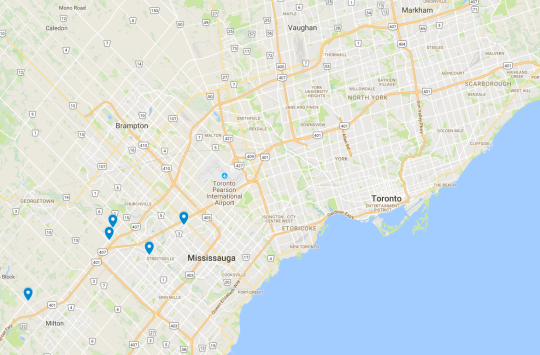
    The first thing I did after reading the article was figure out the location of all of Amazon’s fulfillment centers in the GTA. Amazon doesn’t seem to publish this. But according to TaxJar, they are here (I mapped out the addresses):

    There are two in Brampton at the precise location where Hwy 407 (toll route) and Hwy 401 meet. The other three are distributed along Hwy 401 in Milton and in Mississauga.

    Now let’s get back to that Globe and Mail article:

    – In 6 years, Amazon has leased over 2 million square feet of warehouse space in Canada.

    – Toronto is the third largest warehouse market in North America. It represents 43% of Canada’s total inventory.

    – Average net rents have increased 9.7% over the past year and vacancy rates have dropped to 2.7% (CBRE data). In Vancouver, those same numbers are 5.1% and 3%, respectively.

    – Online shopping is thought to account for about 6.5% of all retail sales in Canada. But in Toronto, 23% of all industrial space is already e-commerce-related (CBRE data, again).

    – CBRE believes that every $1 billion in new online sales per year requires an additional 1.25 million square feet of warehouse space. 

    – Based on online sales projections, Canada needs another 27.5 million square feet of industrial space over the next 5 years. We don’t have that much space in the pipeline.

    – Clear heights are increasing for stacking purposes. Amazon’s new Brampton facility is 45 feet tall / 4 floors. 10 years ago new warehouses were 26 feet tall.

    – Average sale price of warehouses in the GTA has gone from $119.35 psf to $142.19 psf over the last year.

    Perhaps the most interesting takeaway from the article is the discussion around “last mile” distribution hubs. These are fulfillment centers located closer to the city, which are used to offer shorter delivery times: 

    “…instead of having inventory stored for days or months, these fulfilment centres will turn over their inventory in one day, sometimes twice a day.”

    This is something that I addressed in my recent presentation about the “mall of the future” at B+H’s retail design charrette. Where do these physical distribution centers want to be as online sales continue to grow and delivery times continue to compress? Where’s the future growth?

    According to this article, it’s going to be in “last mile” fulfillment real estate – relatively smaller spaces that are located very close or directly in the city center.

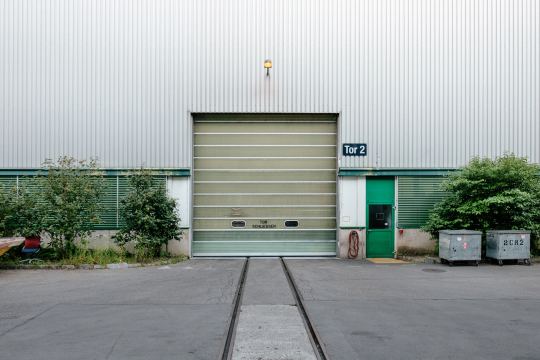
    Photo by Samuel Zeller on Unsplash

  • Marginal cost = 0

    Earlier this week I wrote a post called: The pull from services to products. And in it I made mention of the fact that part of what’s driving this pull towards products is that the marginal cost of servicing additional users or customers is almost nothing in a world of internet services and products.

    Well the reality is that this phenomenon is driving a hell of a lot more. It could – and probably will – fundamentally change almost all aspects of the economy.

    I know that sounds like a pretty audacious statement, but if you watch the following 10 minute talk by Albert Wenger (Union Square Ventures) you might start to feel the same way. He outlines 5 changes being driven by the fact that in the digital world, marginal cost = 0. The impacts go well beyond tech, capturing sectors such as transportation and industrial real estate.

    [youtube https://www.youtube.com/watch?v=sVEtTzlqsoE?rel=0]

    If you can’t see the video, click here.