
Daily insights for city builders, delivered every morning at 6 AM ET. I’m Brandon Donnelly — a Toronto-based real estate developer and founder of Globizen. I’ve been writing here since 2013.

Tag: ibuying

  • Who owns single-family houses in the US

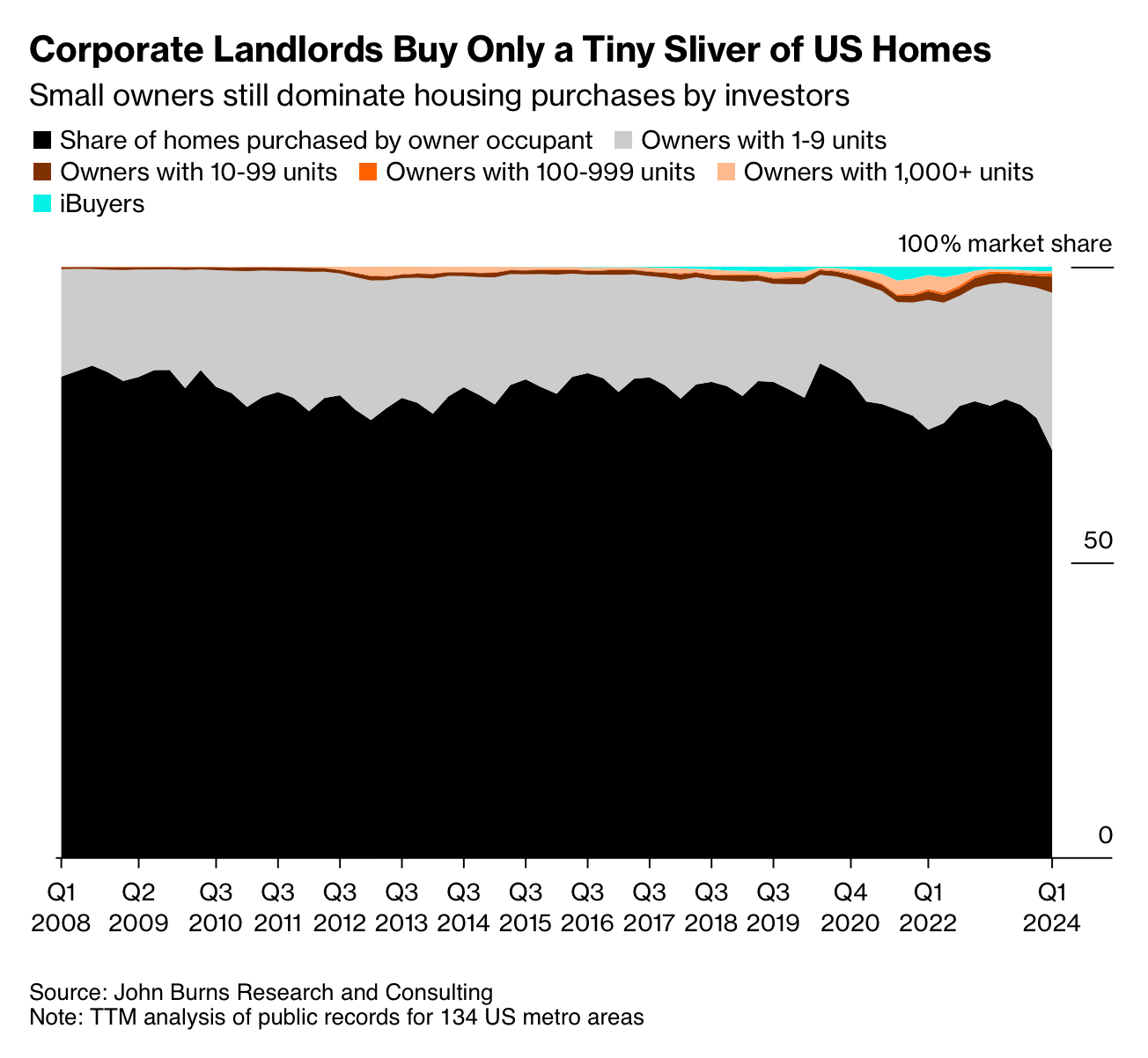
    Here is a chart from a recent Bloomberg article summarizing who owns single-family houses in the US.

    As of Q1-2024, about 69% were owner-occupied, about 26.6% were owned by small landlords (1-9 homes), and the rest were owned by what many are now calling “corporate landlords.”

    The point of this graph was to show that, despite getting a lot of political attention, corporate landlords still own very little. Let’s call it sub 4%, excluding iBuying companies like OpenDoor. So how much of a problem is this, really?

    Smaller landlords control much more of the US market. And at the end of the day, a house owned by a small landlord versus a corporate landlord doesn’t change the supply-demand balance of a market. It still represents an available home.

    The first and more important problem to solve is overall housing supply. Because that does change the supply-demand balance of a market. And once again, there’s no shortage of data to support the finding that increased supply tends to moderate rental growth.

    For the record, I also dislike using the term home to refer to single-family houses. Home is not a housing type. It is simply a place where people live permanently. So whenever I see a title like “US homes,” I get confused, because I don’t actually know what they’re referring to.

    If you read the article, it would appear they’re only talking about single-family houses. But implying that these are the only kind of home feels to me like an anachronism.

  • Thoughts on Opendoor Exclusives

    My most recent post about Opendoor, the so-called iBuying company, is about how it wants to become the “transaction layer for homes.” What that means is they would like to start facilitating third-party transactions between buyers and sellers, and move away (either partially or completely) from actually owning homes for a period of time.

    The company is still trying to sell homes that it purchased in Q2-2022, which, as we all know, was a very different kind of housing market. So by doing this, Opendoor would be both reducing the market risk that it takes on and making its business model less capital intensive.

    Knowing this, I actually think that “iBuyer” is the wrong moniker for their business. As I see it, the long-term objective is not to just be an iBuyer of homes. The objective is to ultimately facilitate transactions in a capital efficient kind of way. The point of iBuying is/was to seed their two-sided marketplace with sellers.

    As we have discussed before, two-sided marketplaces usually always have a chicken-and-egg problem. No sellers equals no buyers, and vice versa. So you have to figure out a clever way to attract one side. Of course, now that Opendoor has sellers, the company can start to aggregate the demand side (i.e. buyers). And that is exactly what it is doing with Opendoor Exclusives.

    Exclusives works like this:

    • The inventory consists of “off-market” homes that have yet to be listed on MLS
    • The homes are discounted about 2-4%
    • They are available for 14 days
    • You can’t negotiate the price — it’s first come, first served
    • If your appraisal comes in lower, Opendoor will price match
    • And finally, Opendoor will not pay any buyer commissions (which is reflected in the above discount)

    As I understand it, if the home doesn’t sell, it then gets listed on MLS and all of the normal terms and practices would apply. But before that happens, the key objective is to facilitate a quick transaction in one of two ways.

    The first way is for the seller to request an offer from Opendoor’s network of buyers. In this scenario, Opendoor never needs to own the home or perform any improvements (which is usually what it does when it iBuys). It is an intermediary earning some sort of take.

    The second way is for Opendoor to do its usual thing and make an instant offer to buy the home. But here’s the thing. With enough buyers on its platform and by creating a sense of urgency (hey, here’s a lower price!), presumably the idea is that it may never need to close on a number of these homes. It just needs to find another buyer within 14 days.

    If it works, this could be an interesting business.

  • Opendoor is creating too many rentals

    Steven Levy over at Wired recently wrote a short piece comparing Opendoor’s iBuying approach to what Zillow was doing when it was in the space. (Thank you Robert Wright for forwarding me the article.)

    As we have talked about before, the fundamental problem with Zillow’s model is that it couldn’t accurately predict where home prices were going. It was losing too much money and so they shut down that side of their business.

    The article talks about Opendoor’s approach and how they’ve spent the last 8 years refining a valuation model/approach that is now apparently pretty accurate. That’s positive. But here’s another excerpt that I found particularly interesting:

    There’s one controversial aspect of the business model that Wong didn’t bring up. It appears that when companies like Zillow and Opendoor can’t easily sell a home, the fallback is what’s called an “institutional sale.” All iBuyers sell a small but not insignificant percentage to institutional investors with aspirations of being “mega-landlords.” While the marketing materials of the iBuyers emphasize clean sunny rooms and frictionless transactions, that segment of the market involves hedge funds like KKR and Blackstone snapping up properties for rental, limiting the inventory available for families seeking homes. Even the Biden administration has weighed in on the evils of this trend: “Large investor purchases of single-family homes and conversion into rental properties speeds the transition of neighborhoods from homeownership to rental and drives up home prices for lower cost homes, making it harder for aspiring first-time and first-generation home buyers, among others, to buy a home,” said a recent White House dispatch.

    It’s interesting for two reasons.

    First, these highly tuned valuation models are now being used to scale the acquisition of single family homes. No specific figures are given, but Levy speculates that some iBuyers could be feeding up to 20% of their homes to institutional buyers. Economies of scale are a challenge with this asset class. Here technology is helping.

    Second, I don’t like the tone toward renters in the above White House dispatch: “[It] speeds the transition of neighborhoods from homeownership to rental.” This line in particular implies that renting is perceived as being suboptimal to homeownership and that “speeding”’ towards the former is something that should be avoided for reasons of social good.

    Even the words that are used here suggest biases. A single-family home is called, well, a home. But a rented one is a rental property. I reckon that a home is a home regardless of whether it’s low-rise, high-rise, rented, or owned.

  • The Zillow postmortem

    The postmortems surrounding Zillow’s exit from the algorithmic home-flipping business are starting to surface. Here’s an article from the WSJ and here’s Matt Levine’s take on it. The latter piece is very Levine-like and is called, “Zillow tried to make less money.”

    The obvious story is that Zillow’s algorithms were not valuing homes correctly. But the story is more nuanced than this. In Q1 of this year, Zillow’s home flipping business was actually more profitable than it had initially expected. And that’s because its algorithms were consistently undervaluing homes. So when it did transact, it was doing so at favorable / low cost bases.

    The problem was that the company was not transacting enough and there was a fear of losing ground to competitors like Opendoor. Apparently only about 10% of people who requested an offer from Zillow actually ended up accepting it. Margins were good, but volumes were too low.

    So what Zillow did was tweak its algorithm to be more aggressive (see above chart from the WSJ). But this created the opposite problem: low/negative margins, higher volumes.

    Once again, it shows you some of the challenges with bringing real estate online. The supply of homes is largely heterogenous and there are a lot of qualitative factors that play into what someone is willing to pay.

  • Zillow exits algorithmic home-flipping business

    Things are happening in the algorithmic home-flipping business right now.

    A few weeks ago I wrote about Zillow pausing this part of its business. It was then later revealed that the company was set to take a loss on many/most of the homes that it had purchased through this “iBuying” division. In October, it listed some 250 homes in Phoenix and on average they were priced about 6.2% below what they had bought them for.

    So it is perhaps no surprise that today the company announced that it will be the exiting the business of buying high and selling low. Turns out this isn’t good for business.

    But does this mean that the model doesn’t work or that Zillow simply didn’t have its algorithms tuned correctly? Following the news, competitor Opendoor took to Twitter to reassure everyone that the digitization of real estate is still well underway:

    Opendoor also announced today that it will be expanding technical hiring into Canada — starting first with Toronto. The plan is to hire upwards of 100 people over the next several years. Presumably this is about access to talent, but presumably it also means that Opendoor is looking toward one day expanding into Canada.

    Stay tuned.

    Disclosure: I continue to be long $OPEN.

  • Zillow pauses algorithmic homebuying business

    Zillow just announced that it has paused its (algorithmic) US homebuying business for the remainder of this year. The company acquired some 3,800 homes in Q2 of this year and, apparently, it now has a backlog of repairs and sales to work through. As a reminder, this business model, which is sometimes referred to as iBuying, is based on using algorithms to quickly value and buy homes (mostly online). The homes are then renovated and flipped for a profit. The problem, as most of you know, is that this pandemic has, among other things, disrupted construction supply chains and made it difficult to hire people. That has hurt the renovation component of this model.

    Today’s news was bad for Zillow’s stock, but good for Opendoor’s stock, which is their main competitor. Opendoor subsequently came out and announced that they remain open for business. (Disclosure: I am long $OPEN). But this announcement is perhaps a good reminder that buying and selling real estate remains a different animal than, say, buying and selling stocks. And so there are some perfectly understandable reasons for why real estate hasn’t been disrupted by the internet in the same way that other industries have. Matt Levine does a great job explaining this in his recent column, “Sorry, Zillow’s Computer Can’t Buy Your House Right Now.”

    Here’s an excerpt:

    “I’ll pay you $350,000 for your house as long as a human can go out there, look around, and make sure that price isn’t wildly off” is an interesting model but it’s not quite the same as “push this button to sell your house for $350,000.” And “I’ll pay $350,000 for a house and then send out a crew to replace the carpets” is not quite the same as “I’ll pay $350,000 for a house and flip it 20 minutes later for $355,000, collecting a small spread for providing liquidity.” Computerization has come into the housing market, but it hasn’t taken it over yet.

    One of the challenges is that the supply of homes is heterogeneous, even in a suburban community or in a multi-family building where you might have the same set of floor plans that repeat. Because maybe the home has been renovated and fit out entirely in gold. Or maybe it’s the opposite and it has been poorly maintained. There are variables to contend with that have historically necessitated more rather than less human involvement. Homes are also something that don’t trade all that frequently, which is less than optimal when it comes to online marketplaces.

    But what if buying and selling a home was dramatically cheaper and easier to do? How often would people actually do it? Presumably more often. I agree with Matt that “computerization” hasn’t taken over the real estate industry just yet. But algorithmic homebuying still appears to be one of the more promising approaches.

  • Knock knock — more on Opendoor

    Packy McCormick’s latest “Not Boring” essay is up and it’s about Opendoor. It’s a good follow up to last week’s announcement.

    Maybe that’s why housing is one of the last major categories that technology has left alone. Sure, companies have tried. Tons of them. The startup graveyard is filled with companies led by entrepreneurs who realized that the way we buy and sell homes sucks, but couldn’t ultimately figure out how to change it. They weren’t thinking big or long-term enough. The companies that have made the biggest impact, like Zillow and Redfin, make it easier to search for houses, but then kick buyers over to agents to go through the offline process, the same way it’s always been done. 

    This is topic/problem that is near and dear to me because I spent a year of my life working on a startup that initially set out to solve this exact problem. But like countless others, we couldn’t figure out how exactly to change things. So we pivoted.

    Has Opendoor finally cracked the code? I don’t know. But they’re on to something. It is, however, worth noting that the company was founded in 2013. And so what is happening today is already 7 years in the making — and probably longer if you consider the founder’s past startups.

    Tough problems clearly require time. Money doesn’t hurt either.

  • A transactional real estate marketplace

    I would like to revisit the post that I wrote last week about the Brazil-based real estate startup, Loft. In it, I said that they are doing in Brazil what Opendoor, and others, are doing in the US. They are buying and flipping homes using algorithms. This has become known as “iBuying” and we’ve talked about it a lot here on the blog.

    But we have also talked about how this is probably not the end game. These companies are seeding a marketplace, because in every new two-sided marketplace you are always faced with a chicken-and-egg problem. You can’t attract supply if you don’t have demand. And you can’t attract demand if you don’t have supply.

    In reading the investment announcement by a16z, this larger vision is pretty clear:

    They [Loft] are building a transactional marketplace for the biggest asset class in the world, starting in the biggest market in Latin America, on a time horizon that makes it hard to believe it’s been less than a year since the PowerPoint. They buy homes, fix them (often according to formulaic specifications provided by active buyers), and sell them — what is now known as “i-buying,” with the vision of turning this into a transactional marketplace.

    If successful, these companies will transform from just “iBuyers” to fully fledged marketplaces for the buying and selling of homes. And when that happens (I believe it’s a when), it is likely to mean dramatic changes to the commissions landscape. Today, over $100 billion in residential real estate commissions are paid out across the United States each year.

  • Algorithmic home buying expands to Los Angeles

    Algorithmic home buying companies (or iBuyers) have now started to expand into Los Angeles. If you recall, most of these companies started in smaller markets where the homes are more homogenous, relatively inexpensive, and generally less liquid. Places like Phoenix.

    By tackling the second largest housing market in the US (after New York City), the algorithms of Opendoor, Redfin, and Zillow will now need to content with an older housing stock, greater variability, and higher values.

    All of these companies have increased their maximum offer price. The sweet spot for algorithmic home buying has typically been in the $150,000 to $300,000 range. Last year, two-thirds of all homes bought by iBuyers were in this range. I can’t imagine that gets you very much in LA.

    I keep expecting these companies to scale into something more beyond just iBuying and flipping. Perhaps we will see that happen once they establish themselves in country’s biggest markets.

    Photo by Josh Rose on Unsplash