
Daily insights for city builders, delivered every morning at 6 AM ET. I’m Brandon Donnelly — a Toronto-based real estate developer and founder of Globizen. I’ve been writing here since 2013.

Tag: ibuyer

  • Who owns single-family houses in the US

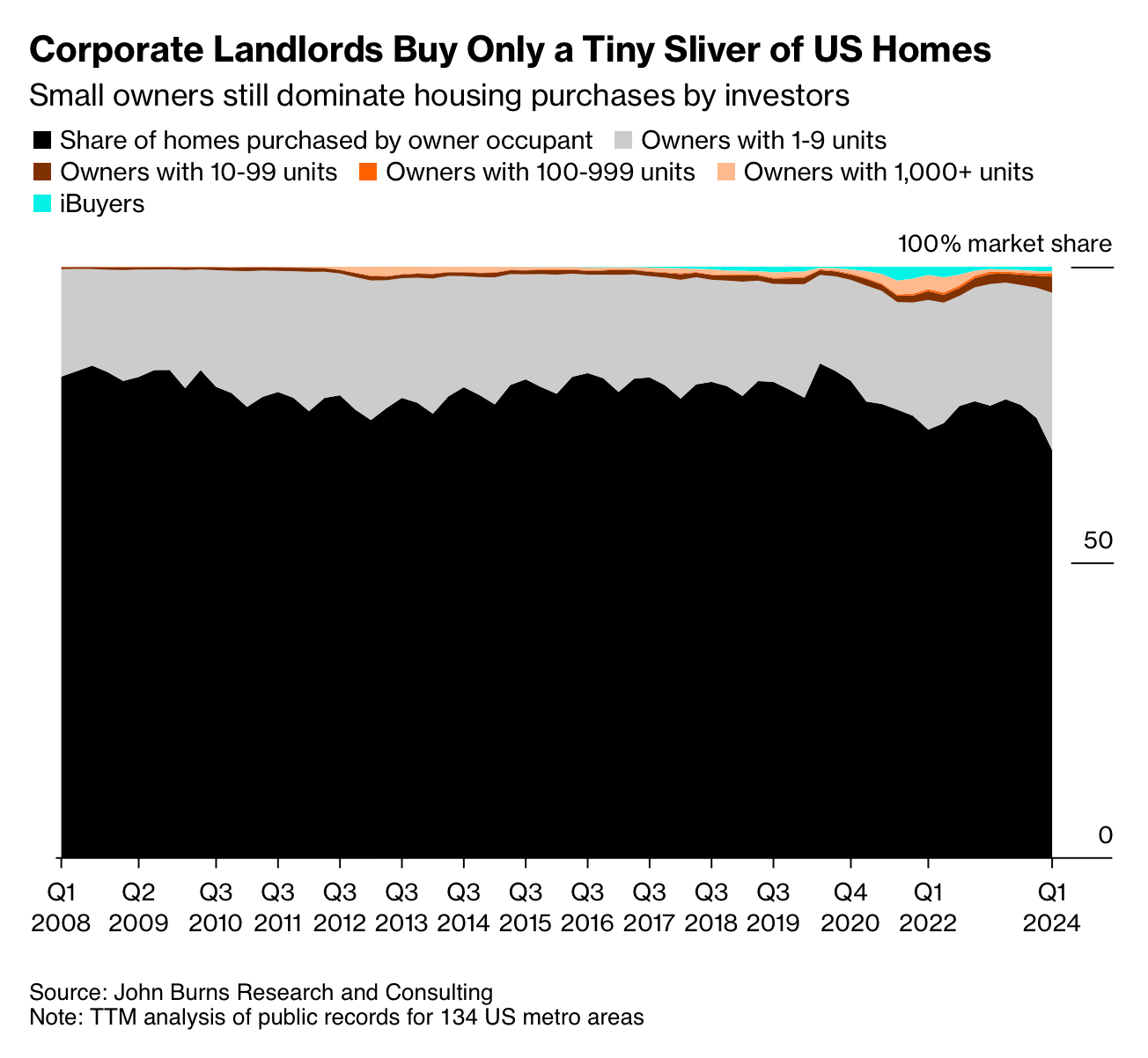
    Here is a chart from a recent Bloomberg article summarizing who owns single-family houses in the US.

    As of Q1-2024, about 69% were owner-occupied, about 26.6% were owned by small landlords (1-9 homes), and the rest were owned by what many are now calling “corporate landlords.”

    The point of this graph was to show that, despite getting a lot of political attention, corporate landlords still own very little. Let’s call it sub 4%, excluding iBuying companies like OpenDoor. So how much of a problem is this, really?

    Smaller landlords control much more of the US market. And at the end of the day, a house owned by a small landlord versus a corporate landlord doesn’t change the supply-demand balance of a market. It still represents an available home.

    The first and more important problem to solve is overall housing supply. Because that does change the supply-demand balance of a market. And once again, there’s no shortage of data to support the finding that increased supply tends to moderate rental growth.

    For the record, I also dislike using the term home to refer to single-family houses. Home is not a housing type. It is simply a place where people live permanently. So whenever I see a title like “US homes,” I get confused, because I don’t actually know what they’re referring to.

    If you read the article, it would appear they’re only talking about single-family houses. But implying that these are the only kind of home feels to me like an anachronism.

  • Thoughts on Opendoor Exclusives

    My most recent post about Opendoor, the so-called iBuying company, is about how it wants to become the “transaction layer for homes.” What that means is they would like to start facilitating third-party transactions between buyers and sellers, and move away (either partially or completely) from actually owning homes for a period of time.

    The company is still trying to sell homes that it purchased in Q2-2022, which, as we all know, was a very different kind of housing market. So by doing this, Opendoor would be both reducing the market risk that it takes on and making its business model less capital intensive.

    Knowing this, I actually think that “iBuyer” is the wrong moniker for their business. As I see it, the long-term objective is not to just be an iBuyer of homes. The objective is to ultimately facilitate transactions in a capital efficient kind of way. The point of iBuying is/was to seed their two-sided marketplace with sellers.

    As we have discussed before, two-sided marketplaces usually always have a chicken-and-egg problem. No sellers equals no buyers, and vice versa. So you have to figure out a clever way to attract one side. Of course, now that Opendoor has sellers, the company can start to aggregate the demand side (i.e. buyers). And that is exactly what it is doing with Opendoor Exclusives.

    Exclusives works like this:

    • The inventory consists of “off-market” homes that have yet to be listed on MLS
    • The homes are discounted about 2-4%
    • They are available for 14 days
    • You can’t negotiate the price — it’s first come, first served
    • If your appraisal comes in lower, Opendoor will price match
    • And finally, Opendoor will not pay any buyer commissions (which is reflected in the above discount)

    As I understand it, if the home doesn’t sell, it then gets listed on MLS and all of the normal terms and practices would apply. But before that happens, the key objective is to facilitate a quick transaction in one of two ways.

    The first way is for the seller to request an offer from Opendoor’s network of buyers. In this scenario, Opendoor never needs to own the home or perform any improvements (which is usually what it does when it iBuys). It is an intermediary earning some sort of take.

    The second way is for Opendoor to do its usual thing and make an instant offer to buy the home. But here’s the thing. With enough buyers on its platform and by creating a sense of urgency (hey, here’s a lower price!), presumably the idea is that it may never need to close on a number of these homes. It just needs to find another buyer within 14 days.

    If it works, this could be an interesting business.

  • Zillow exits algorithmic home-flipping business

    Things are happening in the algorithmic home-flipping business right now.

    A few weeks ago I wrote about Zillow pausing this part of its business. It was then later revealed that the company was set to take a loss on many/most of the homes that it had purchased through this “iBuying” division. In October, it listed some 250 homes in Phoenix and on average they were priced about 6.2% below what they had bought them for.

    So it is perhaps no surprise that today the company announced that it will be the exiting the business of buying high and selling low. Turns out this isn’t good for business.

    But does this mean that the model doesn’t work or that Zillow simply didn’t have its algorithms tuned correctly? Following the news, competitor Opendoor took to Twitter to reassure everyone that the digitization of real estate is still well underway:

    Opendoor also announced today that it will be expanding technical hiring into Canada — starting first with Toronto. The plan is to hire upwards of 100 people over the next several years. Presumably this is about access to talent, but presumably it also means that Opendoor is looking toward one day expanding into Canada.

    Stay tuned.

    Disclosure: I continue to be long $OPEN.