Daily insights for city builders, delivered every morning at 6 AM ET. I’m Brandon Donnelly — a Toronto-based real estate developer and founder of Globizen. I’ve been writing here since 2013.

Tag: hst

  • No more sales tax on new rental housing

    Big news today in development land. The federal government just announced that it has removed sales tax (GST/HST) from new rental housing effective immediately. This is a significant step in the right direction, and something that we have spoken about many times before on the blog.

    Here’s how things used to work:

    In the case of a newly constructed or substantially renovated multiple-unit residential complex or addition to a multiple-unit residential complex, the builder must generally self-assess GST/HST on the fair market value of the whole of the substantially completed multiple-unit residential complex or addition when possession of the first unit is given under a lease, licence or similar arrangement as a place of residence of an individual.

    What this is saying is that if you build new rental housing, and even if you plan to continue owning it forever, you need to determine the fair market value of the property and then pay HST on that amount. In Ontario, the HST rate is 13%. However, the effective rate was a bit lower because of new rental rebates. Let’s say it was somewhere around 11%.

    Now that this no longer needs to be paid, a lot of rental projects that were flirting at the margin should suddenly make economic sense. Which is why I tweeted earlier today that every housing developer in Canada is right now dusting off their “what if we built rental” development pro forma. It didn’t work yesterday, but maybe it does today!

    Today is a good day for new rental housing supply in Canada.

    Update: This announcement only relates to the federal portion of the HST. The feds are now calling on provinces to follow suit.

  • Two ideas for increasing the supply of new rental housing

    There are lots of ideas out there for how to improve the supply of new rental housing. But it is important to remember, at least here in our market, that the playing field is not level between new condominiums and new rental homes. We have spoken about this before, over here, where I compared the (per square foot) revenue generated from your average new condo against that generated by your average new rental home. Of course, since I wrote that post in 2020, we have seen upward pressure on cap rates (meaning downward pressure on values). So feasibility has gotten even more challenging.

    The important thing to remember is that developers do not have some philosophical aversion to building more rental housing; it is that the math is challenging. You generally need economies of scale (really big projects), patient long-term capital, and a belief that rents will continue to exhibit meaningful positive growth. If you want to negatively impact new supply, cap rental growth. But if you want to encourage new supply, somebody needs to pull out a development pro forma and make the call to improve the cost structure for new rental housing.

    In my opinion, two obvious line items to focus on are development charges (as well as the other government levies) and HST (our harmonized sales tax). The point of development charges, as we always talk about, is for growth to pay for growth. They are intended to pay for municipal services like roads, transit, water and sewer, and so on. In the other words, they’re supposed to capture of the cost impacts of new housing. But what about the impact of not building enough new rental housing? Are we thinking about this the right way? Especially if you consider the possibility of more new rental housing in our existing transit nodes.

    The HST charged on new rental housing is also significant. There is a new residential rental property rebate available to builders (not tax advice!), but the thresholds have not been indexed and so it’s grossly out of date compared to where values sit today. In any event, if the goal is more homes, why not make new rental homes exempt? Developers are simple. If the math works, they will build. If the math doesn’t work, they will not build. And these two line items, alone, would go a long way to helping the former.

    Photo by Pierre Châtel-Innocenti on Unsplash

  • What tax policy could be doing to home sizes in Ontario

    Golden City (of Toronto) by Evgeny Tchebotarev on 500px.com

    https://500px.com/embed.js

    In yesterday’s post I made a remark that we have antiquated tax policies here in Ontario that encourage the building of smaller new construction condominiums. There seemed to be a lot of interest in that comment, and so I’d like to talk about that today.

    Some people thought I was referring to development charges, but I was actually thinking of the GST/HST New Housing Rebate in Ontario

    The way it typically works in Ontario is that when buy a new construction home, the price you pay is inclusive of HST (harmonized sales tax) and net of any applicable rebates, such as the rebate program mentioned above. 

    This means that the price you see on your agreement is usually the price you pay. I say usually only because there are ways that you could disqualify yourself from the New Housing Rebate program. But that’s a different post.

    So what does this mean in practice?

    Let’s say you went out and bought a new construction condo for $368,200 (there is a reason I’m picking what seems like an arbitrary number). If there was no such thing as the New Housing Rebate program, then the sales tax owing on this home would be the full 13%. And that would mean that the price paid before any taxes is actually $325,841 (x 13% = $368,200). This is an important number because it represents revenue to the developer.

    But since there is a New Housing Rebate program, the effective tax rate actually works out to be 5.20% for this particular sale price, which means that the price paid before any taxes is now $350,000 (a nice whole number). And so because of rebates and because they are now paying less HST, the developer’s revenue number has increased. It has gone from $325,841 to $350,000.

    The way this logistically works is that purchasers usually assign the New Housing Rebate benefits to the developer who then processes all the paperwork. This is what I mean when I say that the “sticker price” is inclusive of HST and net of any rebates – it already factors in the possible deductions.

    So far things are looking good. And I want to be clear that I don’t have concerns with the New Housing Rebate program in its entirety. In fact, it’s a hugely important part of the new home industry. Without it, many projects would simply not be feasible to build.

    However, as the price of the new home increases (which typically happens as the home gets bigger), the rebates start to fall off. The federal portion of the rebate maxes out at a base purchase price of $350,000 (which is why I chose that number) and the Ontario portion maxes out at a base purchase price of $400,000.

    What all this means is that as the unit sizes get bigger and more expensive, the effective tax rate is no longer at 5.20%, as was the case in the example I gave above. It increases. And if you hold prices constant for the purchaser, it means that the developer’s revenues now start to drop.

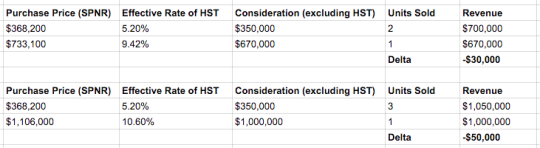
    To illustrate why this matters, consider the following chart:
    image

    In the first scenario, the developer builds and sells 2 units for a price of $368,2000. This translates into revenue of $700,000. However, if the developer instead decides to combine those 2 units and sell the larger single unit for $733,100 (roughly double the price) then the effective rate of HST goes up and revenue drops by $30,000.

    The second scenario is similar to the first one except that instead of 2 units, it’s 3 units which then get combined into one. Here revenue drops even further – by $50,000.

    Now, you could argue that there are some cost savings associated with building fewer suites, but I don’t think it would offset the differentials shown above, especially if you multiply those revenue numbers across an entire project. So what this all means is that it can be more profitable for developers to build smaller units priced below the thresholds mentioned above, as opposed to a smaller number of larger units. 

    Again, I’m not saying that HST rebates are bad. They’re critical to the industry. I love them. But I do believe we should be thinking about the possible implications that the current set up could be having on what we’re building and in particular on unit sizes.

    If you’d like to learn more about how the rebates work, check out this PDF from the Canada Revenue Agency. I tried to keep things simple in this post.
