Daily insights for city builders, delivered every morning at 6 AM ET. I’m Brandon Donnelly — a Toronto-based real estate developer and founder of Globizen. I’ve been writing here since 2013.

Tag: housing

  • The roaring twenties

    We’ve all heard stories or know people who have made the decision to leave the city during this pandemic, either temporarily or permanently. Some young people have moved home until things settle down and some people have sold their real estate and bought something outside of the city.

    I don’t know know what the exact numbers are, but you can see this trend being reflected today in downtown rental rates and other indicators. This is happening in many cities around the world.

    But here’s what I think about when I hear these stories:

    1) Are these people assuming that we will never go back to offices and that WFH is our new reality? In this case, the thinking is simple. The world has changed. I need a proper Zoom room and a home gym.

    2) Did these people never really like urban living or have they simply outgrown the city? Pre-pandemic, family formation was still a major pull away from downtowns for many. In this case, a move was going to happen regardless.

    3) Or are these people taking a short-term view of the world and forgetting/ignoring that our global cities are going to rebound and that 2 hour commutes really suck? (Sitting in front of Zoom all day is also no way to live in my opinion.)

    There are both positives and negatives to urban living. There are forces that make people want to centralize and there are forces that make people want to decentralize. And the reality is that many of the benefits and perks of living in a city are temporarily turned off right now.

    Things are not fun right now, but this isn’t going to last. I’m looking forward to the roaring twenties.

  • Is that delay really necessary?

    The big news this week in Toronto planning & development is the province’s decision to approve three downtown development projects using a tool known as a “ministerial zoning order.” The impetus for doing this was to speed up the approval and delivery of about 1,000 affordable housing units (along with about 2,000 market-rate units).

    The province has made it clear that it wants to do what it can to reduce red tape and unnecessary delays when it comes to building new affordable housing. But this, not surprisingly, upset a number of local councillors who feel the province is overstepping and not allowing the city to govern its own city building affairs.

    Alex Bozikovic’s view in the Globe and Mail this week was: hey, maybe that’s not so bad. The planning process is painfully slow (and political). And Toronto is going to need a lot more housing over the coming years and decades. So why not speed up its delivery? Especially when there’s an affordable housing component and the architecture is exemplary.

    The reality is that our housing delivery system is rife with tensions. A big part of the process is predicated on local voters, who already live in a particular place, opining on their own interests and on the interests of people who don’t yet live there. The incentives in place are anything but aligned.

    We can debate which level of government should have more power and what might be considered an unnecessary delay, but what is clear to me is that it should not take 2-5 years to get new housing approved in this city.

  • Super-prime property transactions in the first half of 2020

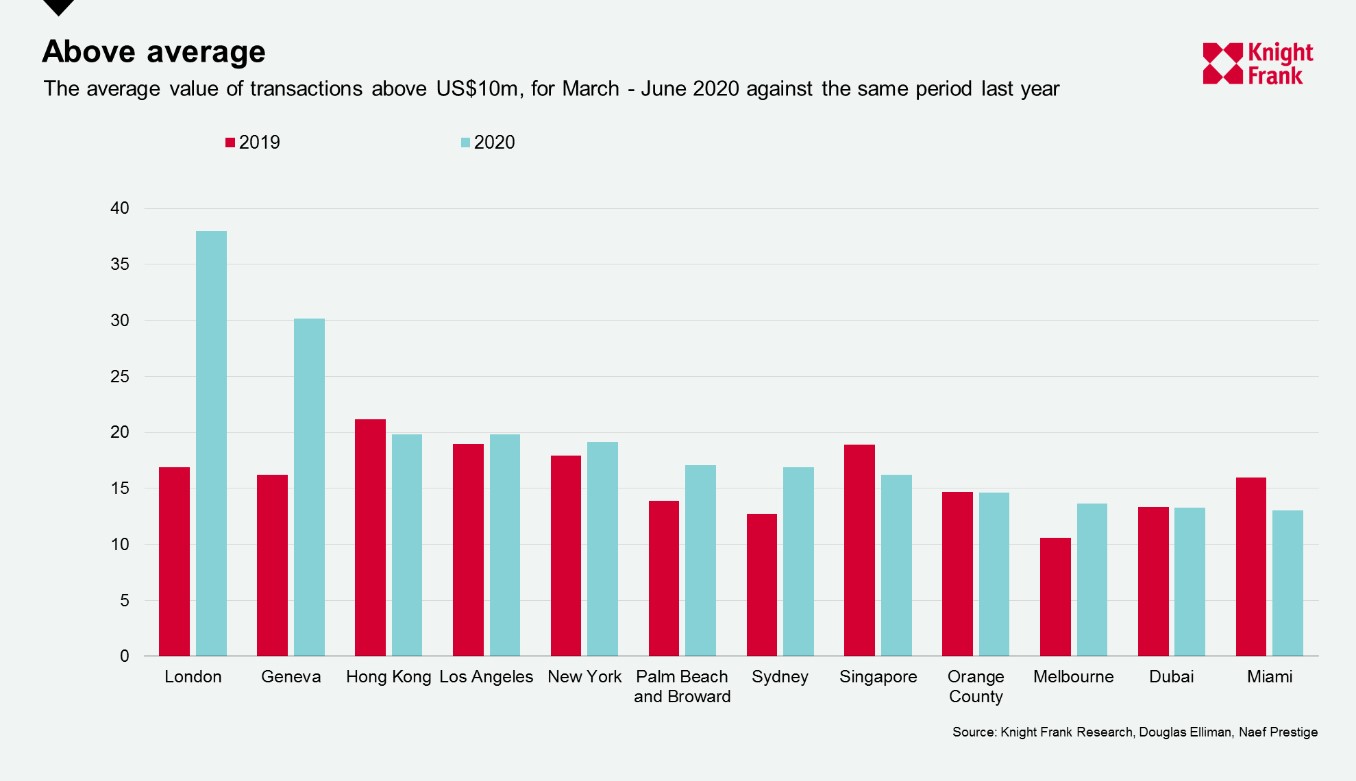
    This is a chart from Knight Frank showing the average value of “super-prime” residential real estate transactions in 12 global markets between March and June 2020, and versus the same period last year.

    Knight Frank classifies super-prime real estate as having a value greater than US$10 million and ultra-prime real estate as having a value greater than US$25 million.

    In this particular chart, London takes the top spot with an average super-prime transaction value of US$38 million. This is a big jump compared to 2019 where the average value was US$16.9 million.

    Typically it is Hong Kong that takes the top spot in this ranking, but this year it fell to third. Still, Hong Kong had the highest number of transactions with 60 super-prime sales taking place in the first half of 2020. This is down from 155 in the first half of 2019.

    Overall, Knight Frank recorded 281 super-prime transactions across these 12 cities in the first half of this year. This is, not surprisingly, a decline compared to last year, which saw 594 transactions over this same time period.

    But all things being considered and given some of these price increases, the super-prime market is certainly holding its own.

    Chart: Knight Frank

  • Were the Victorians better city builders?

    A team of researchers at UCL recently surveyed 2,500 households across the UK to see how the design of their homes and neighborhoods has impacted their experience during lockdown (May to June 2020).

    Perhaps most notably, the report, called Home Comforts, found that people living in housing built in the last 10 years were more likely to feel uncomfortable during lockdown (1 in 5), compared to those living in homes built before 1919 (1 in 7).

    On top of this, people living in Victorian era housing were more likely to say that their neighborhoods were meeting their everyday needs, which seems to translate into convenient access to basic amenities (5 to 10 minute walk).

    So what does this tell us?

    That people want more ornament and clearly defined Zoom-friendly rooms? That the Victorians were better at city and community building? Or maybe that Londoners living in low-rise pre-1919 housing are generally well-established and have the ability to afford more conveniences? It’s likely a bunch of different things.

    There’s no denying that the way we build our homes and our neighborhoods has, for better or for worse, changed over the last 100 years. But let’s not forget that it’s easy to romanticize the past and the things we used to do. I’m sure it wasn’t puppy dogs and ice cream for all of the Victorians.

  • Canadian real estate fundamentals

    Last week was the Vancouver Real Estate Forum. Benjamin Tal (chief economist at CIBC) opened things up, as he usually does, and he was pretty candid about what might be coming this winter. Here is an excerpt from a recent Globe and Mail article summarizing the event:

    “It’s reasonable to assume that the next six months will not be very pretty,” said Mr. Tal. “The honeymoon of the summer is basically over. Now we enter the winter months, and I think the next few months will be much more difficult. We will have a situation where we will clearly see a second wave, and it’s already starting. This second wave will overlap with the flu season, so everybody will be very confused. The fear factor will rise, and that’s something we have to take into account when we look at the trajectory of the economy.”

    Indeed, today kind of feels like the official start of the second wave. Here in Toronto, indoor dining, gyms, and a bunch of other things were just shut down for the next 28 days.

    But I think the more important takeaway from the article is this one here: the fundamentals around Canadian real estate remain incredibly strong. Another excerpt:

    “Let’s visit the market in 2023: I suggest the market will show the same trend we have seen in as 2019. This is a pause, but the fundamentals of the real estate market in Canada are so strong that the demand factor will continue to be there and supply will be limited. I suggest that after a two- to three-year period of some sort of softness, despite the V-shaped recovery that we are seeing, I see continuation of the trend.”

    As I’ve said before on the blog, it’s easy to get caught up in shorter-term and ephemeral headlines. But if one can look through some of that to the other side of this health crisis, I think we would all be in a position to make better decisions.

    As a general rule, I don’t like making long-term real estate decisions based on what is expected to take place in the next 6 months.

  • Percentage of young Americans now living with a parent

    Here’s some data from the Pew Research Center looking at the percentage of young people (18- to 29-year olds) in the US that live with at least one parent. It it based on an analysis of monthly Census Bureau data and is obviously interesting/relevant given that this pandemic seems to have precipitated a number of people moving back home. As of July of this year, 52% of young adults were thought to be living with at least one parent, which is up from 47% back in February.

    At first I was surprised to see these numbers as high as they are. But it’s really the 18-24 age bracket that is driving this number up, which makes sense given that a chunk of this demographic is probably in school, not working, and now unable to do much on a campus. Among 25- to 29-year olds, the range is significantly lower, with just over a quarter (26% -> 28%) living with their parent(s).

    What I’m curious about now, after seeing this chart, is what is driving some of these regional, ethnic, and gender differences? Why are young midwesterners seemingly less likely to live with a parent compared to those in the northeast? Is it cultural? Economic? Or something else? And is the above an indication that maybe women are more independent than men?

  • The paneláks of Prague

    At the beginning of this year (which seems like eons ago), I wrote about a CityLab series that Feargus O’Sullivan was doing on the vernacular home designs of a handful of European cities. Cities like London and Berlin.

    Well, after a brief pause, that series is back in the form of a CityLab “storythread.” It’s now called, “The Iconic Home Designs That Define Our Global Cities.” In it, he explores the various floor plans, housing typologies, and tenures that you might find around the world. Everywhere from from Singapore to Reykjavik.

    The most recent article is all about Prague’s communist-era apartments. Apparently people call these paneláks because they were initially built using some sort of collection of prefabricated panels. They were a quick and dirty housing solution for a city and country that were rapidly urbanizing starting in the late 1950s. (See, prefab works.)

    But what I find most interesting about the story of these paneláks is how their reputation seems to have changed and evolved over time. They proved to be a far more adaptable form of housing than you might initially think, going from written off and ready for demolition, in some cases, to then becoming a form of aspirational housing.

    Part of this allegedly had to do with a handover from state ownership to private ownership, which maybe goes to show you that architecture and design, alone, aren’t enough when it comes to housing innovation. You really need to consider the whole picture.

    But regardless, it is clear to me that tastes do change, and housing is no exception. Renewal is an integral part of urban life. And one generation’s trash might be another generation’s treasure.

    Photo by Jakub Matyáš on Unsplash

  • Everything has a cost

    A new report was just published by Urbanation and the Federation of Rental-Housing Providers of Ontario (FRPO) arguing that the Greater Toronto Area is undersupplying rental housing to the tune of about 20,000 units per year. This number considers both purpose-built rental housing and condominiums that are purchased by investors and later rented out. (Shane Dingman also covered the report in this recent Globe and Mail article.)

    These findings probably won’t come as a surprise to a lot of you. It is pretty common for most big/growing cities to operate with a perpetual housing supply deficit. With all of the barriers to development, it’s often impossible to keep pace with demand. This naturally creates upward pressure on pricing. But the other factor that cannot be ignored is development costs. How much does it cost to actually deliver new supply?

    Here’s an excerpt from the report that speaks to this consideration:

    While the results of the infill development potential exercise are encouraging, the economics
    of intensifying these sites may be too difficult for owners to ultimately move them forward in many cases even with a zero land cost, as achievable rents outside of Central Toronto are
    often not high enough to offset development and operating costs.

    It’s also something that we’ve talked about many times before on the blog. Even with free land, there are going to be countless sites and neighborhoods where it does not make economic sense to build anything new: development costs > potential revenues. And so to build, somebody is going to have to pay. Either the costs need to be subsidized or the revenues needs to be topped up somehow. Otherwise, supply = 0.

    If you’re facing a deficit of 20,000 units per year, this seems like something you may want to consider. How might we increase supply? And how might we increase the supply of affordable housing? Many, including some of the folks interviewed in Shane’s Globe and Mail article, believe that inclusionary zoning is one such solution. Force new developments to deliver a certain percentage of affordable units (kind of like forcing restaurants to offer up 5-10% of their tables at a loss).

    But again, I think it’s important to remember that whenever costs exceed revenues, somebody is going to have to pay for that shortfall, otherwise supply = 0. Something has to give, whether that be reduced costs, greater density, or higher rents on the remaining market rate units. I think part of the allure of inclusionary zoning is that it creates the allusion of a free lunch. But here’s the thing: everything has a cost.

  • Land and improvements

    At a high level there are two components to the value of a house. There’s the value of the land and there’s the value of all the improvements. That is, the bricks, wood, and other stuff that form the actual house. When a media outlet runs a sensational headline about some shack in Toronto selling for, oh I don’t know, a million dollars, what it actually means is that the land in this particular area was just valued by somebody at this number. In fact, if the property is very clearly a “knock down” the improvements sitting on the land become a liability/cost rather than anything of value. Because whoever buys the land will almost certainly need to remove the improvements before they can build whatever it is they want to build.

    This distinction between land and improvements is a valuable one for many reasons. Here’s one example. In cases where the improvements aren’t some shack, you may be faced with a scenario where a property can be valued in two different ways. You can value it based on the development potential of the underlying land or you can value it based on the income (either in-place or potential) that the improvements are generating, or could be generating with some hard work on your part. If the development value is greater than the value of the improvements, then there will be pressure to redevelop. Conversely, if the opposite is true, it is likely that not much will happen other than maybe capital expenditures applied to the existing building(s).

    Of course, you could also run into a scenario where there’s little development potential and there’s zero ability to invest in the existing improvements, either because the market rents are too low in the area or because they’re capped and/or controlled in some way. In this scenario, it’s likely that not much will happen other than the normal and expected depreciation of the improvements. Maybe one day the development/investment math will work. But in the interim, you probably won’t be seeing any of those sensational media headlines.

    Photo by Andre Gaulin on Unsplash

  • A few thoughts about housing supply

    Here are a few things to consider.

    One, the home you live in was likely built by a person or company that was trying to make a profit.

    Two, when your home was being developed and built, it probably upset a bunch of people. Both because something new was coming and because construction can be annoying.

    Three, your home was built using materials and construction techniques that were readily available at the time. Some of those materials and techniques may no longer be practical.

    Four, when your home was complete, somebody probably thought, “boy, they don’t build them like they used to.”

    Five, the need for new housing doesn’t stop just because you now have a home.