
Daily insights for city builders, delivered every morning at 6 AM ET. I’m Brandon Donnelly — a Toronto-based real estate developer and founder of Globizen. I’ve been writing here since 2013.

Tag: housing types

  • Density is good

    Here is an interesting chart (source) showing housing starts in Canada, by type, between 2000 and 2023:

    As recent as 2000, single-family houses accounted for 61% of total starts and multi-family housing accounted for 39%. This flipped somewhere around the financial crisis and, last year in 2023, the percentages were 23% and 77%, respectively. This is a meaningful inversion which has helped our cities become more vibrant and more conducive to non-car modes of transport.

    But in this recent article about Canadian housing, Donald Wright more or less argues: so what? We’ve been densifying our cities for all these years, but it hasn’t helped our affordability problem. Supply must not be the answer to our housing crisis.

    I’m not exactly sure what he believes to be the solution, but I don’t think this problem is as simple as “we’ve built some housing, we made our cities denser, and yet housing is still expensive — more supply must not be the answer. Let’s move on.”

    Among many other things, it’s important to understand what kind of density we’ve been building. Because up until very recently, we’ve basically taken the position that single-family neighborhoods should never be touched, and that density should only go in very specific areas — and only after a lengthy and expensive rezoning process has been completed.

    We’ve designed new housing to be expensive.

    But attitudes are changing all across North America. We are now starting to do two very important things: (1) we are opening up more of our cities to intensification and (2) we are now allowing more multi-family housing on an as-of-right basis. Meaning, no lengthy rezoning exercises and no risk of community opposition.

    These are two fundamental changes that should alter the kind of density that gets built. And in my view, it’s going to be a positive thing for Canadian cities.

  • What is an urbanist?

    Cities are in vogue. And that has brought about buzzwords like urbanism, tactical urbanism, urbanist, and the list goes. But what exactly does it mean to be an urbanist?

    If you look it up in the dictionary, you’ll likely get something along the lines of: someone who is a specialist in city planning. But I bet that there are many people out there who would self-identity as being an urbanist, but who would also not consider themselves specialists in the field.

    The term has evolved to imply other things.

    To this end, Scott Bonjukian (over at The Urbanist) recently wrote a good piece called, Why I call myself an urbanist. And in it he offered up this definition from the former mayor of Seattle, Michael McGinn:

    “At the core, urbanists want more people living in cities, so they support more urban housing of all types. They prioritize walking, biking and transit, and support a high quality shared public realm. Parks, nightlife, theaters, transit and taxis can replace backyards, TV rooms and private cars. That way we can live well with less stuff, sprawl and pollution.

    I’ll go a little further, and say urbanists prefer bottom up, granular, and seemingly chaotic innovation to top-down planning and mega-projects. Think the “Main Street” of neighborhoods with food trucks and lots of little stores, as opposed to tax-subsidized big box stores with legally required massive parking lots. Bike lanes, crosswalks and plazas instead of public garages and new highways.

    Urbanists believe that mixing people and ideas creates wealth in a city. Why else would people choose to live so close to each other? Cities, therefore, should be open to people of every background, ethnicity, race and class to maximize the potential from our human capital.”

    Scott added that most urbanists are probably also environmentalists on some level, and I can certainly see where he’s coming from with that. Regardless, I think the above definition is pretty apt.

    But if you unpack some of the points, this definition raises some interesting questions. For instance, take the first line around supporting housing of all types. 

    This could mean that even if you lived in an inner city transit-served single family neighborhood, but you didn’t support alternate housing types such as duplexes, triplexes, accessory dwelling units and/or laneway houses, then you might not be a true urbanist. You would rather homogeneity over a “chaotic” mix of housing types. And I can certainly think of inner city neighborhoods in Toronto that have fought against “monstrous” duplexes. 

    So I would be curious to hear your thoughts on the above definition of urbanist. Do you agree or disagree? Is there anything you would add or take away? Are you an urbanist? Let us know in the comment section below.

  • The housing typologies of American cities

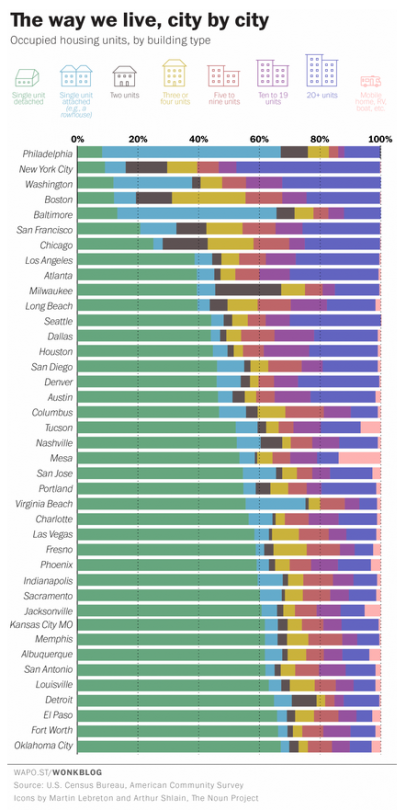
    Yesterday the Washington Post published a great chart showing the housing types of the 40 largest cities, by population, in the US. The list is ordered from lowest to highest according to the percentage of single-family houses in the city (green bar).

    Here’s the chart:

    image

    Not surprisingly, many of the cities at the top of this list (meaning they have the lowest percentage of single-family houses) are in the older east coast cities. 

    It’s also interesting to see just how much the rowhouse dominates the urban landscape in Philadelphia and Baltimore. In Philadelphia, almost 60% of the housing stock is an attached rowhouse.

    Housing is the backdrop for such a big portion of our lives. And when you live in a particular kind of home, it impacts your life whether or not you realize it. The dense rowhouses of Philadelphia and the single-family houses of Oklahoma City are the result of two very different kinds of urban landscapes.

    In Toronto, that backdrop is in the midst of a dramatic change. More and more of us are now living in high-rise condos. That hasn’t always been the case, of course. It’s a recent shift. But it looks like it’ll be a big part of our future.

  • A few thoughts on Toronto’s rental resurgence

    Photograph Condos in Fog by Richard Gottardo on 500px

    Condos in Fog by Richard Gottardo on 500px

    Earlier today I attended a lunch and learn talking about the renewed interest in rental apartment development here in Toronto. Since this is a topic I’ve written about a few times here on Architect This City, I thought I would summarize some of my key takeaways from the panel discussion:

    • Market fundamentals are strong for purpose-built rental apartments. Vacancy is very low and demand will likely outstrip supply for many decades to come given the barriers to building (land availability, planning/approvals, and so on).
    • As of September 2014, CMHC reported 2,212 purpose-built rental units under construction in the Toronto region. And yet the annual demand for new rental housing is likely somewhere between 10,000 to 30,000 units (clearly some of this demand is being absorbed by condo rentals – the secondary rental market).
    • Millennials and retirees are seen as core markets for new rental apartments. Millennials want to live in urban centers and they like the flexibility that renting provides. Retirees want to know that they won’t be asked to move out because the owner wants to sell their condo unit.
    • It’s almost impossible to compete against condo developers when it comes to buying land (despite the next point). They (condo developers) will pay more. Therefore intensifying our “tower in a park” building stock is going to be a critical component of meeting rental demand in the region.
    • Part of what’s driving this interest in purpose-built rental (on the part of developers) is a softening condo market. So don’t be surprised when some developers flip back to condos when it makes financial sense to do so.

    It was interesting to hear this last point. It’s something that has been on my mind, but for whatever reason wasn’t really being talked about by the industry. That’s not to say that I think the condo market is in trouble though. It has just become more balanced. And ultimately that’s probably a good thing.

    Either way, I think that more rental and more housing options are a positive for the city and for consumers.