Daily insights for city builders, delivered every morning at 6 AM ET. I’m Brandon Donnelly — a Toronto-based real estate developer and founder of Globizen. I’ve been writing here since 2013.

Tag: housing policy

  • Conservatives announce four-point housing plan

    Earlier today, the Conservative Party of Canada made the following housing policy announcement. If elected this fall, they would (copied verbatim from here):

    • Fix the mortgage stress test to ensure that first-time homebuyers aren’t unnecessarily prevented from accessing mortgages and work with OFSI to remove the stress test from mortgage renewals to give homeowners more options.
    • Increase amortization periods on insured mortgages to 30 years for first-time homebuyers to lower monthly payments.
    • Launch an inquiry into money laundering in the real estate sector and work with our industry partners to root out corrupt practices that inflate housing prices.
    • Make surplus federal real estate available for development to increase the supply of housing.

    There aren’t a lot of details here, but Andrew Scheer did say that his party would eliminate the financing “stress test” for all mortgage renewals. Currently, you’re only exempt if you renew with your existing lender.

    As Rob Carrick points out, this is a pretty sensible move. (Though he doesn’t agree with “fixing” the stress test.) The current situation gives the incumbent lender almost monopolistic power if the borrower can’t meet the stress test and is unable to shop around for a better rate.

    At the same time, we know that the price of a highly levered asset tends to correlate with financing ability. So depending on what serves you better, you may be either concerned or delighted that this increased buying power could spur further housing consumption/appreciation.

    Housing policy is a complex and curious thing.
  • The density delusion

    Joel Kotkin and Wendell Cox recently published a piece in the Orange County Register called, “California’s housing crisis and the density delusion.” I’m sure you can guess where this is going, even if you don’t follow the work of Joel Kotkin. But if you do, you will know that he is an ardent supporter of suburbia and the single-family home.

    Here is an excerpt from the article:

    In reality, the YIMBY’s suggestion that new, dense housing will improve affordability for all is patently absurd. Decades of densification in Los Angeles has seen ever higher rents, displacing low-income, especially minority households. Many former transit customers have been driven to lower-rent areas with less transit service, precipitating a massive decline in ridership, even as billions continue to be spent building new rail lines. The Wiener Bill [my link, not theirs] could exacerbate this trend, and likely increase the need for low-income housing, already well beyond the capability of public coffers.

    I fully appreciate the argument that high-density housing isn’t for everyone and that we shouldn’t be “forcing everyone back to the ‘glory’ days of the city of tenements.” But I disagree with many of their points, including the argument that density doesn’t encourage transit ridership. Density isn’t everything, but it’s an important something.

    The article is definitely worth a read, particularly if you disagree with their positions. That’s how you avoid confirmation bias. I was trying to keep that in mind as I read it. Maybe it worked.

  • California State Senator wants to mandate denser and taller zoning near transit

    California State Senator, Scott Wiener, introduced 3 new bills at the beginning of this year intended to address the statewide housing shortage and continue the pivot from a housing-last agenda to a housing-first agenda.

    Here is a summary of the 3 bills:

    These three bills (1) mandate denser and taller zoning near transit; (2) create a more data-driven and less political Regional Housing Needs Assessment process (RHNA provides local communities with numerical housing goals) and require communities to address past RHNA shortfalls; and (3) make it easier to build farmworker housing while maintaining strong worker protections.

    And here is a bit more information about the first one:

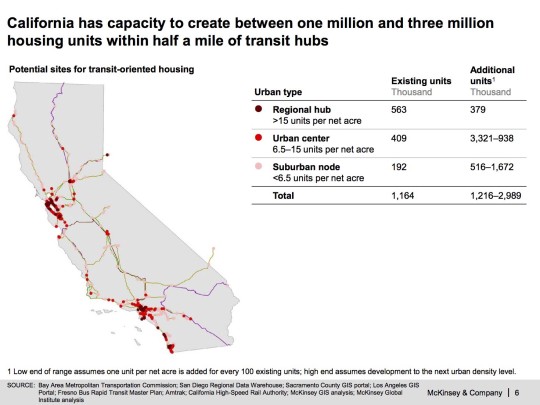
    SB 827 creates density and height zoning minimums near transit. Under SB 827, parcels within a half-mile of high-connectivity transit hub — like BART, Muni, Caltrain, and LA Metro stations — will be required to have no density maximums (such as single family home mandates), no parking minimums, and a minimum height limit of between 45 and 85 feet, depending on various factors, such as whether the parcel is on a larger corridor and whether it is immediately adjacent to the station. A local ordinance can increase that height but not go below it. SB 827 allows for many more smaller apartment buildings, described as the “missing middle” between high-rise steel construction and single family homes.

    The belief is that transit-oriented sites in the state of California have the potential to accommodate up to 3 million additional housing units.

    Fewer barriers to creating new housing. More data. And less politics. You can read more about Wiener’s 2018 housing package over on Medium.

  • Thoughts on inclusionary zoning

    Ontario is looking to pass legislation that would allow municipalities in the province to implement something known as inclusionary zoning. If passed and should municipalities decide to use this tool (Toronto almost certainly would), developers would then be required and/or incentivized to include some percentage of affordable housing in their new market rate developments. 

    Politically, inclusionary zoning tends to be popular. It’s believed to be a way for governments to create new affordable housing using relatively small public subsidies. Not surprisingly though, the development industry generally hates IZ. It’s another cost that needs to be added to the development pro forma – though some municipalities rightly offset these additional costs with additional density, breaks on levies, and so on.

    What I always think about when this topic comes up is the broader economic impact of the land use policy. Because I’m suspect that it’s as simple as: mandate affordable housing; get more affordable housing for free. Generally there are always trade-offs.

    So here’s some reading material for you all this morning.

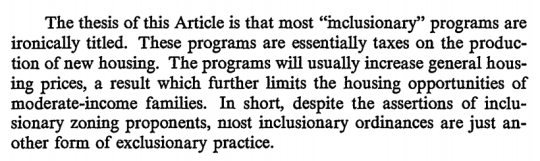
    In a classic paper (1981) by Yale Professor Robert C. Ellickson – called The Irony of Inclusionary Zoning – he argues that these practices can actually increase general house prices:

    image

    As a counterargument Owen Pickford over at The Urbanist argues that IZ simply reduces land prices as a result of the new tax. Land, after all, is the residual claimant. Therefore, he believes it’s an effective affordable housing policy. (I’m not so sure I believe that land prices would decrease in practice.)

    There’s also debate about the effectiveness of inclusionary zoning to actually deliver affordable housing at a meaningful scale. City Observatory wrote a post that looked at the total number of units produced (through IZ) across a number of American cities and the results were spotty. It should, however, be noted that not all inclusionary zoning policies are mandatory.

    Finally, the Furman Center for Real Estate & Urban Policy at New York University published a housing policy brief back in 2008 that looked at this exact topic. While they admit that the data is scarce, they come to the conclusion that IZ had no meaningful impact on the prices and production of single-family housing in San Francisco, but that IZ seems to have slightly decreased production and slightly increased pricing in the suburbs of Boston.

    What this last point suggests is that inclusionary zoning policies are not all created equal. So like all difficult questions, the answer to this one is likely: it depends. If anyone can point me to better data on inclusionary zoning, I would love to see it.

  • The contradiction in American housing policy

    I really like this post by Daniel Hertz talking about the inherent tension in American housing policy.

    Here’s his conclusion:

    We are, in conclusion, profoundly conflicted as a nation when it comes to housing: we want it to be affordable, but we also want its prices to rise fast enough to be valuable as a financial investment. That’s a contradiction we need to acknowledge if our housing policy debate—and, ultimately, our housing policy—is going to be coherent and constructive.

    Of course, this situation isn’t unique to the US. Though the US does have homeownership subsidies – such as the mortgage interest tax deduction – that other similar countries, like Canada, do not have.

    Still, I feel a similar kind of contradiction here. We worry about excess supply and housing bubbles when the reality is that both of these things are desirable outcomes if, and only if, the primary objective is to maintain housing affordability.

    But I don’t think that is the primary objective in practice. At least in this part of the world, I think we worry first and foremost about making sure that home prices continue to go up and that wealth is being built. Then, we worry about providing affordable housing for those that are unable to participate.

    I’m not making a judgement call on whether or not that’s a good or bad thing. It just strikes me that this tension, and there certainly is a tension, is not an equal one.

  • A century of homeownership and renting in England and Wales

    This morning while I was reading about gentrification in Berlin, I clicked through to an interesting overview of homeownership and renting in England and Wales over the last century. Here’s a video. If you can’t see it below, click here.

    [youtube https://www.youtube.com/watch?v=LDnGryGJ1ZA]

    The video starts in 1918, where the vast majority of households (77%) rented. As of 2011, this number has reversed. 64% of households in England and Wales now own their home.

    If you compare this housing trend to what happened in the United States and Canada, you’ll see a similarity. Although, the US was ahead in terms of promoting homeownership. They reached 50% ownership somewhere in the mid 1940s, whereas England and Wales didn’t reach this number until around 1971.

    image

    All of this is an interesting reminder that our obsession with homeownership is a relatively new one. But it’s also not a universal one. The homeownership rate in Berlin is 15.6%, and it’s only 49.5% in London. People in big cities tend to rent more.

  • Housing policy in San Francisco

    The tech community has been receiving a lot of backslash in San Francisco as of late. And Peter Shih’s infamous 10 things I hate about San Francisco post certainly didn’t help. But I think there’s a bigger issue than just rich tech people driving up the price of real estate.

    I was reading Quartz this morning and I think they nailed it: 

    “But the blame shouldn’t go to the tech companies or their employees moving to San Francisco, however despicable some might be. Blame San Francisco for being pleasant, and its policymakers for being foolish: When a lot of people are moving to your city—San Francisco the city gained 50,000 new residents between 2000 and 2012, including some 25,000 between 2010-2012 and likely more since—home prices are going to increase unless you build a lot more housing.”

    I’ve talked about this idea before. But I wanted to break it down a bit more precisely.

    If San Francisco, the city, gained 25,000 people between 2010-2012, let’s say that the city gained roughly 8,300 people per year. I just divided by 3. However, if you look at the rate of new housing supply, you get a 10-year average of 2,350 housing units a year (from the Quartz article) and an even lower amount according to Atlantic Cities.

    Regardless, what you end up with is a pretty simple phenomenon: More people are moving to the city than new housing is being provided and that’s driving up the price of real estate. In fact, San Francisco allegedly only created 269 housing units in 2011! That’s the equivalent of only one fairly typical Toronto condo building going up (and we have hundreds under construction). No wonder there’s upward pressure on prices.

    So rather than just blame the tech community for the city’s housing problems, I think there needs to be a broader look at housing policy. If you really want to help affordability, here’s one simple solution: start building.