Daily insights for city builders, delivered every morning at 6 AM ET. I’m Brandon Donnelly — a Toronto-based real estate developer and founder of Globizen. I’ve been writing here since 2013.

Tag: housing market

  • Opendoor.com launches in Phoenix

    Yesterday Opendoor.com finally launched their product in Phoenix. If you’re a regular reader of Architect This City, you might remember that back in July of this year I wrote about how they had just raised $10M of funding to make selling your home as easy as a few clicks.

    Well, since then, I’ve been following them like a hawk. I had all the founders on Twitter notification (so I got notified every time they tweeted) and I was eagerly anticipating their launch.

    Now that they’ve launched, we have a much better idea of how their business model is going to work. I say “better idea” only because there’s still portions of it that are a question mark for me.

    In any event, Opendoor basically provides instant liquidity to homeowners. You go on, tell them about your home, and they then make you an offer to buy, which looks like this and lasts for 3 days. The offer they make you is calculated using comparable sales and adjustments based on your home’s unique characteristics.

    Upon accepting their offer, they then schedule a home inspection (at their cost) to confirm your home’s condition. Once this is done, you just select your move out date and Opendoor handles the rest. The fee for all this is 5.5%, which the company claims is less than the 6% that realtors typically charge (this would be high for Toronto).

    After buying your home, Opendoor plans to turn around and resell it.

    What this reminds me of is a “bought deal.” In the world of investment banking, a bought deal is when the bank itself agrees to buy the entire offering of a particular security, as opposed to going out to the market and trying to raise the money. The advantage to the company (offering the securities) is that there’s no financing risk. They know they’re going to get their money. But it usually means the company gets a lower price.

    So what I wonder, is if this is what’s going to happen here. Since Opendoor is effectively taking on the selling risk, does that mean their offers will be lower? Or are all their costs built into that 5.5% and that’s truly their core business model? I’m sure some of this will surface in the coming weeks.

    I do, however, think they are smart to be focusing on the supply-side of the marketplace and offering virtually perfect liquidity to homeowners. Real estate is a unique asset in that it’s difficult to bring supply to the market. And so if control the supply-side, I think you have a pretty good shot at controlling the market as a whole.

  • In search of affordable housing

    Earlier this week I stumbled upon this entertaining article from the Guardian talking about how expensive housing is in London. The author’s tongue-in-cheek suggestion was to setup a new miniature London in the middle of nowhere where everyone could flock for affordable housing, but where many of London’s attributes could be exported: “We can all refuse to wear socks and sell each other overpriced cocktails in jam jars.”

    All joking aside, the article is yet another reminder that big global cities are expensive places to live. And in these cities, one of the most precious commodities is, quite simply, personal space. That’s why a garage in London can sell for £550,000 and why a 35 square foot storage cage in New York can sell for $75,000

    But affordable housing is not the reason why people want to live in places like London and New York. If it were, they wouldn’t be coming. Instead, they come for lifestyle, wealth creation, and the dating market – among other things. However, at a certain point, usually when they form families and start to need/want more space, they start looking around.

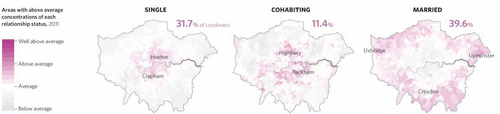
    Here’s an infographic via the Atlantic showing how relationship status impacts where people tend to live in London. The purple areas indicate an “above average concentration” of a particular relationship status. As you can see, single people tend to live in the core of the city, and when they get married, they move out to the periphery. Intuitively, this probably makes sense to you.

    image

    However, I’m always curious as to whether this trend happens more because of consumer preference (people don’t want to raise kids downtown) or because of economic necessity (they can’t afford anything beyond a shoe box apartment). Because if it is largely out of economic necessity (and the Guardian article would suggest it is), then we’re not creating the inclusive cities and neighborhoods that all city builders like to talk about.

    So how do we get better at this?

    In my view, and I’ve argued this before, the first step should be about improving supply. That is: get more housing built. And the way to start doing that is to make land available and improve the approvals process for new developments. In a recent McKinsey report, they referred to my first point as “unlocking land.”

    “Land cost often is the single biggest factor in improving the economics of affordable housing development. It is not uncommon for land costs to exceed 40 percent of total property prices, and in some large cities, land can be as much as 80 percent of property cost.”

    The reason this is important is because most big cities operate with massive supply deficits. There simply isn’t enough housing. And so if you can address that at a fundamental level, you can actually do a lot to start improving affordability.

  • How wise are crowds?

    Earlier this week I wrote a post about a new build home under construction at 37 Canerouth Drive in the west end of Toronto. As part of that post, I asked people what they thought the home would be valued at when it was completed. There were just under 10 responses (many thanks!) and I thought it was really fascinating to see the ranges.

    A lot of you responded in the comment section of the post, but a bunch of the other estimates came in via Facebook, Twitter, and email. It isn’t a huge data set, but I’ve nonetheless consolidated the ones I could remember I received:

    $2,375,000
    $2,750,000
    $1,800,000
    $3,000,000
    $8,500,000
    $2,600,000
    $3,500,000
    $1,750,000

    If you average these estimates, you come to a value of $3.3M. However, the clear outlier is the $8.5M. So let’s take that one out and see how the number changes. If you do that, you then get an average estimate of $2.5M. A pretty big swing.

    Now, I don’t know offhand how accurate that number really is, but I’m fascinated by this idea of “the crowd” determining value. Particularly for markets such as housing where supply can be completely heterogeneous and there isn’t a lot of transaction volume to refer back to (compared to other types of markets).

    Because my strong belief is that under the right circumstances and with enough data points, this number could end up being hugely accurate. And, it could also be more forward looking since it’s capturing current market sentiment as opposed to being based on historical transaction prices.

    If you have any thoughts on this, I’d love to hear from you 🙂

  • When rent control goes too far

    I was catching up with a friend of mine over coffee this morning and he was telling me about his recent trip to Porto, Portugal. I’ve never been, but it’s fairly high up on my list of places to visit.

    He was telling me about how beautiful the center of the city is and how it’s a UNESCO World Heritage Site. But he was also telling me how eerie it was to see so many abandoned and decaying buildings.

    And part of the reason for this – I learned – is that up until fairly recently, Portugal had some incredibly onerous pro-tenant rent controls in place that dated back to the beginning of the 1900s.

    In fact, they were so onerous that, by some estimates, roughly 150,000 households in Portugal were paying less than €50 per month in rent before the laws were changed!

    Because of this, landlords in many cases could not, and cannot, actually afford to maintain their properties. Buildings were left to decay, and in some cases they were completely abandoned. That was their only option. And it led to a virtually non-existent rental housing market (according to the IMF).

    Clearly, this is a problem. If you have a market distortion as serious as this one – where there’s virtually no incentive to invest – you’re on a highly unsustainable economic trajectory.

    Which is why when Portugal received its bailout package from the International Monetary Fund and European Union following the 2008 financial crisis, it was asked to reform its rent control laws – which it agreed to do.

    The hope was that the reforms would allow Portuguese landlords to charge more reasonable and market-oriented rents, as well as do other crazy things like evict tenants that don’t actually pay their rent. Not surprisingly, many fought the changes.

    I don’t know precisely how these reforms have ultimately played out in the market over the past few years (if you do, I’d love to hear from you in the comments below), but I do believe that liberalization of the market was, and probably still is, needed.

    While paying €5 a month for a 4 bedroom apartment in a desirable central neighborhood might be great for that one individual family, it’s not so great for the economy as a whole. And ultimately that comes around to impact even that household.

    Image: Flickr

  • Should you own or rent your home?

    image

    I was at a good friend’s wedding last night (congratulations again to Adrien + Rachel!), and one of the topics that came up at our table was whether it is better to own or rent your home. Now, in North America, conventional wisdom would suggest – almost mandate – that you have to own your place. If you’re still a renter, well then you’re “throwing away your money” my friend.

    But are you really? 

    A big part of the value of owning your home is that it’s forced savings. Every month when you make those principal and interest payments, you’re paying down your mortgage and socking away money for the future. And this can be a great thing for a lot of people, particularly if you’re not disciplined enough to save otherwise.

    But when you own a home, you’re also spending time and money on maintaining that home, and you’re also tying up capital that could be used elsewhere. So consider this: what if, instead of putting your savings towards a downpayment, you simply continued to rent and created an investment portfolio that you then contributed to on a regular basis just as you would a home?

    Depending on your assumptions, renting could turn out to put you further ahead financially. Here’s an example of that scenario from the Globe and Mail.

    Similarly, I remember being told in business school that companies that own their own real estate tend to under perform those that do not. And the rationale is that owning lots of real estate ties up capital that could otherwise be reinvested in the core business. In other words, if your core business is making widgets, then invest your money in making better widgets, not in real estate.

    But this is not to say that everybody should rent. Obviously I’m a big believer in real estate. And for a lot of people, owning may make sense. This post was really just to say that the owning vs. renting decision may not be as black and white as you might think.

    Image: Flickr

  • What are Boomers going to do with their suburban homes?

    The following chart represents births in the United States per 1,000 people. The segment in red demarcates the birth years between 1946 and 1964, which is generally considered to represent the Post-World War II population spike known as the Baby Boom. Besides this jump, we have for the most part been seeing declining birth rates.

    US Birth Rates.svgUS Birth Rates” by Saiarcot895. Licensed under CC0 via Wikimedia Commons.

    Given the magnitude of this population segment, demographers and others love to talk about the impact that this generation has had and will continue to have on society, particularly as many Baby Boomers now start to enter retirement.

    But arguably one of the most significant areas of impact could be the housing market. Today, I stumbled upon an interesting CityLab article from last year talking about “The Great Senior Sell-Off.” And it raises an important question: As Baby Boomers begin to sell off their large single-family homes in the suburbs, will there be enough people to buy them?

    For the most part, the next generation seems to still want a nice detached house in order to raise a family. But that doesn’t necessarily mean that the numbers will match up. Because if you factor in generation size, buying power, and even small shifts in consumer preference (towards, say, urban centers), the equation may not balance.

    If this ends up being the case, I don’t think it’ll impact large, growing cities as much. I mean, most are operating today with severe supply deficits. Instead it’ll probably be the smaller, perhaps already declining cities, that feel it the most. And this will ultimately serve to reinforce the “spiky” world that we’re already seeing today.

    At least that’s my hunch.

  • A century of homeownership and renting in England and Wales

    This morning while I was reading about gentrification in Berlin, I clicked through to an interesting overview of homeownership and renting in England and Wales over the last century. Here’s a video. If you can’t see it below, click here.

    [youtube https://www.youtube.com/watch?v=LDnGryGJ1ZA]

    The video starts in 1918, where the vast majority of households (77%) rented. As of 2011, this number has reversed. 64% of households in England and Wales now own their home.

    If you compare this housing trend to what happened in the United States and Canada, you’ll see a similarity. Although, the US was ahead in terms of promoting homeownership. They reached 50% ownership somewhere in the mid 1940s, whereas England and Wales didn’t reach this number until around 1971.

    image

    All of this is an interesting reminder that our obsession with homeownership is a relatively new one. But it’s also not a universal one. The homeownership rate in Berlin is 15.6%, and it’s only 49.5% in London. People in big cities tend to rent more.

  • Vancouver boomers are sitting on $163 billion of mortage-free property

    Continuing with our discussion of Vancouver, I was reading today that baby boomers in the metro area (those aged 55 and older) are estimated to be holding over $163 billion of clear title property. That is, homes without any mortgage. This figure comes from Rennie Marketing Systems out of Vancouver.

    What’s interesting about this number is that it signals both a lot of equity that could be used for downsizing, rightsizing and lateral moves into a condo, and a source of capital for millennials to buy their first home. In fact, according to a survey that Rennie Marketing also conducted, somewhere around 40% of first time buyers in Vancouver are getting deposit help from their parents and/or grandparents.

    But the question that comes to my mind is: Are there going to be enough middle aged people willing and able to buy $163 billion worth of real estate? Because one person’s sale is another person’s buy.

  • What are Generation Y condo dwellers going to do when they have kids?

    I gave a talk about condos this evening at the Ted Rogers School of Management. For regular readers of this blog, the material wouldn’t have been all that new. I talked about supply and demand in housing markets and 2 of the projects that TAS is working on. The best part though was the Q&A, which, I think, was longer than the actual talk.

    One question that I particularly liked (maybe because I’ve blogged about it before) was the question of what all these Generation Y condo dwellers are going to do when they decide they want a family. We know that people are getting married later and that more people are living alone. So there are some demographic changes at work here. But people are still going to have kids and people are still going to need more space.

    At that point, I think 2 other, interrelated, factors come into play: first, a lot of people still feel you need a house in order to raise kids; and, second, there’s a problem of affordability. Multi-family dwellings (built out of reinforced concrete) are inherently more expensive to build than wood-framed single family homes.

    To deal with these factors, a lot of young couples in Toronto (at least from my own empirical research) seem to be looking to inner city neighborhoods like Leslieville, Roncesvalles, Trinity Bellwoods, High Park, the Junction and so on. They still want to be in the city, but they want a house, for their kids. Problem is, everybody is trying to do the same and it’s creating tremendous pressure on our low-rise housing stock.

    So what’s going to happen in the longer term?

    Well if low-rise housing keeps appreciating at the rate it has been, we could reach a point, I think, where all of a sudden condos become the more cost effective solution.

    For example, let’s say a young family is looking for a 3 bedroom home. It’s not inconceivable that the 1,500 square foot, 3 bedroom condo could become the cheaper option. At $650 per square foot (I’m assuming a slightly higher number because I’m assuming this is at some point in the future), you’re looking at roughly a million dollars. No question this is a lot of money, but what if the alternative (a single family home) is $1.5 million?

    I’m sure there will always be a segment of the market that rushes towards the suburbs and/or a house when they decide they want to have kids. But I think we’ll see more and more families decide–either because of cost or because of a lifestyle preference–that having children in a condo isn’t all that bad.

    What do you think? Would you ever raise children in a condo?