Daily insights for city builders, delivered every morning at 6 AM ET. I’m Brandon Donnelly — a Toronto-based real estate developer and founder of Globizen. I’ve been writing here since 2013.

Tag: housing affordability

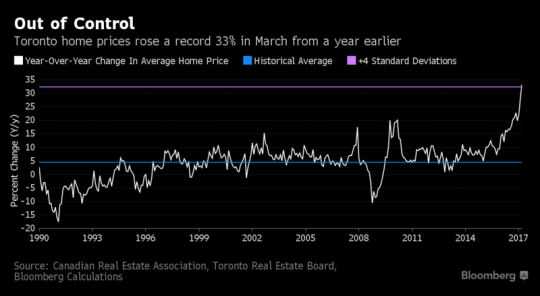
  • Toronto real estate is out of control

    You can’t have an Easter dinner in Toronto right now without somebody bringing up the topic of our “crazy” real estate market. 

    Below is a chart from Bloomberg showing the year-over-year change in home prices in the Greater Toronto Area since 1990. It also shows the historical average (in blue) and how in March 2017 we hit 4 standard deviations above that. Home prices rose 33% in March compared to a year earlier.
    If I were a realtor, I’d probably tell you that the market is hot hot hot. Now is the time to sell because you’ll get some absurd number above your asking price and now is the time to buy because prices are going nowhere but up. Don’t miss out. 

    I would like to try and be a bit more nuanced than that. Here are 3 thoughts:

    1)

    There’s no question that low rates / cheap money is one of the root causes of the real estate valuations we are seeing today. But frankly I have no idea when or if that will change. There is an interesting argument out there that capital is no longer scarce. Our economy is going through a fundamental shift, which is why real estate is not the only asset class seeing these sorts of valuations and growth figures.

    2)

    There are a number of global factors which are helping to cement Toronto’s position as an alpha global city and destination for human capital. Think Trump, Brexit, and so on. I agree with Richard Florida’s argument that our real estate market will see more – not less – pressure going forward. Here is a snippet from a recent interview with Florida in Toronto Life:

    I think Toronto is going to get an even bigger influx of the creative class. With the rise of Trumpism, more and more people who might otherwise have gone to the United States are going to come to Canada. We’re going to see American tech companies invest more and more in Toronto. And if we think the housing affordability and economic divide we see today is bad, it’s going to grow ever more gaping. 

    3)

    I believe that there are always opportunities in the real estate space, but that you have to be disciplined, focused on fundamentals, and willing to do things that others won’t. What bothers me is when I hear people say things like: “Real estate only goes up. You can never go wrong.” I started my career pre-2008 and lived in both the United States and Ireland. I saw what down looks like.
  • 10 most unaffordable housing markets

    image

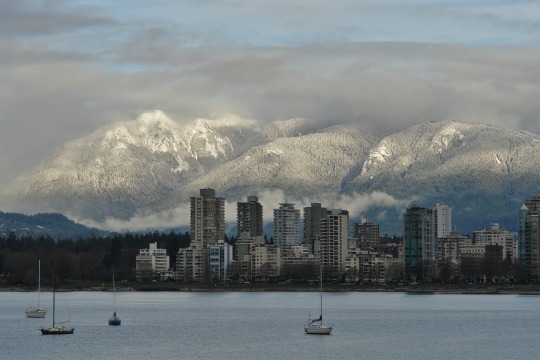
    I flew into Vancouver this morning, which means it was only a matter of time before the topic of house prices came up.

    According to the 13th Annual Demographia International Housing Affordability Survey (2017), the 10 most unaffordable housing markets are as follows:

    1. Hong Kong, China
    2. Sydney, Australia
    3. Vancouver, Canada
    4. Auckland, New Zealand
    5. San Jose, California
    6. Melbourne, Australia
    7. Honolulu, Hawaii
    8. Los Angeles, California
    9. San Francisco, California
    10. Bournemouth, UK

    The survey measured the affordability of “middle-income” housing in Australia, Canada, China (Hong Kong), Ireland, Japan, New Zealand, Singapore, the United Kingdom, and the United States. 

    It is based on a “median multiple” approach, which tries to normalize house prices across the world by looking at median house prices over median household incomes.

    The above list probably won’t surprise you, as well as the report’s focus on land supply. But I did want to call attention to the following remark:

    My own housing research focused on this difference: Why did Germany (and similarly Switzerland) provide housing stability where much of the Anglosphere did not? 

    In a nutshell, the answer to this question has a lot to do with the way councils are funded. In jurisdictions where local decision-makers stand to gain from new development, they will be much more eager to make it happen.

    The topic of incentives is not something that is often focused on when we talk about land supply. But it’s a really interesting point. Because the reality is that, in many cases, the incentives probably work in the opposite direction to the one described above.

  • One becomes four

    The New York Times posted an interesting article today talking about how roommates in the city are dividing and conquering expensive rentals using temporary walls. This is obviously not a new practice. But it’s a good case study in what people will do in order to make living in a specific location affordable – in this case, Manhattan.

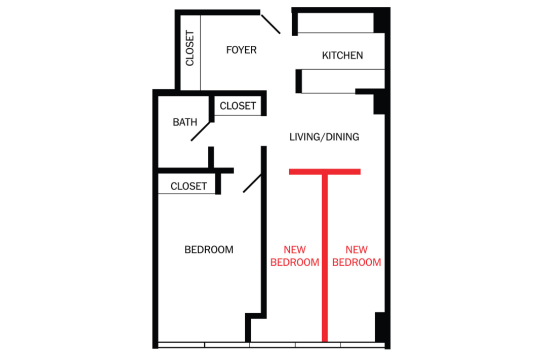
    The first example is a one bedroom apartment that was converted to a 4-person apartment. Here is the floor plan (from the New York Times):

    image

    The living/dining room was divided up using a T-shaped partition wall – which is required to stop 2 feet shy of the ceiling – to create two additional bedrooms. The original bedroom is then shared via two twin beds. Et voilà. Now you have an apartment where the $3,750 per month rent becomes less than $1,000 per person.

    Probably the most annoying thing about this setup would be the lack of acoustic privacy. Since the partition walls don’t go all the way up to the ceiling (photo here), you’d obviously hear everything. One person in the article described it as living in the same room as all of your roommates, but not being able to see anyone.

    Of course, there’s also a space consideration:

    Mr. Meyer, 23, has the smallest room by far. “It kind of feels like you’re living in Harry Potter’s cupboard,” said Mr. Meyer, who is in his freshman year at Columbia after serving for three years in the Israel Defense Forces.

    The roommates, three of whom grew up together in Toronto, don’t mind the close quarters or the lack of privacy. “It’s definitely not for everyone,” Mr. Meyer said. “When you live with your best friends, it couldn’t be better. We hardly spend time in our rooms.”

    I saw a lot of this here in Toronto while I was in undergrad. 55 Charles Street West was always a great candidate for these sorts of hacks because the units are large and because the building is filled with solariums. Inevitably, they became additional bedrooms. 

    (Sidebar: My understanding is that there was a period of time in Toronto where solariums were excluded from gross floor area calculations. So developers used to always put them in to capture more area. That’s why buildings of a certain vintage always seem to have them.)

    In any event, the above certainly makes the case for more micro units and co-living arranagements. Many people seem willing to deal with a variety of living situations in order to live where they want to live. Urban affordability is certainly a global concern.

  • New political support for laneway housing

    There’s some great news in the Toronto Star this week.

    (Thank you Mike for bringing this to my attention.) 

    Two councillors – Mary-Margaret McMahon and Ana Bailao – have come out in support of allowing laneway housing in Toronto. Some cities call them detached accessory dwelling units (DADUs). 

    If you’re new to laneway housing, check out this post and this post (both are 2+ years old). I’ve been on this horse for over a decade.

    Because going beyond their small space cool factor, laneway housing has the potential to fundamentally alter the housing supply constraint that I wrote about a few weeks ago – namely the yellowbelt. It’s a way to gently allow for new housing, while at the same time preserving the character of our “stable” neighborhoods. 

    And frankly, I can’t think of any other way to add new ground related housing at any sort of meaningful scale within the city limits – not unless we’re willing to give up the “stability” of our neighborhoods. So this is it.

    If you’re on the same page, I would encourage you to reach out to Councillor McMahon and Bailao and let them know that. There’s also a public workshop scheduled for Monday, December 5th at 7pm at the Evergreen Brick Works (550 Bayview Avenue).

  • Within-city house price gradients

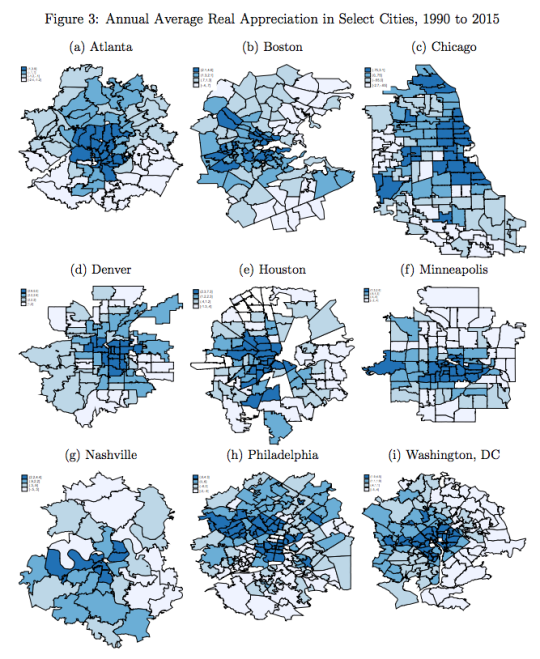
    The Federal Housing Finance Agency recently published a working paper where they looked at within-city house price gradients for a selection of US cities over a 40 year period. The goal of the study was to address what they call a “persistent blind spot” in local house price measurements.

    Here is their diagram showing annual average real appreciation from 1990 to 2015 for 9 US cities: 

    The darker areas indicate more appreciation. They are generally clustered around each city’s CBD.

    And here is an excerpt from the paper’s conclusion:

    “In an area with a highly elastic housing supply, a permanent housing demand shock is first capitalized into prices, but over time as quantities adjust, prices return to pre-shock levels (see Glaeser, Gyourko, Morales,
    and Nathanson, 2014). In contrast, near the CBD, where buildable sites are less available and regulation is presumably more onerous, a permanent demand shock can outpace supply responses, leading to permanent price increases.

    What stood out for me was this last sentence. It’s a reminder of the perfect storm that many cities now find themselves in.

    When everyone wanted to live in the suburbs, it was fairly easy to just build more homes. Supply was relatively elastic. And this kept prices in check.

    However, the same is not true for city centers. Supply is relatively inelastic, meaning it’s much harder to build more homes when demand increases. And demand has been increasing.

    So what we have today is a situation where many central cities are operating with basically a perpetual supply deficit. Hence the the comment about “permanent price increases.”

    I don’t want to oversimplify the situation, the potential solutions, and/or the well-documented mistakes, but there was arguably a middle class price benefit to mass produced sprawl.

    What should we be doing today to address housing affordability concerns?

  • The answer to San Francisco’s housing affordability problem

    Blogger and programmer Eric Fischer has an excellent post up on his site where he looks at: “Employment, construction, and the cost of San Francisco apartments.” It’s worth a good solid read.

    What he did was dig deep into whatever data he could find – the data goes back to the beginning of the 20th century in some cases – to try and figure out a solution to San Francisco’s housing affordability problem.

    Many (including myself) have argued that, at least part of the solution, is to build more, not less, housing. However, others, such as Tim Redmond of 48 Hills, have argued that building more market-rate housing would simply exacerbate the current situation.

    In Eric’s analysis, he looked at everything from median rents and new housing units constructed (above graph) to annual wage growth and income inequality. I particularly liked his summary of the city’s various building booms. 

    In the end, here’s the conclusion that he came to:

    “In the long run, San Francisco’s CPI-adjusted average income is growing by 1.72% per year, and the number of employed people is growing by 0.326% per year, which together (if you believe the first model) will raise CPI-adjusted housing costs by 3.8% per year. Therefore, if price stability is the goal, the city and its citizens should try to increase the housing supply by an average of 1.5% per year (which is about 3.75 times the general rate since 1975, and with the current inventory would mean 5700 units per year). If visual stability is the goal instead, prices will probably continue to rise uncontrollably.”

    By visual stability, he is referring to maintaining the current urban fabric of San Francisco just the way it is. In other words, he is making the link between preservation and affordability in a prosperous and growing city.

    Intuitively, this makes sense to me. It’s unrealistic to think that you can maintaining some level of housing affordability without allowing supply to increase alongside demand.

    At the same time, I do not believe that preservation needs to equate to no changes whatsoever. Urban preservation, to me, should be about dutifully respecting the past while still looking firmly towards the future. And that’s how I believe successful should be approaching this problem.

  • Population growth across North American cities

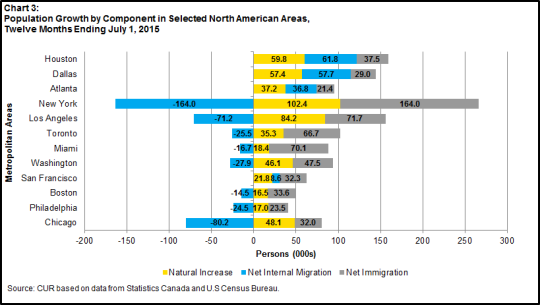
    The Centre for Urban Research and Land Development at Ryerson University recently published the following chart on their blog:

    It’s a look at population growth across a few North American cities, broken down according to natural increases, net internal migration from other parts of the respective country, and net immigration from outside of the respective country.

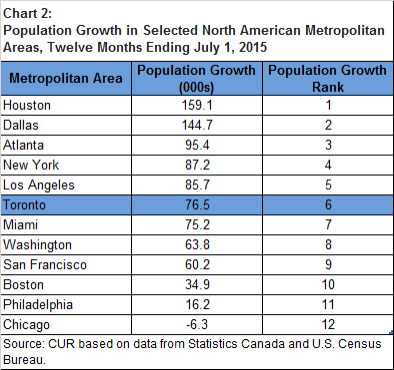
    When you sum up the pluses and minuses shown above, you get to population growth numbers that look like this:

    Houston, Dallas, and Atlanta are monsters in terms of population growth. They’re obviously smaller than New York and Los Angeles, and so on a percentage basis they are really adding a lot of people. Much of this has to do with the ease in which housing can be added in those cities and their relative affordability.

    Toronto is competitive with New York and Los Angeles in terms of an absolute number, but again our base is smaller so on a percentage basis we are growing faster. The big story with Toronto is our dependence on immigration to grow.

    The one city on this list that might surprise some of you is Chicago. Toronto and Chicago share many similarities and are often compared. But when you look at how the Chicago metropolitan area is shedding people, you see that, at least in this regard, it’s in structural decline.

  • BARF is fighting for more housing in San Francisco

    A new YIMBY activist group is starting to gain meaningful traction in San Francisco. They were recently featured in the New York Times and they have managed to secure the financial backing of people like Jeremy Stoppelman – co-founder and CEO of Yelp. 

    (All excerpts in this post were taken from the NY Times.)

    image

    The group is called SF BARF, which stands for SF Bay Area Renters’ Federation. The group, however, supports new development of all kinds. So I think the name is more driven by the fact that the founder, Sonja Trauss, wanted the acronym to be BARF. It speaks to their shit disturbing approach:

    “Her group consists of a 500-person mailing list and a few dozen hard-core members — most of them young professionals who work in the technology industry — who speak out at government meetings and protest against the protesters who fight new development. While only two years old, Ms. Trauss’s Renters’ Federation has blazed onto the political scene with youth and bombast and by employing guerrilla tactics that others are too polite to try. In January, for instance, she hired a lawyer to go around suing suburbs for not building enough.”

    The impetus for all of this, of course, is San Francisco’s lack of affordability and severe housing shortage. Housing supply is decades behind the city’s population and job growth. 

    Most people are directing the blame at the tech community for bidding up housing. But there’s clearly growing recognition that housing supply matters.

    As a real estate developer, my industry obviously benefits from fewer barriers to building. So let’s get that out there:

    “Ms. Trauss’s cause, more or less, is to make life easier for real estate developers by rolling back zoning regulations and environmental rules. Her opponents are a generally older group of progressives who worry that an influx of corporate techies is turning a city that nurtured the Beat Generation into a gilded resort for the rich.”

    But let’s also be clear that I don’t believe we should be developing roughshod over our cities. New development should respond to what’s already there and give back. 

    At the same time, housing supply matters a great deal. A big part of the reason that cities like San Francisco, New York and Vancouver are so expensive is that they’re naturally supply-constrained markets. Geographically, they are either peninsulas or islands.

    When you overlay tight land use restrictions, fierce community opposition and/or foreign investment on top of this geography, it should come as no surprise to anyone that demand is outstripping supply. 

    New supply won’t solve every problem, but I do agree that it is an important part of the solution.

  • Global home prices at the end of 2015

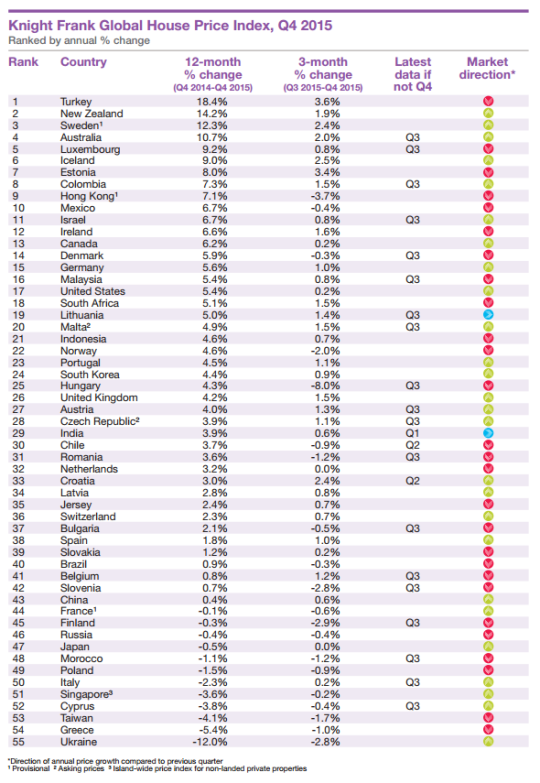
    Seeing how we’ve started looking at data from last year, I thought it would be interesting to look at global home prices as of Q4 2015. Here’s a chart from Knight Frank, which they refer to as their Global House Price Index:

    At the top of the list is Turkey, with an 18.4% increase from Q4 2014 to Q4 2015. (Supposedly this is because it has recently become easier for foreigners to buy property in the country.) Canada is 13th with a 6.2% increase (during this same time period) and the United States is 17th at 5.4%.

    This is obviously a high level analysis. There are lots of regional and local variations within each country. For instance in Canada right now, Calgary is a very different place than, say, Vancouver or Toronto.

    Nonetheless, it’s still valuable to see the relative performance of each country and see what their (Knight Frank’s) prediction is for 2016:

    “Our outlook for 2016 is muted. We expect the index’s overall rate of growth to be weaker in 2016 than 2015. The global economy is experiencing a potentially dangerous cocktail of low oil prices, a strong [US] dollar and a continued slowdown in China.”

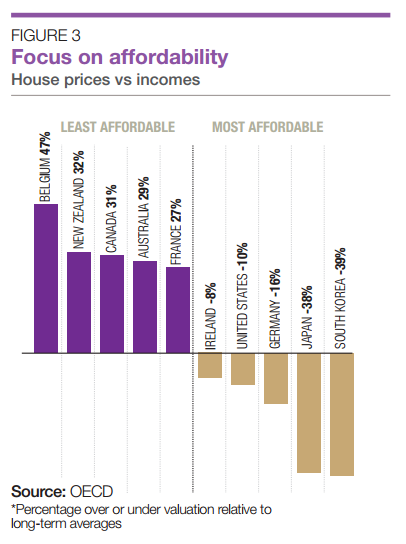
    It’s also interesting to see how the countries rank in terms of affordability:

    Once again, Canada ranks as being one of the least affordable countries in terms of home prices.

  • Cities aren’t the only places struggling with housing affordability

    We already know that many successful cities are struggling with housing affordability. But what you may not know is that a similar phenomenon is happening in many ski towns. Supply is constrained and demand is high.

    Here is an excerpt from a recent New York Times article:

    Local officials and housing experts say it is a symptom of widening economic inequality, one that is especially sharply felt in tiny resort towns hemmed in by beautiful but undevelopable public land. While the wealthiest can afford $5 million ski homes and $120-a-day lift tickets, others work two jobs and sleep in shifts to get by.

    “It’s so much worse today than it’s ever been,” said Sara Flitner, the mayor of Jackson, Wyo., where the median single-family home price rose 24 percent last year to $1.2 million, according to the Jackson Hole Report.

    It’s for reasons like this that some ski towns have strict criteria around who is an eligible resident. For example, Banff, Alberta does this to ensure, “that housing remains available for those whose primary objective is to live and work in the community.”

    In small landlocked ski towns – where it’s difficult or almost impossible to increase supply – there are only so many options.