Daily insights for city builders, delivered every morning at 6 AM ET. I’m Brandon Donnelly — a Toronto-based real estate developer and founder of Globizen. I’ve been writing here since 2013.

Tag: household income

  • Pay and performance for graduates of elite universities

    We know that educational attainment is probably the single biggest determinant of urban economic success. If you’re hoping to predict average household incomes, looking at the percentage of the population with a 4-year college degree is a pretty good place to start. But let’s take this a step further: to what extent does graduating from an elite university affect both pay and performance?

    It turns out, according to this recent study, that the pedigree of one’s university isn’t all that good at predicting motivation and talent. It does, however, impact pay. Average early career salaries for graduates of the top 10 colleges in the US are almost 50% higher than those with degrees from the ten colleges within the City University New York school system. This is according to data from Payscale and the US Department of Education.

    But this pay delta doesn’t necessarily match the performance delta that you might expect. The study found that for every 1,000 positions that you move in Webometrics’ global university ranking (which is what they used for their research), overall performance only changes by about 1.9%. In other words, a graduate from the alleged number one university is only going to perform, on average, about 1.9% better than someone from the 1,000th best school.

    I’m not exactly sure how to practically interpret a 1.9% improvement in performance. But 2% compounding on 2% each year should get you somewhere. Regardless, graduates from top universities do generally score higher on competency examinations. The reasoning behind this is thought to be at least twofold: 1) more selective admissions create a better pool of students and 2) top universities should provide better training.

    Whether that’s enough to justify the higher pay is a separate discussion. But if you’re looking to measure urban economic success, the data does suggest that elite universities should lead to overall higher average incomes.

  • Median household income vs. health insurance costs

    I just came across this chart from Axios, which relies on data from the Federal Reserve Bank of St. Louis and the Kaiser Family Foundation. It compares median household income against the average cost of employer health insurance (in the United States).

    What it is saying is that, after adjusting for inflation, the median household income has only increased by 2% from 1999 to 2017, whereas employer health insurance costs have increased by some 121% over this same time period.

    The takeaway: Rising healthcare costs are believed to be eating away at take-home pay in the US. As of 2017, health insurance costs were estimated to represent about 30% of the average household income. That feels like a big number to me.

  • Doing stuff vs. owning stuff

    “People get income for doing stuff, and they get income for owning stuff. Increasingly the latter. And the ownership share of income goes to a small slice of households that own almost all the stuff.”

    This is a quote from a recent article by Steve Roth over at Evonomics, where he breaks down the share of US household income that is derived from “labor” vs. “capital.” In other words, how much money do households make from working (trading their time for money) and how much do they make from their existing wealth (that is, owning stuff)?

    If I were to oversimplify how he calculates this (you can read all of the details, here), it is: (Income – Labor Compensation) / Income. Take all of the household income. Subtract the money made from doing stuff. And then divide it by total income to get the percentage made from “unearned property income.” There are gray areas and others things to consider, but that’s the gist of it.

    What he discovers and argues is that basically 50% of household income comes from simply being wealthy and owning stuff. He also reminds us that approximately 60% of US wealth is… “earned the old-fashioned away: it’s inherited.”

  • 2 new ways to think about economic inequality

    We talk a lot about economic
    inequality these days. We worry, among other things, that our successful cities
    are becoming playgrounds for the rich and that housing is becoming increasingly
    unaffordable for the middle class.

    Without negating the
    importance of things such as attainable housing, I’d like to offer up two,
    potentially new, perspectives on economic inequality.

    The first is an
    essay by venture capitalist Paul Graham
    . In it, he rationally unpacks, as he always does, the phenomenon of economic inequality. One of his key points is the distinction between rent seeking degenerate economic inequality and the economic inequality caused by rapid value creation (i.e. Two Stanford students decide to create a new search engine called Google).

    “If the rich people in a society got that way by taking wealth from the poor, then you have the degenerate case of economic inequality where the cause of poverty is the same as the cause of wealth. But instances of inequality don’t have to be instances of the degenerate case. If one woodworker makes 5 chairs and another makes none, the second woodworker will have less money, but not because anyone took anything from him.”

    Of course, Paul Graham is thinking about this from the perspective of a venture capitalist that funds startups and helps entrepreneurs get rich. But what about the impacts to people who live in a city where the rich are far richer than the poor?

    That brings me to the second perspective.

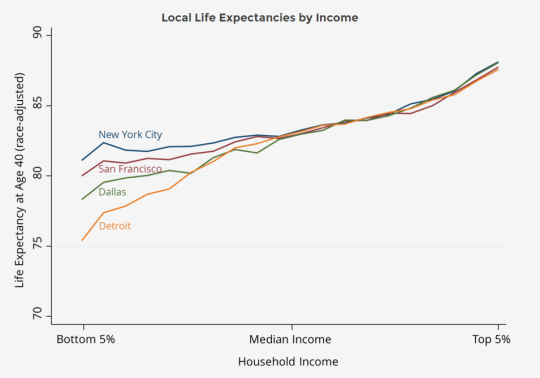
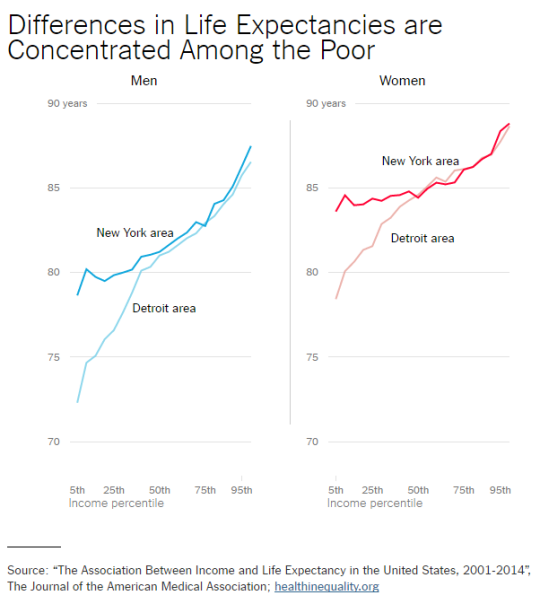
    A recent study, published in The Journal of the American Medical Association and written about in the New York Times, has discovered a surprising relationship between income and life expectancy across the United States from 2001 to 2014.

    What they found was that cities with high economic inequality – such as New York and San Francisco – actually have lower inequality when it comes to life expectancy. 

    Here is a chart from the New York Times:

    And here is a chart from healthinequality.org:

    If you’re rich, it doesn’t matter where you live. The life expectancy of a rich person in New York is roughly the same as a rich person in Detroit. (Though, as to be expected, women generally live longer than men.)

    However, as income levels fall, so does life expectancy. But it falls more in a city like Detroit than it does in New York. In fact, rich cities such as New York and San Francisco are almost model cities in this regard. Why is that?

    The biggest predictor appears to be health behaviors, such as smoking and obesity:

    “The research seems to suggest that living in proximity to the preferences — and tax base — of wealthy neighbors may help improve well-being. New York is not just a city of rich and poor, but also one of walkable sidewalks, a trans-fat ban and one of the most aggressive anti-tobacco agendas of any place in the United States.”

    So there you have it. Two, potentially new, ways to think about economic inequality.

  • Art and apartments

    Photograph Vancouver by Marc M on 500px

    Image Source: Vancouver by Marc M on 500px

    According to a recent Bloomberg article, this is where the rich are putting their money today:

    “The two greatest stores of wealth internationally today is contemporary art….. and I don’t mean that as a joke, I mean that as a serious asset class,” said Fink. “And two, the other store of wealth today is apartments in Manhattan, apartments in Vancouver, in London.”

    In case you wondering, Laurence Fink is the founder and CEO of BlackRock Inc., which today is the largest asset manager in the world. They have over $4.77 trillion in assets under management according to their website. That’s a mind boggling number.

    And if you read the Bloomberg article cited above, you’ll see that this interest in both art and apartments represents a shift away from gold as the de facto safe haven.

    “Historically gold was a great instrument for storing of wealth,” the chairman of BlackRock Inc. said at a conference in Singapore on Tuesday. “Gold has lost its luster and there’s other mechanisms in which you can store wealth that are inflation-adjusted.”

    What’s interesting and probably most relevant to the Architect This City community though is this investment focus on apartments.

    When people talk about a possible housing bubble in Canada they often cite house prices to median household income as a key ratio. The question then becomes: How can house prices be such a high multiple relative to local incomes?

    That’s relevant, but it’s not the entire story for cities like New York, London, and Vancouver. That ratio alone assumes that real estate isn’t a global investment vehicle. And for some people people it is exactly that.