Daily insights for city builders, delivered every morning at 6 AM ET. I’m Brandon Donnelly — a Toronto-based real estate developer and founder of Globizen. I’ve been writing here since 2013.
Some four years ago, people were talking about the possibility of New York City being dead. But of course that was nonsense. Last week, New York City published the initial findings of its housing and vacancy survey and the key takeaway is that the city’s vacancy rate dropped to 1.41% last year (2023). This is a drop from 4.54% just two years ago and the lowest measurement since 1968. It’s also even worse at more affordable rent levels:
The problem, as described by the city, is a supply-demand imbalance. Over the last two years, the city’s net housing stock grew by about 60,000 homes (~2%). This is, apparently, pretty good compared to recent years/decades; but it wasn’t nearly enough given that the city added 275,000 new households. This is the opposite of dead, and it’s not going to be addressed by just doing things like restricting short-term rentals.
We have a structural delivery problem and New York City is not alone in facing it.
Newly released data from the US Census Bureau has just revealed that the average household size is increasing for the first time in over 160 years. Put differently, the formation of new households has started to trail overall population growth. And that is causing the average number of people per household to increase.
In 1790, there were about 5.79 people per household in the United States. That number has been in decline pretty much since then, though there was a slight increase in the decade that began in 1850. Last year (2018), the number grew to 2.63 people per household (2.71 for owner occupied households and 2.48 for renter occupied households).
Here are two charts from Chris Fry’s recent piece at the Pew Research Center:
So what is causing this?
Well, we know that US fertility rates aren’t on the rise. In fact, they’re generally viewed as hitting record lows. I say “generally” because there are a number of different ways to measure fertility. There’s the general fertility rate, completed fertility, the total fertility rate, and others. But we are seeing some alignment here: fertility rates are down.
One probable explanation is the fact that more Americans are living multi-generationally. According to the Pew Research Center, 1 out of every 5 Americans lived in such a household as of 2016. Part of this may be a result of immigration. Asian and hispanic populations are more likely to live in a multi-generational household compared to white people.
Another demographic trend is the increase in people living in shared quarters, whether that might be with a roommate or someone else. This is interesting because it suggests that there’s an affordability constraint. Are people being forced to “double up?” The current co-living trend is at least partially because of this.
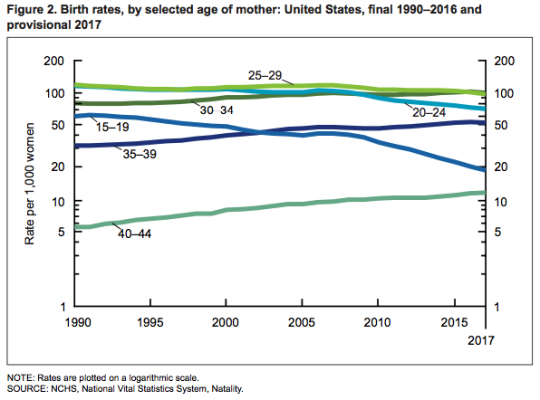
The National Center of Health Statistics just released this update on births and birth rates for the United States in 2017. The provisional number of births last year was 3,853,472, which represents a 2% reduction from 2016 and the lowest number in 30 years. The general fertility rate was 60.2 births per 1,000 women aged 15-44, which represents a 3% reduction from 2016. Also a record low.
Here is a chart from the report showing birth rates for selected age ranges from 1990 to 2016 (the 2017 numbers are provisional):
Many of the age ranges have remained stable. Notable are the decline in the teenage (15-19) birth rate and the increase in births to women aged 40-44. The teenage birth rate declined 7% from 2016 and has averaged a decline of nearly 8% a year since 2007. And the birth rate for women aged 40-44 has generally been rising since 1982.
I am sure that you can all think of many explanations for the above phenomena without even diving into the report. I find all of this relevant because demographics obviously impact the real estate business and how we build cities.
Earlier this week I attended RealNet’s Q1 2015 market update webinar for the Greater Toronto Area. If you don’t already subscribe to RealNet, you should consider it. They’re one of the best sources for Canadian real estate market information.
During their webinars, they occasionally run interactive surveys where they ask the audience a question and participants respond using their web browser. On this particular webinar, they asked the following question, which I thought was interesting:
What is the likely housing moving by Millennials in raising their families?
A) Move Up – Embrace urban high-rise housing forms
B) Move Out – Accept extended commutes (including the Greater Golden Horseshoe and Hamilton Area) to find affordable ground oriented housing
C) Move In – Cohabitate parental homes
It’s an interesting question because it’s one that I’ve asked myself a number of times. Sure, Millennials are rushing back to cities and living in high density and walkable communities, today, but what are they going to do and where are they going to move when they start having children?
As a Millennial myself, I know that I’ve always told myself that I want to stay urban for as long as I can (i.e. Move Up). But I’m only one data point. And given the seemingly endless demand for low-rise housing in Toronto, I always felt like I was in the minority. I figured that the majority of people, at least here in this city, still want a ground-related home when it comes time to raise a family.
Putting aside economics, I still think that may be the case for a lot of home buyers. But the majority of people on this week’s RealNet webinar (which would be almost exclusively folks from the real estate industry) either think that preference is going to change (or already has) or that consumers won’t have a choice due to affordability.
50% of the people on the call answered A – move up and embrace urban high-rise housing forms. The balance was about 44% for B and 6% for C.
That’s not the outcome I expected to see. So today I’d like to re-ask this question to the Architect This City Community. Where do you think Millennials are going to move once they start having children? Please let us know in the comment section below.