
Daily insights for city builders, delivered every morning at 6 AM ET. I’m Brandon Donnelly — a Toronto-based real estate developer and founder of Globizen. I’ve been writing here since 2013.

Tag: hotels

  • The growth of branded residences

    A branded residence is, as the name suggests, a residential building with a known branded attached to it. Historically, these have tended to be hotel brands. But it really just needs to be any brand that people know, care about, and will pay a premium for. So it could also be a fashion brand, a car brand, or whatever else.

    This is a growing segment of the residential market. According to UK-based Savills, there were only 15 or so of these “schemes” in the 1990s (the UK uses scheme in lieu of project, which always sounds conniving to me), but by the end of this decade they expect the pipeline of branded residences to exceed over 1,200.

    I would also argue that projects designed by celebrated architects and/or designers are a form of branded residence. And this is not being captured in Savills’ number above.

    Whatever your definition, today, the branded residence capital of the world seems to be Dubai, which feels right. And the biggest brands, by what appears to be a long shot, are Four Seasons and Ritz-Carlton (hotel side), and YOO and Trump (non-hotel side). Here are the full rankings from Savills:
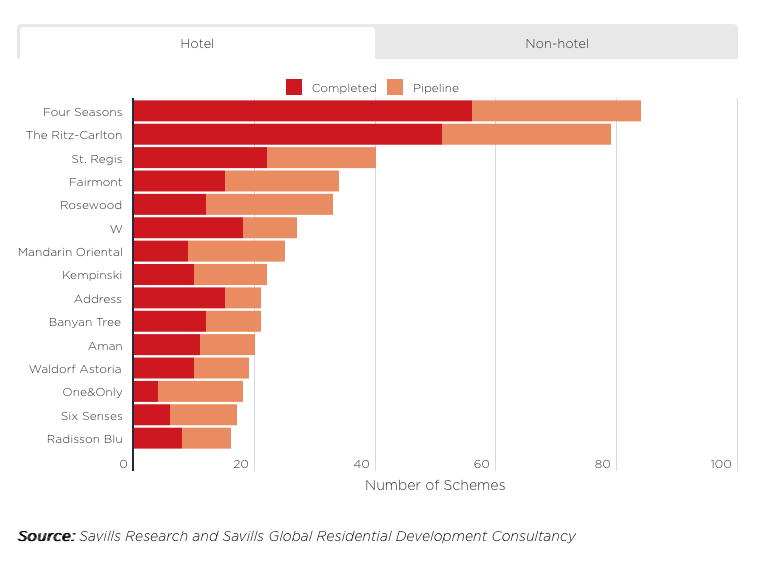
    This is an interesting part of the real estate business for a few reasons. One, it makes sense. A New Balance shoe that gets co-branded with Aimé Leon Dore unlocks additional value for both sides. ALD has a brand that certain people care about. So, of course the same would be true of real estate paired with the right brand.

    Two, it’s a growing market, and I think this is aided by the fact that development is an intensely local business — so it can be hard to grow a globally-significant brand on your own. Sometimes you just need to borrow someone else’s.

    And three, it’s usually a less risky approach to getting your name on buildings. Branded residences typically operate on a licensing model, which means developers pay for the right to use the brand. The brand may also capture some of the upside in the form of a percentage of sales. That’s less risky than putting up your own money.

  • Design-forward vacation rentals

    What I was getting at with the above tweet is that I think there’s way more demand, for places like this and this, than there is supply. Click on the first link and you’ll see that it’s booked up all summer long. And as for the second link, I just booked one of their rentals for this summer, but I have been trying — for years — to book it in the winter.

    I think the unmet use case is as simple as this: I live in a big city, and I want to get out of the city and go somewhere cool and design-forward. There are, of course, some options. But there’s a need for a lot more. Generally speaking, it feels to me like the majority of the supply is either (1) an expensive/large cottage or (2) an old “classic luxury” kind of hotel.

    I’m specifically referring to Toronto and southern Ontario with these options, but judging by some of the responses I got to my tweet, this appears to be an opportunity in many other markets as well. But I would be curious to hear from all you in comments or on Twitter. What “local” hospitality offerings are missing in your market? Where would you like to travel to and stay, but can’t?

  • Equinox to open its first hotel this summer

    Equinox Holdings operates, among other things, 99 fitness clubs in the US, the UK, and Canada. And this June, the first Equinox Hotel will open in a 92-storey tower in New York’s Hudson Yards. It will occupy floors 24 to 38. Below it will be Equinox’s corporate headquarters. And above it will be residential condominiums.

    Supposedly, the brand emerged out of a trend that the company saw over a decade ago: Its fitness club members were choosing to stay in hotels based on their proximity to an Equinox. They simply weren’t satisfied with the gym offerings at other luxury hotels.

    The full back story, which can be found here in WSJ. Magazine, is a good read. I think their ambition of trying to “own sleep” is a clever one. They are pitching their rooms as dark, quiet, and cool. I am sure other hospitality brands have tried to do this, but Equinox is clearly taking this directive very seriously. They even sponsored a sleep study with UCLA.

    This feels like a natural extension of their existing brand. Equinox is focused on regeneration. What better way to accomplish that than through a good night’s sleep?

    Image: 35 Hudson Yards via Related-Oxford

  • Guide to hotels, inns, and hideaways

    Monocle has a new guidebook out that is dedicated to hotels, inns, and hideaways. It also has a particular emphasis on the “honest, charming, quirky and independent.” So forget the conventional 5-star hotels. Hotels are fascinating places, even in today’s world of Airbnb. If you’re planning a trip or planning to start a hotel, this may be a useful handbook for you. Pick one up, here.

  • Editions of Edition

    A few weeks ago Surface Magazine interviewed Ian Schrager. If you don’t know who Ian Schrager is, you should look him up. He started Studio 54 in New York (along with Steve Rubell) and is largely credited with inventing the boutique hotel genre. His latest project is Edition Hotels, which launched in London in 2013 and in Miami in 2014.

    What I found particularly interesting about the interview are the “serious snafus” that Edition experienced at the outset. There was a project in Waikiki and a project in Istanbul. Both failed. Here’s a guy who invented the genre and had partnered up with Marriott to pioneer a new brand. And it wasn’t until Edition London that they were able hit their stride.

    I say all of this not to poke fun at their failures. Nobody should do that. Poke fun at not trying instead. My point is the exact opposite. To create something new and amazing, such as Edition, you often have to subject yourself to a few scrapes and bruises along the way.