Daily insights for city builders, delivered every morning at 6 AM ET. I’m Brandon Donnelly — a Toronto-based real estate developer and founder of Globizen. I’ve been writing here since 2013.

Tag: hospitality

  • This is not a hotel

    I am not the target market for Restoration Hardware, I mean RH. But I do think it is interesting the way they are evolving their brand. At the beginning of 2021, the company announced a $105 million equity investment in a development project in Aspen, where it is planning a new guesthouse and, more broadly, a new “RH ecosystem” that will include residences, restaurants, a spa, etc. It hasn’t opened yet, but RH does now have a guesthouse in New York. To be clear, it is not a hotel:

    So what is RH trying to do with all this?

    Surface Magazine recently argued that they are trying to become the “public” version of Soho House. That is, a lifestyle omni-brand that isn’t membership-based, but that will still make you feel rich and special while you eat, sleep, play, and shop for various things for your home. Now, I do think that their target customers aren’t exactly the same person. But of course, I see the parallels. And it’s certainly interesting from an experiential retail, brand ecosystem, and real estate development standpoint. It gets the brand everywhere.

  • Design-forward vacation rentals

    What I was getting at with the above tweet is that I think there’s way more demand, for places like this and this, than there is supply. Click on the first link and you’ll see that it’s booked up all summer long. And as for the second link, I just booked one of their rentals for this summer, but I have been trying — for years — to book it in the winter.

    I think the unmet use case is as simple as this: I live in a big city, and I want to get out of the city and go somewhere cool and design-forward. There are, of course, some options. But there’s a need for a lot more. Generally speaking, it feels to me like the majority of the supply is either (1) an expensive/large cottage or (2) an old “classic luxury” kind of hotel.

    I’m specifically referring to Toronto and southern Ontario with these options, but judging by some of the responses I got to my tweet, this appears to be an opportunity in many other markets as well. But I would be curious to hear from all you in comments or on Twitter. What “local” hospitality offerings are missing in your market? Where would you like to travel to and stay, but can’t?

  • Soho House went public this week

    So Soho House went public this week. It is now trading on the NYSE under the ticker $MCG. It renamed itself the Membership Collective Group Inc. for the IPO given the myriad of brands that the company now operates. The company went public at $14 a share and with a $2.8 billion valuation. It raised $420 million through the offering.

    My first reaction when I heard the news was that going public is maybe at odds with being a cool, urban, and exclusive membership club. We’re all about creatives; also, buy our stock. But maybe I’m wrong. This is just the company maturing. At 26 years old, the company now has some 119,000 members and has 30 Soho Houses around the world in 12 different countries.

    Full disclosure: I am a member and a big fan of Soho House.

    But now that the company is public, we also know that it has never turned a profit. And it hopes to do that by next year, as well as open some five to seven new Soho Houses each year while trying to remain “asset light”. As the company does this and pushes toward profitability, there is, of course, a very natural question about what that does to the experience and the overall brand.

    Does it get diluted at all?

    I don’t think that necessarily needs to be the case. But of course the company will end up evolving. On a related note, if anyone from Soho House / MCG is reading this post (unlikely), I would love to connect about an opportunity here in the Toronto area. I think it has the potential to become something truly remarkable — not to mention, much needed. I can be reached, here.

  • Culture, architecture, and hospitality in the Algarve

    The Addresses is a new hospitality brand that offers up beautifully designed custom houses for rent in the Algarve region of Portugal. Designed by Lisbon-based architects, atelier RUA, the company’s initial houses include a former fish warehouse that was renovated with both modern and traditional Portuguese touches.

    Alongside these retreats, the company (by way of a partnership with Studio Stories) also offers its guests curated “experiences.” This is all part of the company’s focus on culture, architecture, and hospitality.

    I am a big fan of these design-forward hospitality companies, which offer experiences that you could probably describe as existing somewhere between a traditional hotel and an Airbnb. Similar to the latter, they are decentralized and they are focused on authentic and local experiences.

    But they also come with a particular set of sensibilities — and perhaps some consistency — that you could argue starts to reflect your favorite hotel. Another more local example is Canadian-based Hinter, which I discovered and blogged about last fall.

    When I checked this past winter, Hinter’s houses were booked up several months in advance. This tells me that there’s more than a few people who are hungry for these sorts of travel experiences. At the same time, I think it speaks to the tremendous value that you can create with beautiful architecture and design.

  • The new Miami

    The last year has been challenging for the hospitality industry. But at the same time, it was a good year to renovate. The W South Beach recently unveiled a $30 million renovation project that includes all 357 rooms. Designed by local studio Urban Robot Associates, the project directive was an interesting one. The team was asked to reimagine the hotel for the “new Miami.” A Miami that is more grown up and cultured, but that, of course, still has a bit of an edge. With all of the attention that Miami and Florida are getting right now, this project feels timely and indicative of something broader underway. Indeed, it’s hard not to acknowledge that Miami is having a moment right now. This also happens to be one of the last hotels that I stayed at prior to last March’s lockdown. So I have a clear “before” in my mind. It’s fun to see how much it has changed over the last year while I was mostly sitting at home. (Shameless plug: I also love the pale wood herringbone floors, which, coincidentally, will also be on offer at One Delisle.)

    Images: Urban Robot Associates

  • Equinox to open its first hotel this summer

    Equinox Holdings operates, among other things, 99 fitness clubs in the US, the UK, and Canada. And this June, the first Equinox Hotel will open in a 92-storey tower in New York’s Hudson Yards. It will occupy floors 24 to 38. Below it will be Equinox’s corporate headquarters. And above it will be residential condominiums.

    Supposedly, the brand emerged out of a trend that the company saw over a decade ago: Its fitness club members were choosing to stay in hotels based on their proximity to an Equinox. They simply weren’t satisfied with the gym offerings at other luxury hotels.

    The full back story, which can be found here in WSJ. Magazine, is a good read. I think their ambition of trying to “own sleep” is a clever one. They are pitching their rooms as dark, quiet, and cool. I am sure other hospitality brands have tried to do this, but Equinox is clearly taking this directive very seriously. They even sponsored a sleep study with UCLA.

    This feels like a natural extension of their existing brand. Equinox is focused on regeneration. What better way to accomplish that than through a good night’s sleep?

    Image: 35 Hudson Yards via Related-Oxford

  • Introducing Stephen Avenue Place

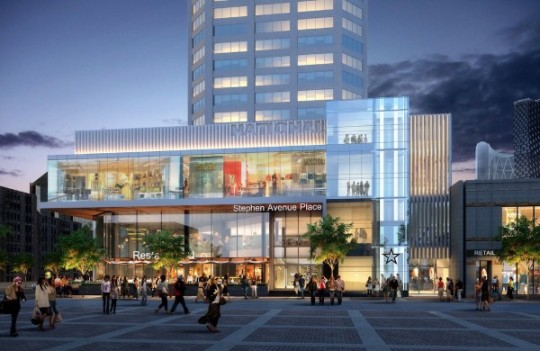
    Today, the Slate Canadian Real Estate Opportunity Fund I announced a new name for its 40 storey tower at 700 2nd Street in Calgary: Stephen Avenue Place

    It also announced that it has partnered with Oliver & Bonacini Hospitality and Concorde Entertainment Group to create three new dining destinations at the property: a top floor restaurant, a food hall, and a high-energy restaurant/bar/patio at street level.

    Here are a couple of excerpts from today’s press release:

    Stephen Avenue Place offers 620,000 square feet of rentable space at the nexus of the historic Stephen Avenue Walk and 2nd St. This classic of the Calgary skyline will undergo a significant renovation – from its public-access ground floor to exclusive tenant amenities and top-floor restaurant – that will reposition it as a modern hub for energy, innovation, business, dining and shopping.

    The acquisition and renovation of Stephen Avenue Place is part of Slate’s growing investment in Calgary. In the past 18 months, Slate has increased its footprint in Calgary to 2.3 million square feet with the purchase of 21 office properties, including 12 downtown.

    “We are thrilled to acquire and develop such a high-quality property in downtown Calgary that offers businesses, diners and shoppers the very best in location, amenities and access,” said Slate founding partner Blair Welch. “Stephen Avenue Place will undergo an extensive renovation to fully reflect the way we work and live now, while respecting and celebrating its history and future as a Calgary landmark.”

    For the full press release, click here. And to learn more about Stephen Avenue Place, including leasing opportunities, click here.

    Disclosure: As many of you already know, I work for Slate Asset Management L.P. I am responsible for the company’s ground-up development efforts.

  • The un-hotel

    According to Condé Nast, the coolest hotel trend for 2018 is the “un-hotel.” Here’s what they mean by that: “Instead of many rooms under one roof, these new un-hotels have different rooms in various locations, united only in character and concept.”

    I wrote about one of these un-hotels, the Vipp Shelter, back in the spring. I was interested both in how the company was using their hotel as a kind of shop and how they had adopted this decentralized approach to hospitality.

    Different rooms in different locations has got to create some diseconomies. But the appeal is clear. We are all craving new experiences.

    To me, it feels like a hybrid between an Airbnb and a boutique hotel. You get to “travel like a local”, but you’re still staying with a brand and there’s likely some sort of unifying concept across the portfolio.

    Check out the SWEETS hotel in Amsterdam.

    Image: SWEETS hotel

  • Editions of Edition

    A few weeks ago Surface Magazine interviewed Ian Schrager. If you don’t know who Ian Schrager is, you should look him up. He started Studio 54 in New York (along with Steve Rubell) and is largely credited with inventing the boutique hotel genre. His latest project is Edition Hotels, which launched in London in 2013 and in Miami in 2014.

    What I found particularly interesting about the interview are the “serious snafus” that Edition experienced at the outset. There was a project in Waikiki and a project in Istanbul. Both failed. Here’s a guy who invented the genre and had partnered up with Marriott to pioneer a new brand. And it wasn’t until Edition London that they were able hit their stride.

    I say all of this not to poke fun at their failures. Nobody should do that. Poke fun at not trying instead. My point is the exact opposite. To create something new and amazing, such as Edition, you often have to subject yourself to a few scrapes and bruises along the way.

  • Imagining the way things could be

    Photograph Old in new by Andrew Johnston on 500px

    Old in new by Andrew Johnston on 500px

    I was out for lunch with a colleague of mine yesterday afternoon and he said to me: “Brandon, I’m really surprised that you’re so interested in technology. It just seems so different compared to real estate and architecture.”

    And I’ve certainly heard that exact same comment from a number of people before. But I don’t see it that way and here are a few reasons why.

    The common thread for me between architecture, real estate development, and technology is that in all of these cases it is about imagining the way things could be in the future and then creating it. It’s about change. It’s about growth. It’s about creation. And I consider myself a builder in practically every sense of the word.

    At the same time, each of these disciplines is about creating engaging spaces for people. Architects and real estate developers do it in the physical world, but many technology products strive to do exactly the same thing in the online world.

    In fact, a couple of years ago I was fascinated to learn that Facebook has and continues to draw inspiration from many of the same books and philosophies that architects, planners, and developers rely on when it comes to creating engaging communities. The medium might be different, but it’s still about people.

    Finally, as I’ve said many times before here on Architect This City, I think that the distinction between tech and non-tech companies and industries is quickly evaporating. Is Airbnb a tech company or a hospitality company? Is Uber a tech company or a taxi company? Pretty soon we’ll be saying that about many other industries.

    Maybe it’s because I’ve always been interested in wading through the overlaps between disciplines, but this is just the way I see it.