Daily insights for city builders, delivered every morning at 6 AM ET. I’m Brandon Donnelly — a Toronto-based real estate developer and founder of Globizen. I’ve been writing here since 2013.

Tag: homeowner

  • A new kind of homeownership

    Yesterday Andreessen Horowitz announced an investment in the startup Point. They led an $8.4 million Series A round.

    Point is an alternative to traditional home equity loans and HELOCs. The way it works is that you actually sell a portion of your property. Here’s an example:
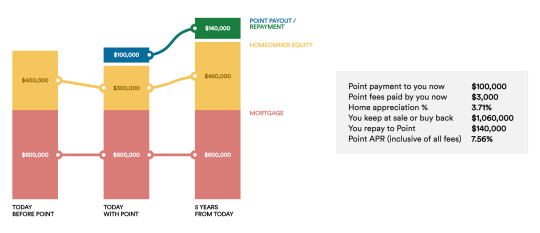
    In this scenario, the home is worth $1M. Point makes an offer to buy 10% of today’s value in exchange for 20% of the home’s future appreciation on a 5 year term. You pay a 3% fee when the $100,000 (10%) is paid out, but you don’t make any monthly payments. You just give up potential future appreciation. (If the home doesn’t appreciate, Point doesn’t make money.)

    What’s interesting about this model is that traditionally “housing” has meant one of two things. Either you own 0% of the home (i.e. you rent) or you own 100% of the home (usually with the help of a mortgage).

    Point is making it easier for you to potentially own 95% or 90% of your home. They are taking an equity stake, which is why there are no monthly payments associated with it. 

    The investment angle is that homeowners get to diversify their wealth out, and (Point) investors get to diversify in, without having to worry about actually managing the property.

    Would you use this as a tool to unlock your home equity wealth?
  • Transparent offer platform

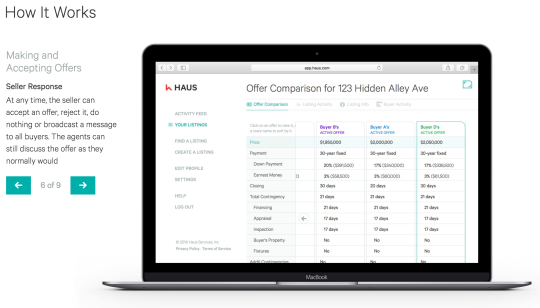
    A new “transparent offer platform” called Haus has just launched in California to serve the residential real estate market. The way it works is that all offers are submitted online. And once an offer has been confirmed, it – along with all of its terms – gets revealed to every other potential buyer. See image below.

    image

    I’ve seen a number of different iterations of this same idea, which tells me that this is a well-identified problem in the real estate market. Here’s a snippet from a recent TechCrunch article announcing Haus:

    “We think the openness will create a more efficient market and that the number of offers and price will ultimately be dependent on demand,” said Haus GM Sarah Ham. “Bidding wars are a common, almost accepted, part of the real estate process today. But with our approach, buyers know where they stand. Buyers will know what they need to offer to make their offer competitive, but they also won’t negotiate against themselves.”

    I completely agree that this is a problem that needs to be solved. It will create a more efficient marketplace. However, in this market, I suspect that the current information asymmetries largely benefit sellers, to the detriment of buyers. So I wonder if the supply-side of the marketplace will be willing to participate at scale. What’s really in it for them?

    Side note: Haus is the latest project from Expa, which is a “startup studio” that works on its own ideas, as well as partners with other founders. I am very interested in this approach to creation because I think you have to try and make a lot of things if you want to do truly innovative things.

  • Find the best local construction professionals at the lowest prices

    One of my closest friends, who also happens to be in the same industry, is currently testing out a new construction marketplace idea. It’s called Tenderlet and it’s an online platform that helps your average house or condo owner “find the best local construction professionals at the lowest prices.”

    Right now it’s just a basic website, but he is obviously thinking that it could grow into a far more robust online marketplace.

    The way it works is real simple:

    1. You tell Tenderlet about your construction job – everything from a water damaged ceiling repair to new hardwood flooring. 
    2. Tenderlet goes out and gets multiple quotes on your behalf (just like how the professionals do it). 
    3. Then Tenderlet comes back to you with at least 3 quotes and a recommendation. It’ll even handle scheduling and payments.

    Eventually he’s imagining that there will be a mobile app, reviews for the construction professionals, and a location dimension, which can make all the difference, particularly for smaller jobs. But you have to start somewhere.

    I think he’s on to something here. I know I want to use it. So I would encourage you to check out tenderlet.com and give it a try. If you have any feedback about the idea, I am sure he would love to hear from you in the comment section below.

  • Why do more people in Quebec sell their home without an agent?

    If you ask most people, they’ll tell you that real estate agents will never ever disappear. 

    Despite the internet, mobile phones, social networks, and companies (here in Canada) such as comFree and PropertyGuys, the bulk of the market still employs an agent when it comes time to buy and/or sell a home. This is true both in Canada and the United States. And it may always be true.

    But there are lots of entrepreneurs and people in the real estate community experimenting with different models. OpenDoor and Open Listings are two new startups out of the US that I’ve been following closely.

    At the same time, there is a certain fraction of the market that is willing to go at it alone. By some estimates this number could be as high as 25% in Canada. Of course, this is a hard number to measure accurately since there isn’t just one method of selling a home privately and many transactions likely go untracked.

    But one thing that I’ve been wondering for awhile now is why the percentage of private home sales is seemingly so much higher in the province of Quebec. According to Wikipedia, this number might be greater than 50%. And a quick search on comFree (duProprio in Quebec) seems to suggest that this may indeed be the case.

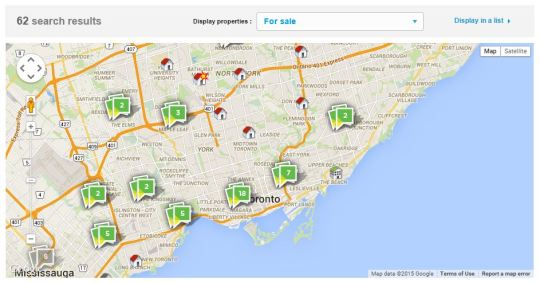
    Here are the comFree search results for downtown Toronto. There are 62 properties.

    image

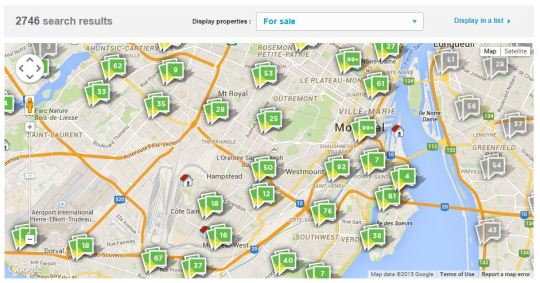
    And here are the duProprio search results for downtown Montreal (notice I tried to maintain the same zoom level). There are 2,746 properties.

    image

    If anyone has any insights on this phenomenon, I would love to hear from you in the comment section below. I don’t know why this is the way it is.