Daily insights for city builders, delivered every morning at 6 AM ET. I’m Brandon Donnelly — a Toronto-based real estate developer and founder of Globizen. I’ve been writing here since 2013.

Tag: home equity

  • Equitable Bank launches construction financing product for laneway houses

    A few weeks ago, Equitable Bank launched a new construction financing product for laneway homes and garden suites in Canada. Here is the announcement. This is generally good news. When we completed Mackay Laneway House back in 2021, the banks hadn’t yet gotten their head around this housing type. I remember RBC getting tripped up on the fact that there were two detached dwellings on the same residential lot.

    That said, there are some important conditions around this new mortgage product:

    “The Laneway House Mortgage is offered on properties that are free and clear, or in combination with new or existing mortgages where Equitable Bank holds, or will hold, the first position.”

    In other words, they want no debt on the property or they want sufficient equity in the property — but Equitable Bank needs to hold the mortgage. I suspect that most of the people who have built laneway and garden suites have done so by leveraging the equity in their main house; so I’m not sure how “innovative” this product will end being in practice. You’ll also need to switch to Equitable Bank if you have your mortgage with another lender.

    Still, if you’re looking to build one of these homes — and I continue to believe that they make a ton of sense both financially and from a city-building standpoint — it wouldn’t hurt to see what Equitable Bank can offer.

  • Cashing out home equity

    Below is an interesting chart from the WSJ showing total home equity cashed out in the United States by quarter. What is clear is that the US is nowhere near its pre-2008 peak in terms of total dollars. However, if you look at the percentage of homeowners who refinanced their home in 2018 and took out cash at a higher interest rate, it was nearly 60% of all refis. This is up in the pre-2008 territory and it’s about 3x more than the average from 2009 to 2017.

    Now, you could argue that this is a fairly rationale outcome after a long period of economic expansion and home price appreciation. And interest rates were, on average, even lower in the 2012 to 2016 period. But, the WSJ posits that this could be a signal that people simply need the cash — which is why the majority are willing to accept a higher interest rate. Here is another chart from a different WSJ article:

    Housing debt (mortgage balances) has come way down since 2008, but non-housing debt has come way up and now exceeds that of the former. Non-housing consumer debt rose by about $1 trillion in real dollars from 2013 to 2019, principally driven by student loans and car loans. Noteworthy is the fact that student loans are rising fairly linearly (along with dramatically), whereas car loans and credit card debt seem to follow the overall economy.

    When people are feeling richer (and confident about their economic prospects) they go out and buy things, like cars.

    Charts: WSJ

  • A new kind of homeownership

    Yesterday Andreessen Horowitz announced an investment in the startup Point. They led an $8.4 million Series A round.

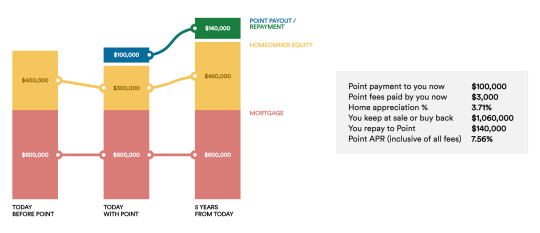
    Point is an alternative to traditional home equity loans and HELOCs. The way it works is that you actually sell a portion of your property. Here’s an example:

    In this scenario, the home is worth $1M. Point makes an offer to buy 10% of today’s value in exchange for 20% of the home’s future appreciation on a 5 year term. You pay a 3% fee when the $100,000 (10%) is paid out, but you don’t make any monthly payments. You just give up potential future appreciation. (If the home doesn’t appreciate, Point doesn’t make money.)

    What’s interesting about this model is that traditionally “housing” has meant one of two things. Either you own 0% of the home (i.e. you rent) or you own 100% of the home (usually with the help of a mortgage).

    Point is making it easier for you to potentially own 95% or 90% of your home. They are taking an equity stake, which is why there are no monthly payments associated with it. 

    The investment angle is that homeowners get to diversify their wealth out, and (Point) investors get to diversify in, without having to worry about actually managing the property.

    Would you use this as a tool to unlock your home equity wealth?