Daily insights for city builders, delivered every morning at 6 AM ET. I’m Brandon Donnelly — a Toronto-based real estate developer and founder of Globizen. I’ve been writing here since 2013.

Tag: high-rise housing

  • The art of high-rise living

    Today, I’m excited to share that I’ll be attending the second annual Elevate event this December as an industry ambassador. This means I get to ride alongside industry celebrities like Norm Li. (He better be DJ’ing.)

    Put on by Zonda, in partnership with Livabl and ARCHITECT Magazine, the event is focused exclusively on “the art of high-rise luxury living.” Everything from the overall state of the housing market to how to sell branded residences.

    Here’s the agenda and here’s the list of speakers.

    I wasn’t able to attend last year, but I heard from a number of industry friends that it was very well done, which is why I agreed to participate this year. That now means I have a discount code you can all use if you’d like to attend — BRANDONVIP30.

    For those of you who like art and culture things, the event also happens to fall right after Art Basel. This was done on purpose, and so now you have at least two good reasons to be in Miami Beach in December.

  • Shrinking lot sizes and unit sizes

    Shane Dingman’s recent piece in the Globe and Mail about shrinking lot sizes raises two interesting points.

    One, new low-rise lot sizes seem to be shrinking and that’s probably a normal market outcome. Similar to the way in which average unit sizes have been generally coming down for mid-rise and high-rise product, it is a way to maintain some semblance of affordability in the face of ever-rising costs.

    The average price of a new condo in the City of Toronto last quarter was nearly $1,300 psf. That means that if you had an average unit size of 1,000 square feet, you’d have an average selling price of $1.3 million (to state the obvious). Not everyone can afford this ticket price, and so there’s downward pressure on unit sizes in order to get the face prices down.

    Two, developer margins aren’t increasing just because home prices have been going up. At best, they’ve remained constant (Shane provides a quantitative example in his article). But there are also many cases where margins are getting squeezed as a result of rising costs.

    All of this to say that I think we can continue to expect downward pressure on lot sizes and unit sizes as the Toronto region continues to grow.

  • New high-rise home prices up 39.5% year-over-year

    February data (2018) for the new home market in the Greater Toronto Area was released this past week by BILD and Altus. I seem to have gotten into the habit of writing about this every month.

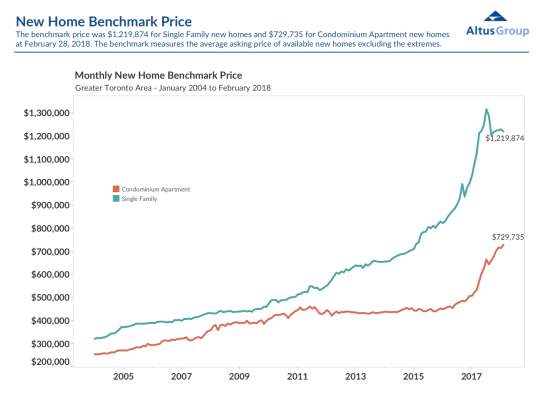
    The benchmark price for new low-rise single-family housing was down slightly from January to $1,219,874, but still up 12.8% from a year prior.

    The benchmark price for new high-rise housing was up a whopping 39.5% year-over-year to $729,735. But part of this is being driven by an equally dramatic increase in average unit sizes.

    Here is the relevant graph:

    image

    The story continues to be about tight supply, historically low developer inventories, and a lack of affordable low-rise product. 

    As I have argued many times before on this blog, I believe these factors — and in particular the last one — are, at least partly, driving this recent pop in high-rise pricing. People are priced out and now searching for substitutes.

    So my prediction continues to be that we will see a convergence (i.e. diminishing spread) between new low-rise and high-rise pricing.

    That will also bring about design and product changes on the high-rise side.

  • Multi-Unit Housing in Urban Cities: From 1800 to Present Day

    I just ordered a copy of Multi-Unit Housing in Urban Cities: From 1800 to Present Day by Katy Chey. I figured this was a book that we should have hanging around our office. I also like to support the Daniels Faculty.

    The book covers the following multi-unit housing typologies:

    • Back-to-backs in Birmingham
    • Tenements in London
    • Haussmann apartments in Paris
    • Tenements in New York
    • Tong lau in Hong Kong
    • Perimeter block, linear block and block-edge in Berlin
    • Perimeter block and solitaire in Amsterdam
    • Space-enclosing structures in Beijing
    • Kyosho jutaku in Tokyo
    • High-rises in Toronto

    In addition to each typology, the book analyzes the connection between the housing type and the city. Why did certain typologies flourish where they did and how have they helped to define their city?

    It reminds me of what I was trying to do with some of my recent posts about Hong Kong’s typical tower plan, albeit with far less rigor than what I am sure has been applied to this book.

    I am also curious to read what has been written about high-rises in Toronto. It goes to show you just how defining the current real estate cycle has been for this city. That’s our multi-unit housing typology.

    Image: Daniels Faculty. My multi-unit home made the book.

  • Toward larger condo units

    One of the things that I’ve been following over the years (and writing about a lot on this blog) is average condo/apartment sizes, specifically in Toronto. I’m interested in this topic because I think it tells you a lot about what’s going on in the market and who is buying/renting.

    Developers are often criticized here for building tiny “shoebox condos.” It wouldn’t be unusual to see a building with an average unit size somewhere in the range of 600-700 square feet.

    But it’s important to keep in mind that the pull toward smaller units is largely because of one important reason: affordability. All things being equal, I’m sure that most people would gladly take an expansive 2,000 sf apartment. But how many people can actually afford a place that large? And for those who can afford it, many seem to opt for ground-related housing instead. So for the most part, the market has said: not many.

    But I’ve suspected for awhile that it was only a matter of time before we saw unit sizes start to creep upward. And indeed today there seems to be a trend toward larger units. I can’t tell you the exact percentage increase for average unit sizes across the city, but you don’t have to look very hard to find a proposed project with average unit sizes in the range of 1,000 to 1,500 sf. I spent this morning looking many of them up and going through their data sheets. If any of you have a larger sample size, please share it in the comment section below.

    To me this feels like a maturation of the market. More of us are deciding to move up, instead of out, which is absolutely what we need to do. Affordability, perhaps more than ever, is still a concern. But the confluence of a couple of factors seem to be expanding the multi-family market in this direction.

    One, empty nesters are starting to cash out of their large houses and they still want/need space. Two, the price of low-rise housing has increased so dramatically that it’s now out of reach for many and/or it no longer feels cost competitive on a per square foot basis. Three, Toronto’s status as a global city continues to increase and this is making it more of a magnet for foreign capital. And four, central and transit-adjacent housing is incredibly desirable for a large segment of the population. Horrible traffic is probably helping this one.

    If there’s any truth to my logic, then I wonder if we won’t see a bit of a bifurcation in the market, if we aren’t already. On the one end, there will still be the pull to shrink unit sizes and maximize affordability. See micro-units. But on the other end, there will be a product segment that now acts as a substitute for low-rise housing.

    I’ve said this before, but I’ll say it again: I think more families in condos and apartments would be a positive thing for the city.

  • Supply down. Prices up. Unit sizes up.

    This morning BILD released its November new home data for the Greater Toronto Area. 

    The story is one we’ve been hearing for a while. Supply is trending downward. It’s becoming harder to build. And prices are up. The average new detached house in this region is now C$1,230,961 and the average new condo is now C$493,137 (~$601 psf). Overall, average pricing is up 20% for low-rise houses and up 10% for condos, compared to this time last year.

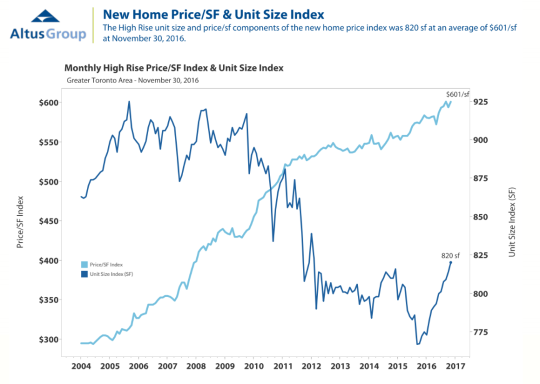
    One of the things that I find interesting about the data is how unit sizes have recently started trending upward on the high-rise (condo) side. Below is a chart from Altus Group that shows what I’m talking about. Look at the increase from the middle of 2015 to today. The average is now 820 sf, compared to what looks to be around 770 sf at its lowest point.

    image

    Now, there are a number of possible explanations for this. One is that boomers are starting to sell their houses and move into condos in larger numbers, and 500 sf just don’t do. The market is starting to cater to them. Another possible explanation is that low-rise pricing has become so out of reach for many people and families, that they are now looking to condos to fill that need.

    I see both scenarios playing out in new projects today. But this second scenario, in particular, is one that I’ve been thinking about for a few years now. It’s less obvious than the boomer play. But I think of it as the market maturing. I like seeing families living right in the city and I am sure we will see more of that in the future.

  • Housing completions in Toronto from 1996 to 2014

    Whenever I read studies that cite census data, I’m often left feeling like the data is out-of-date. 

    Five years – which is how often Canada conducts its national census – is a long time. Somebody could move to this country for school, complete a 4-year degree, and then leave, and we wouldn’t even pick it up in our data.

    Thankfully, we’ve at least reinstated the long-form census for next year. Here are the questions, if you’re curious.

    But all of this is a digression. 

    This morning I read through a housing report that the City of Toronto published in October of this year. It’s about housing trends. And I wanted to share the below chart that covers housing completions for the period of 1996 to 2014. Keep in mind that this is for the City of Toronto, and not the Greater Toronto Area.

    What it shows is that over this 18 year period, 78% of all housing completions in this city have been either low-rise or high-rise condominiums/apartments. The remaining 22% is a mix of detached and semi-detached houses and townhouses.

    However, this 22% is an average. 

    Detached and semi-detached housing completions declined from 22% in the 1996-2001 period to 10% a decade later. And row and townhouses declined from 16% to 6% during this same period.

    At the same time, “many” of the housing units in this 22% were actually replacing existing and older housing stock. That is, according to the report, many were “knock-downs” and rebuilds. In these cases, it means that the completions actually do not represent net new housing units. So in reality, the supply of new single-family housing is even lower than it appears in the chart above.

    When you look at all of this, it should come as no surprise to you that our current combination of low interest rates and low supply has been leading to huge price increases on the single-family side of the market.

    And it’s for this reason that I believe Toronto will eventually start to look towards allowing more low-rise intensification. Laneway housing, as one example, would represent virtually 100% new ground-related housing in already built up areas. Where else are we going to find that kind of housing opportunity?

    So in my view, it is a question of when, not if, this will happen.

  • I’d raise kids in an apartment

    One of the North American truisms that I often like to challenge is the belief that kids should be raised in a house.

    I’m interested in this topic, not because I’m planning for a kid, but because Toronto has gone through such a dramatic transformation over the past 15+ years to become a city where more and more people are living in multi-family dwellings (condos, apartments, and so on).

    However, there’s still the belief amongst many circles that condo living is merely a stepping stone on the way to a house. Since Millenials have effectively added a new life phase between University and marriage, condos have become the home of choice for many twenty and thirty somethings. But how long will they stick around? I see a lot of people in my network getting married and subsequently moving from a condo to a house.

    Why is this?

    Is it because of schools? Is it a cultural belief that families require a house and a backyard? As someone who grew up in the suburbs, I can tell you that I never played in the backyard. I played on the street with other kids. I used a shared public space rather than a private one.

    On a practical level, I think the condo-to-house tradition has a lot to do with the fact that condos are just more expensive on a per square foot basis than wood-framed houses. For the same price that you might pay for a small 2 bedroom condo in Toronto, you could still conceivably buy a 3 bedroom house in some inner city neighbourhood.

    But the supply of single family homes in the city is limited. We’re not adding anymore. So as the price of these homes continues to increase – at what is now a faster rate than high rise housing – we may eventually reach a point where there’s no longer a cost savings associated with low-rise housing. In fact, they’d just be a luxury for the well-heeled.

    In this scenario, I think we’d naturally see an increase in larger condo units – something the city has been trying to artificially encourage. And out of necessity, we’d see more and more families in condos. However, it’ll take a change in mindset. Are you ready for it? I’d like to think that I am.