Daily insights for city builders, delivered every morning at 6 AM ET. I’m Brandon Donnelly — a Toronto-based real estate developer and founder of Globizen. I’ve been writing here since 2013.

Tag: heritage buildings

  • The Château Laurier battle in Ottawa

    As I was going through this Twitter thread by Alex Bozikovic on the “Château Laurier battle,” I came across a great line by Robert Wright: “We cannot recreate the past only parody it.” I told him I was going to steal it, but here I am giving him credit.

    The controversy in Ottawa stems from the fact that a number of people believe that a modern addition to the Fairmont Château Laurier (which was constructed between 1909 and 1912) amounts to heresy.

    Instead, the addition should be designed to match the “Château style” that already exists. There should be no change. As Alex put it, “people want Disneyland.”

    We’ve had this very same debate come up on some of our projects, where people — but notably, not the city — have asked us to replicate something that was constructed in the 1800’s using labor and material techniques that no longer exist.

    This is where Robert’s line comes in.

    Architecture is a reflection of the cultural milieu in which it was designed and built, which is one of the reasons why we sometimes preserve old buildings. They communicate to us a particular moment in time.

    The reason architects, designers, and planners so often respond — negatively that is — to Disneyland-type architecture, is that it lacks that same authenticity. It’s only a simulacra.

    It’s for this reason that one of Ontario’s “eight guiding principles in the conservation of built heritage properties” is, in fact, legibility:

    New work should be distinguishable from old. Buildings or structures should be recognized as products of their own time, and new additions should not blur the distinction between old and new.”

    This is not to say that we shouldn’t be respectful of the past. Five of the eight guiding principles include the word “respect” in the title. There should be lots of that.

    But we would be fooling, and cheating, ourselves if we believed we could mimic the past with any justice. We cannot recreate the past only parody it.
  • Thoughts on urban renewal and Geary Avenue

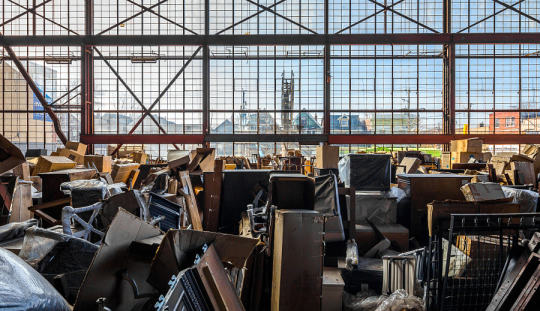
    Photograph dupont survivor by Josemaria de Churtichaga on 500px

    dupont survivor by Josemaria de Churtichaga on 500px

    I was on CBC radio this morning talking about the revitalization of Dovercourt Village and Geary Avenue in Toronto. 

    The funny thing about this topic is that it’s one I actually held off writing about. I’ve been thinking about this street and area for probably about 5 years now. However, I do have to keep some secrets to myself 🙂

    But then I started feeling like the cat was already out of the bag. Everyone in my circle was talking about it. So I wrote a post calling Dovercourt Village the next Ossington. I had no idea it would get the traction that it has gotten, but in hindsight it makes total sense. It makes a great headline: “Toronto’s ugliest street to become the next Ossington.” Boom.

    The tough question that Matt Galloway asked me this morning was: What happens to all the blue collar businesses when/if Geary Avenue and the area really takes off? My response – given that it was only a 5 minute radio piece – was that it comes down to preservation vs. progress. 

    This is a topic that I’ve written about with respect to heritage buildings, but the same concept applies to communities as well. How do you allow neighborhoods to receive new investment while at the same time not erasing its past and the things that made it interesting in the first place?

    It’s not easy, that’s for sure.

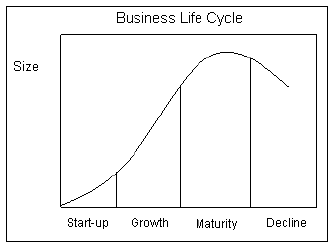
    I absolutely believe that there are things that developers can do to respect the neighborhoods in which they build in. But at the same time there are economics at play. In business school, they teach you this:

    It’s the lifecycle of businesses and industries. 

    The key takeaway here is that the rise and decline of businesses is actually quite healthy for markets. History is littered with examples. The word processor replaced the typewriter. The mobile phone replaced the landline. Air travel replaced rail travel. And the list goes on.

    Today, I think we’re at a moment in time where our relationship to cars is changing dramatically. How we get around and how we own and operate them is being called into question. 

    So just because there’s auto shops on Geary Avenue today, doesn’t mean they’ll be there tomorrow regardless of whether the area takes off or not.

  • A walk down memory lane in the St. Lawrence Market

    I recently got lost looking through the Toronto Archives for old photos of my neighborhood. I’ve blogged about what the St. Lawrence Market neighborhood looked like in the 70s, but I wanted to go back even further. I wanted to see what exactly had been demolished and lost over the years.

    But by the end of it, I was just sad. As a lover of cities, it always makes me upset to see great buildings disappear. I think you too will be surprised at what I found.

    The following picture depicts the north side of Front Street East, about 2 blocks east of Yonge Street. I don’t know what year it is, but look at how stunning these buildings are. It looks like Soho, New York meets some glamorous European capital.

    Can you imagine what we could do with these buildings today?

    image

    If there’s any doubt in your mind that this is Toronto or that it’s Front Street East, take a look at the spire in the far left hand side of the picture. It belongs to the Toronto Board of Trade Building, which used to sit at the north east corner of Yonge Street and Front Street. When it was built in the late 1800s, it was considered one of the first “skyscrapers” in Toronto. It was demolished in the 1950s.

    Here’s a picture of the Board of Trade Building so that you can compare. Again, take a look at the spire.

    image

    For those of you who might not be familiar with the area, here’s a map to help you out. The Board of Trade Building is shown on the bottom left hand corner. And the buildings in the first picture are in the triangular land area between Wellington and Front.

    image

    Now, let’s fast forward to the late 1960s. Those same buildings shown in picture number one have been demolished and in their place is the following parking lot. It’s a bit less glamorous looking. There are still heritage buildings on the south side of Front Street, but the balance of the area seems to have been blown out. What a shame.

    image

    Finally, here’s an aerial view of the area. It’s also from the late 1960s or early 1970s. You can see the same triangular land area, with only the Flatiron Building still standing at the very tip of it.

    image

    Obviously the St. Lawrence Market has come a long way since the 70s. That triangular area has since become Berczy Park, which is actually in the midst of being completely revitalized, and all of those parking lots have been filled in. But I still can’t help but wonder what the neighborhood would be like today had we preserved all of those heritage buildings. 

    I think cities work best when you can figure out that delicate balance between preservation and progress. It’s not always the simplest approach, but as most things in life, the right decisions are often the toughest ones to make.

  • The demand for character office space

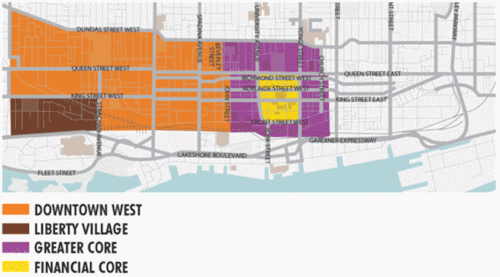
    Last Friday the Toronto Star published an article talking about the growing demand for character office buildings in submarkets outside of Toronto’s core. Specifically, it was talking about the Downtown West and Liberty Village submarkets (citing a report from CBRE).

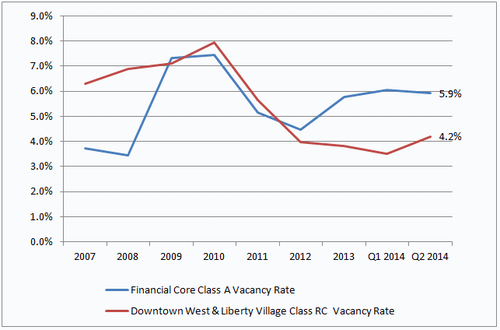
    I’m sure this isn’t news to most of you. Cool loft spaces have been popular for years. But it’s interesting to look at how rents and vacancy rates have changed for these submarkets and product types over time.

    Since 2002, average (net) asking rents for brick-and-beam buildings in the west end have gone from $16.12 to $22.23 per square foot. Almost a 38% increase. By comparison, office space in the core has gone from $28.40 to $32.38 per square foot. A 14% increase.

    And if you look at vacancy rates since 2007, you’ll see that the character office market has really tightened up over the past 4 years or so. There’s growing demand for a limited amount of supply.

    With the growth that the downtown core is seeing and with the rise of Toronto as a creative startup hub, I’m sure we’ll continue to see strong demand for this type of space. But there’s only so much of it to go around. So I think we’ll also end up seeing greater interest in the east side of downtown and also more interesting new builds.

    Images/Charts: CBRE

  • Mirvish+Gehry and the story of 4 heritage buildings

    I am a real estate developer and I believe in progress. But I also fundamentally believe in balancing progress and preservation. I’ve said this before.

    This morning, Alex Bozikovic of the Globe and Mail, published a piece on the epic Mirvish + Gehry proposal for Toronto’s Entertainment District. It’s called, “Frank Gehry and David Mirvish’s tall order in Toronto.

    Now, I’ve said before that I like this project. I don’t mind the height and I don’t buy the argument that there aren’t enough public spaces in the area. There’s David Pecaut Square directly to the south that could use a few more warm bodies in it.

    But as I also said before, I think the key concern here is one of heritage. There are 4 heritage designated buildings on the site dating back to as early as 1901. Here’s where they sit:

    image

    The Anderson Building (1915) is particularly unique. Here’s a larger photo (via blogTO):

    image

    So while I’m excited by the prospect of a real Gehry project in Toronto, I think we need to figure out a way to find a balance. Preserve the facades, build on top, or relocate them. Do something besides wipe the slate clean.

    As Bozikovic rightly points out in his article, “Toronto has a sophisticated culture of working with heritage buildings.” There are lots of great examples of how we managed to move forward as a city, without erasing our past.

    And in many ways, I see this ability to work with and build upon heritage buildings as an emerging Toronto vernacular. I mean, what could be more appropriate for the most diverse city on the planet than an architectural style—of our own—that blends and layers history with disparate design ideologies.

    I sense an opportunity.

    We could have Gehry’s white sinuous curves drape over the heritage buildings. Make them become a literal unveiling of Toronto’s past and a metaphor for the sophisticated way in which we build upon legacy.

    It’s too easy to just demolish everything. We’re better than that.