Daily insights for city builders, delivered every morning at 6 AM ET. I’m Brandon Donnelly — a Toronto-based real estate developer and founder of Globizen. I’ve been writing here since 2013.
We have spoken many times over the years about Paris’ investments in cycling infrastructure and about its plans to become a 100% cycling city. And my twitter feed (see above/here) seems to suggest that it’s working really well.
Between 2015 and 2020, the city saw a doubling of its bike lanes. And from September 2018 to September 2019 alone, the city saw a 54% increase in cycling usage, with its street meters recording about 840,000 daily bike trips in the center of the city.
Of course, if you’re a cycling skeptic, you’re probably thinking at least two things right now. One, Paris is Paris. Not all cities have the benefit of such a compact urban form. And two, Paris doesn’t get real winters. So sure, it’s easy to cycle there. Where’s the snow?
While it is true that density is a key ingredient for walkability and active transport, the real catalyst for Paris was its cycling network. A lot more people are cycling in Paris today because it is now safer and more convenient to do so.
It is also true that Paris generally doesn’t get as cold as, say, Toronto.
However, Helsinki does. It has the same humid continental climate (and a lower average annual temperature). And if you look at the Copenhagenize (Cycling) Index, you’ll see that, in 2019, Paris had a bicycle modal share of under 5%, whereas Helsinki had a modal share of 11% (plus a near equal gender split).
Maybe it’s the over 1,300 km of bicycle infrastructure.
One of Alphabet’s moonshot projects is an autonomous delivery drone service called Wing. As far as I can tell, they’re only company offering this kind of service to the general public in North America — though they are only operating in a few test locations in Virginia, Finland, and Australia.
Specifically:
Canberra, Australia
Logan, Australia
Helsinki, Finland
Christiansburg, United States
Not surprisingly, demand for Wing deliveries has surged during this pandemic. According to the Verge, the company made over 1,000 deliveries in the past two weeks, which represents a doubling of deliveries in the US and Australia. The most popular items seem to be essentials like toilet paper and coffee.
This is perhaps a good example of the argument that COVID-19 isn’t going to change things per se, it will simply accelerate the adoption of things that were already in the process of happening. I was and am of the opinion that drones will become an integral part of delivery logistics. (Full disclosure: I own a bit of Alphabet and Drone Delivery Canada stock.)
There is still a lot that will need to happen. Alphabet/Wing is also working on an autonomous traffic management platform, because you obviously need something robust if you’re going to scale this up. How you make this work in dense urban environments is also a whole other kettle of fish, though already people are starting to reconsider how rooftops are used.
If you’re a regular reader of Architect This City, you’ll know that I’m a big supporter of public transit. And that’s because, as far as I can tell, it’s the most efficient way of moving lots of people around a big city.
But more and more I’ve been thinking about how technology might change, or even disrupt, this school of thought. Which is why when I wrote this post a few days ago, I was careful to say that private cars aren’t the mobility answer. Because in reality, cars likely aren’t going to go away. We’re just going to use them differently.
Here are the two things I’m thinking about most:
1. Driverless cars
I’ve written about driverless cars before in terms of how they might be used as a form of public transit. But I think it’s worth revisiting them for a moment. There are lots of driverless car critics out there and they usually fixate on the fact that a car is still a car, whether or not you happen to be driving it. It still takes up the same amount of space in our cities. Or does it?
The key thing to keep in mind is that when we’re not longer driving the vehicle, it opens up lots of different possibilities in terms of how they might be used and also how they might be designed. I was watching this fireside chat with the founders of Google the other night and, for them, driverless cars offer the possibility of solving two big problems: traffic and parking.
We know that parking takes up a lot space in our cities. But that’s really symptomatic of the fact that the utilization rate for most people’s cars is incredibly low. Most of the time a car is sitting parked and idle. But with driverless cars, they’ll be able to drop you off at your destination and then continue on to pick up their next ride–thereby minimizing the need for all that parking.
This would bring the utilization rate way up for each car, which would also minimize the number of absolute cars that we’d need to have in our cities to move everybody around. Of course, this would mean that we’d be sharing cars. People wouldn’t own cars; they would be an on-demand service.
2. Networked vehicles
This brings us to my second point: driverless cars will be networked cars. Again, I’ve written about this before, but I specifically wanted to raise it again because of a new service that Lyft just launched in San Francisco called Lyft Line.
The way it works is simple. You input where you’re going and Lyft will match you up with others who are going to more or less the same destination. The routes get shared and this brings down the costs to everyday use. It runs on the same principles as the on-demand minibuses I wrote about in Helsinki.
But if you combine this with driverless cars, you’re starting to get at something incredibly interesting. Now all of sudden you’re getting the door-to-door convenience of private cars with many of the efficiencies of public transit.
So in my mind, it’s very possible that platforms like Uber, Hailo, and Lyft could became major infrastructure backbones in a world of driverless cars. And if you think about it in this context, then I don’t think the valuations for these companies should seem all that surprising. These are potentially huge innovations.
In the end, I don’t know how this will all shake out. I don’t think anybody does. I believe that strong public infrastructure (such as subways, light rail, and so on) will still be needed in big cities, but I’m starting to think that mobile apps and driverless cars will also form a big part of how we get around. Probably more so than most people think today.
Last night my father and I were walking to dinner and he commented to me that he thinks my generation will be a lot healthier than his–at least on average–given how much more my generation walks. I responded by reaffirming to him how little I drive these days and how much I enjoy that.
Then today, I was watching this short clip of the The High Road with celebrity chef Mario Batali, where he interviews venture capitalist Fred Wilson. During their tour around New York City, Mario asks Fred what he thinks the future of transportation will be. Fred responds by saying that nobody will drive anymore. He then went on to say that the technology for driverless cars is already ready, but that we as a society just aren’t ready for it, yet.
Finally, on my way home from wakeboarding today, I stumbled upon this Guardian Cities article talking about Helsinki’s ambitious plan to make owning a car pointless. By 2025, the goal is have a “point-to-point mobility on-demand system” that will integrate all forms of mobility into one booking and payment platform. Think everything from public transit to carpools to taxis.
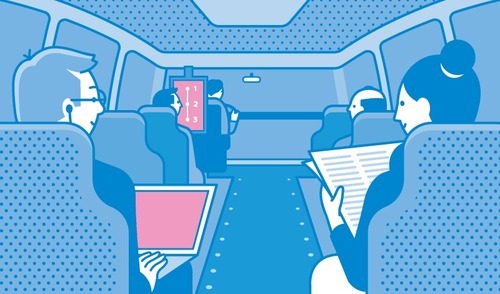
As I read on, I then discovered that Helsinki is already offering on-demand public minibuses that allow people to specify their own routes on their smartphone. The system then aggregates all of the requests and establishes the most efficient route based on the immediate demand. Coincidentally enough, it’s quite similar to a use case I wrote about for driverless cars.
All of this got me thinking that one day we’ll probably look back at that time when people used to drive their own vehicles around as some antiquated and hilarious moment from the past.