Daily insights for city builders, delivered every morning at 6 AM ET. I’m Brandon Donnelly — a Toronto-based real estate developer and founder of Globizen. I’ve been writing here since 2013.

Tag: healthcare

  • It’s time to build

    Marc Andreessen’s recent essay, called “It’s time to build,” is destined to ruffle feathers. In it, he not only sings the virtues of building in its broadest sense — everything from healthcare and housing to education and manufacturing — but he calls out the western world for smug complacency with the status quo. We are no longer choosing to build. And a good example of that is how we have been managing (and mismanaging) this current pandemic.

    Here’s an excerpt:

    In fact, I think building is how we reboot the American dream. The things we build in huge quantities, like computers and TVs, drop rapidly in price. The things we don’t, like housing, schools, and hospitals, skyrocket in price. What’s the American dream? The opportunity to have a home of your own, and a family you can provide for. We need to break the rapidly escalating price curves for housing, education, and healthcare, to make sure that every American can realize the dream, and the only way to do that is to build.

    Marc has also included a suggested reading list if you click through on the above tweet. By the time you do that, I am sure there will also be a lot of discussion around his essay.

  • Median household income vs. health insurance costs

    I just came across this chart from Axios, which relies on data from the Federal Reserve Bank of St. Louis and the Kaiser Family Foundation. It compares median household income against the average cost of employer health insurance (in the United States).

    What it is saying is that, after adjusting for inflation, the median household income has only increased by 2% from 1999 to 2017, whereas employer health insurance costs have increased by some 121% over this same time period.

    The takeaway: Rising healthcare costs are believed to be eating away at take-home pay in the US. As of 2017, health insurance costs were estimated to represent about 30% of the average household income. That feels like a big number to me.

  • The “R” word

    Albert Wenger recently penned an interesting post about the “R” word.

    It’s about health insurance and why redistribution is a toxic word in U.S. politics, but also why much of what we do as a society – from public roads to insurance – is actually about redistribution. What I like about the post is that he cuts through a lot of the noise and gets right at the crux of things.

    Here’s part of his conclusion:

    So what should you take away from this? There always is some element of redistribution to insurance – at a minimum ex post and generally also ex ante. The “why should I (usually some healthy person) pay for x (usually some payment for someone from a different demographic)” objection to health insurance is about redistribution. We should acknowledge this openly and not pretend that it is otherwise, because then we can move forward and say “you should, because that is your contribution to how our society works.”

    The point of his post, which he reiterates in the comment section, is that “insurance is a commons more than it is a market.” Too much individual choice – for instance, rich people opting out because they don’t need it – actually weakens the system.

    But you should really read his entire post. It’s good.

    Photo by Jamie Street on Unsplash

  • 2 new ways to think about economic inequality

    We talk a lot about economic
    inequality these days. We worry, among other things, that our successful cities
    are becoming playgrounds for the rich and that housing is becoming increasingly
    unaffordable for the middle class.

    Without negating the
    importance of things such as attainable housing, I’d like to offer up two,
    potentially new, perspectives on economic inequality.

    The first is an
    essay by venture capitalist Paul Graham
    . In it, he rationally unpacks, as he always does, the phenomenon of economic inequality. One of his key points is the distinction between rent seeking degenerate economic inequality and the economic inequality caused by rapid value creation (i.e. Two Stanford students decide to create a new search engine called Google).

    “If the rich people in a society got that way by taking wealth from the poor, then you have the degenerate case of economic inequality where the cause of poverty is the same as the cause of wealth. But instances of inequality don’t have to be instances of the degenerate case. If one woodworker makes 5 chairs and another makes none, the second woodworker will have less money, but not because anyone took anything from him.”

    Of course, Paul Graham is thinking about this from the perspective of a venture capitalist that funds startups and helps entrepreneurs get rich. But what about the impacts to people who live in a city where the rich are far richer than the poor?

    That brings me to the second perspective.

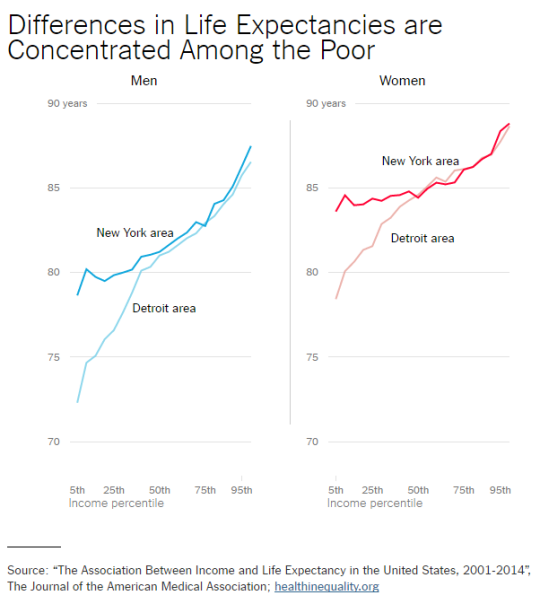
    A recent study, published in The Journal of the American Medical Association and written about in the New York Times, has discovered a surprising relationship between income and life expectancy across the United States from 2001 to 2014.

    What they found was that cities with high economic inequality – such as New York and San Francisco – actually have lower inequality when it comes to life expectancy. 

    Here is a chart from the New York Times:
    And here is a chart from healthinequality.org:
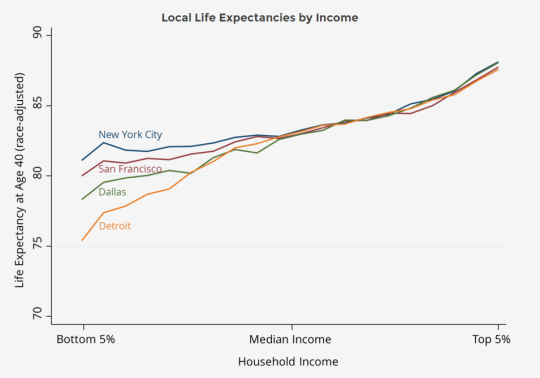
    If you’re rich, it doesn’t matter where you live. The life expectancy of a rich person in New York is roughly the same as a rich person in Detroit. (Though, as to be expected, women generally live longer than men.)

    However, as income levels fall, so does life expectancy. But it falls more in a city like Detroit than it does in New York. In fact, rich cities such as New York and San Francisco are almost model cities in this regard. Why is that?

    The biggest predictor appears to be health behaviors, such as smoking and obesity:

    “The research seems to suggest that living in proximity to the preferences — and tax base — of wealthy neighbors may help improve well-being. New York is not just a city of rich and poor, but also one of walkable sidewalks, a trans-fat ban and one of the most aggressive anti-tobacco agendas of any place in the United States.”

    So there you have it. Two, potentially new, ways to think about economic inequality.

  • Architecture and well-being

    I haven’t spent a lot of time in hospitals. So I may not be the best judge of what I’m about to say. But why do we design hospitals to be so depressing? Why do they have to look so, well, clinical?

    I asked this question on Twitter a few days ago and I was recommended to listen to a 99% Invisible podcast called The Blue Yarn. If you haven’t yet heard of this podcast series, I would highly recommend you check it out (in addition The Blue Yarn episode).

    What this particular podcast was about was rethinking hospital design in terms of patients, as opposed to staff hierarchy. And the way they illustrated the need for that was through some simple blue yarn.

    Using yarn, management physically mapped out the paths of patients as they moved through this particular medical center. And what they found was a tremendous amount of waste. There was a lot of waiting around (in dingy rooms) and a lot of unnecessary moving around.

    Instead of putting patients first, the hospital had been designed in terms of staff offices and other criteria. Ultimately, this exercise ended up triggering a complete redesign of the hospital.

    After the redesign, there were a lot of grouchy doctors who had lost cushy offices. Some even quit. But the hospital became more efficient, more profitable, and, most importantly, safer for patients. So much so that their insurance expenses dropped by 37%!

    But this obviously isn’t the only foray into rethinking hospital design. In fact, there’s something out there called “evidence-based hospital design”, where the objective is to leverage data and actual evidence to figure out the relationship between architecture and patient well-being.

    One of the pioneering studies in this area was done in 1984 by Roger Ulrich. 

    The study took patients in Pennsylvania recovering from gallbladder surgery and split them up into two groups. The first group was given a room with a beautiful nature view and the second group was given a room with a view of a brick wall.

    What they discovered from this experiment was that the group with the view of nature not only recovered faster but also needed fewer painkillers during the recovery. That’s a fascinating finding.

    So it’s not surprising that this sort of thinking is making its way into contemporary hospital design. And that’s a great thing.

    Hospitals should be uplifting, restorative, and beautiful spaces. Does that not seem sensible?

  • Toronto’s “Instagram for doctors” raises $4 million

    image

    Earlier this week it was announced that Fred Wilson and his firm Union Square Ventures have just led a $4M Series A round of venture funding in the Toronto-based startup Figure1. Figure1 is essentially “Instagram for doctors.” Here’s how it works (via WSJ):

    Today, more than 125,000 health-care professionals use Figure 1 to view or share free medical imagery, including photos of patients with personally identifiable details blurred out or excluded; x-rays; charts; and still images taken from MRI or CAT scans, for example.

    The app’s users include board-certified doctors, registered nurses, medical and nursing students, physicians’ assistants, and others who use the app and share images for teaching and studying purposes, or even to request community feedback about a possible diagnosis.

    With this round, USV is now up to 3 investments in the Toronto/Waterloo region (I think of us as one center). The other 2 are Kik (out of Waterloo) and Wattpad, which is actually headquartered here in the St. Lawrence Market.

    What’s exciting to me about all of this is that it’s further evidence of a growing and thriving Toronto/Waterloo startup ecosystem. And while to some it may not seem like a big deal for yet another mobile app to receive funding, it’s actually great news.

    Because as these companies grow and become successful, they’ll not only create new jobs in the region, but also create a tremendous amount of wealth and expertise. And when this wealth and expertise gets reinvested into future startups, you end up with a powerful snowball effect. That’s how startup ecosystems are built.

    It’s also great to see companies staying put, because the pull towards more established startup hubs can be significant. When my friend Evgeny raised a Series A round from Andreessen Horowitz last year, he told me that they asked him to move 500px down to California. As is the case with a lot of VCs, they like their portfolio companies to be nearby.

    But ultimately 500px decided to stay headquartered here in downtown Toronto. And they did that for a few reasons: There’s lots of great engineering talent here and it usually comes at a discount relative to California (5-15%). He also finds that employees here are more loyal. There’s less turnover. In California, everyone is looking for that next best startup to join. Here 500px gets to be that big fish in a small pond.

    Anyways, a big congratulations to the Figure1 team. I hope they continue crushing it and that they stay put in Toronto. If you’re a healthcare professional, you can click here to download the app.

  • Starting from the bottom in real estate and healthcare

    Earlier this week when I responded to a Globe and Mail article that was arguing condo rents were on the decline in Toronto, I talked about how imperfect and opaque I feel the real estate market is. Today I’d like expand on that.

    The reason I call the real estate industry imperfect is because of 2 main reasons: first, there’s a lot of friction when it comes to buying and selling as a result of high transaction costs (amongst other things); and, second, there are massive information asymmetries between marketplace participants. This could be buyers and sellers, purchasers and developers, clients and real estate agents, and so on.

    But it’s only a matter of time before these issues get resolved. And I think it’ll happen through better access to data and more transparency in the marketplace. The question, however, is: Where is this big data going to come from?

    I was reading Fred Wilson’s post this morning on Large Networks, Big Data, and Healthcare, and I was struck by a parallel. Here’s what stood out for me:

    “The question is who will control the input of the patient data, the aggregated data sets, and the results the data science produces. If the answer is the current healthcare system; the insurance companies, the hospitals, and the doctors, then we will have missed a big opportunity to reshape healthcare. If, on the other hand, the data is entered by patients, controlled by patients, and benefits patients, then we would have something new, different, and disruptive.”

    In both healthcare and real estate, we have large bureaucratic institutions and bodies that control the industry. And in both instances, we’ve seen that they’ve been slow to adapt to the changing times. Therefore, I think the billion dollar opportunity is the same in both: the data is going to have to come from the ground up via patients and real estate consumers. Only then will we have something truly innovative.