Daily insights for city builders, delivered every morning at 6 AM ET. I’m Brandon Donnelly — a Toronto-based real estate developer and founder of Globizen. I’ve been writing here since 2013.

Tag: haussmann

  • I love narrow streets

    If you’re a regular reader of this blog, you’ll know that I’m a fan of narrow streets. It’s one of the reasons I have been such a supporter of laneway housing here in Toronto, and why I think they should ultimately allow for some non-residential uses.

    If you have narrow streets and reasonably decent buildings that frame them, you have a base condition that has worked remarkably well since the creation of cities. Almost by default, and even if you don’t have proper sidewalks, it is going to feel pedestrian-oriented.

    The challenge, however, is that it’s usually difficult to create these after the fact. Street networks are powerfully sticky; they generally don’t change unless you have someone like Haussmann rebuilding your city. So if you have these in your city, try and take advantage of them. You’re fortunate to have them.

    The above two photos/measurements are from Milan. Both streets are around 20 feet wide (or 6 meters), which happens to be the required width of a standard two-way drive aisle here in Toronto. It’s a good example of how differently cities can view and allocate space.

    You can do a lot with 6 meters.

  • Are you sure you want Parisian-style urbanism?

    This might seem like a fairly benign tweet by Clive Doucet, a former Ottawa City Councillor. I mean, Paris is wonderful. It is livable, walkable, and my favorite city in the world after Toronto. But as I have argued many times before on the blog, there is a tendency to look at Paris’ uniform mid-rise buildings and then incorrectly try and translate it over to a North American (or other) context with opinions that we should simply cap building heights. Because if only we were to do that, then we would be left with our own version of beautiful Paris.

    This is false. And you should immediately call bullshit on anyone who suggests this might be the case. It ignores most of what Napoleon III and Haussmann did to Paris in the 19th century, and instead just cherry picks height so that it can be exported back home to oppose tall buildings. If we really and truly want Paris, then it is important to be reminded that, among many other things, the Paris we all love today is the result of:

    • The annexation of eleven surrounding communities (in order to form the city’s current boundaries)
    • Mass urban renewal, involving the displacement of some 350,000 people (according to some estimates at the time)
    • Nearly two decades of large-scale disruptive construction
    • The demolition of hundreds of old dilapidated buildings (some of which may have even been in a Heritage Conservation District — bad planning joke)
    • The cutting through of nearly 80 kilometers of new avenues all across the city
    • The building of high-density courtyard buildings and blocks

    As you might suspect, Parisians at the time were upset with this kind of large-scale change. The now famous Impressionist painters lamented the new monotony of Paris’ regular mid-rise blocks. Where had the unique and quirky Paris of past gone? It was, of course, being systematically erased in the name of modernization and urban renewal, which by the way, included a new and important water and sanitation network. What Napoleon III and Haussmann did was transform Paris from a crumbling medieval city into a modern metropolis.

    I am not suggesting that any of this is bad and shouldn’t have happened. Today, Paris is deeply loved the world over. But what I am suggesting is that if we truly want to create our own version of Paris, then we are going to need to be realistic with ourselves on what it is going to take to get there. It will require nothing short of massive change.

    If we want Paris and Paris-like densities (despite what Clive posits in his tweet, Paris is not the densest city in the world), we are going to need to be fully prepared to rip up and rethink our entire approach to zoning. Taller buildings are partially (largely?) a result of our cultural obsession with single-family houses. We restrict supply, codify low-densities, and then wonder why the remaining areas need to be so tall. We then grasp at out-of-context examples in order to justify our own selfish interests.

    If Paris is really what we want, then we must be prepared for everything that comes along with its pretty mid-rise buildings. Are you ready?

    Photo by Nil Castellví on Unsplash

  • The reversion of European cities

    This recent Economist article makes the argument that, despite the recent (and sometimes annoying) proliferation of electric scooters across Europe, we probably shouldn’t be that grouchy about them. And that’s, “because the rise of the electric scooter is part of a broader and welcome phenomenon: the gradual retreat of the car from the European city.” By way of one example, by next year, Paris will have grown its bike lane network by 50% in five years.

    The article ends with the point that, while this may seem like a “revolution,” it’s actually a “reversion.” European cities such as Paris and Antwerp (examples from the article) were both built before the advent of the car and were never really designed for it, although Haussmann’s wide avenues certainly helped. All of this gets back to a point I tried to make over the weekend with this post about driving and parking, and the relevance of urban form.

    Reversion is a lot easier than a revolution. And for most North American cities, a revolution is what’s needed if we are in fact serious about a post-car future.

    Photo by Z Klein on Unsplash

  • Crypto networks and top-down urban planning

    Taylor Pearson recently compared crypto networks to cities and argued that the best crypto networks, much like the best cities, are formed from the bottom up. 

    The example he gives is that of Paris (bottom-up) vs. Brasilia (top-down). Paris is the hugely successful city and Brasilia is the failure of high-modernism.

    I appreciate the argument he’s making and I do agree with him on the potential of decentralization, but I couldn’t help but dig into his city example a bit further.

    The Paris we all know and love today is the result of an enormous centrally planned urban renewal exercise. Baron Haussmann carved, among many other things, long straight boulevards through Paris’ medieval fabric in order to modernize and rationalize the city.

    What makes this top-down exercise different from that of Brasilia’s? Is it simply that Haussmann was constrained by Paris’ existing and decidedly urban fabric?

    Because then we could turn our attention to New York City’s gridiron plan of 1811, which laid out – before the island of Manhattan had even fully developed – a relentless and orthogonal street network from Houston Street all the way up to 155th Street.

    Is the difference that Brasilia was planned with suburban sensibilities in mind and Manhattan was not? Or was it the restrictive Euclidean zoning that did it in for Brasilia? 

    Whatever the case may be, history suggests that some top-down planning exercises may have worked out just fine. Though to be fair, each of them was not without their share of critics.

    Photo by Rafael Leão on Unsplash

  • That hustle and bustle

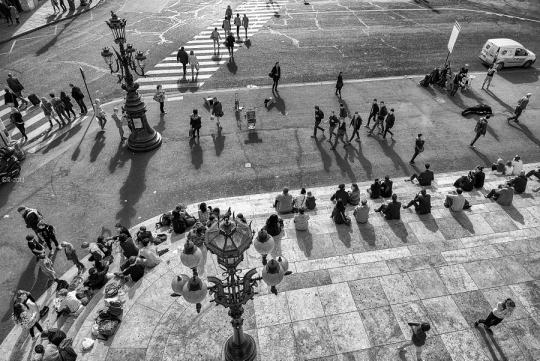
    Street Scene(s) by Olivier Rentsch on 500px.com

    https://500px.com/embed.js

    One of things I love about cities is the hustle and bustle of people. 

    I would rather eat at a busy restaurant than a quiet or dead one. I would rather workout at a busy gym than one with nobody there. And I would rather work in an office or at a coffee shop than work at home by myself. Working at home actually drains me if I do too much of it.

    The reason for that is because I derive a lot of my energy from the outside world. Urban life energizes me. To Swiss psychiatrist Carl Jung, that is the defining characteristic of an extrovert. I am focused on the “outside world of objects.”

    But because of this, I can’t help but slowdown during the holidays. Once the city dials down and the streets become emptier, my mood actually changes. I don’t feel as energized.

    It’s fascinating to think about the connection that many of us have with urban life. Since the first cities were established there has always been some kind of centralized place, market, or agora (in the case of ancient Greek cities) where people came together to exchange goods and ideas.

    But one of the most interesting turning points for modern urban life, as we know it today, came in 19th century France with poets and writers such as Charles Baudelaire.

    At the time that Baudelaire was active, Paris was undergoing Hussmannization. It was being transformed from a medieval city with cramped narrow streets into a modern metropolis of broad avenues.

    And essential to these new streets and urban spaces was the flâneur. At the time, the flâneur was an important literary and artistic figure. He was a man about town. A man of leisure. An urban explorer in the new modern metropolis.

    Here is how Baudelaire defined the flâneur in his Painter of Modern Life:

    The crowd is his element, as the air is that of birds and water of fishes. His passion and his profession are to become one flesh with the crowd. For the perfect flâneur, for the passionate spectator, it is an immense joy to set up house in the heart of the multitude, amid the ebb and flow of movement, in the midst of the fugitive and the infinite. To be away from home and yet to feel oneself everywhere at home; to see the world, to be at the centre of the world, and yet to remain hidden from the world—impartial natures which the tongue can but clumsily define. The spectator is a prince who everywhere rejoices in his incognito.

    One of the central themes at the time was that of anonymity. The modern city had grown to such a scale that a paradox had emerged. Despite all its density and physical proximity, urban life had an isolating effect. It had become easy to just be a number in an ephemeral crowd.

    But fascinating to me is this idea that urban life – with all its ebbs and flows – could bring “immense joy” to the flâneur. In fact, the very definition of a flâneur was someone who did nothing. They weren’t capitalists on the pursuit of new material possessions. Their sole focus was urban life and nothing else.

    And while most of us probably don’t routinely wander around our own cities as tourists without purpose, I suspect that many of us can appreciate the impact that urban life has on us. I know I do. It gives me energy.

  • Haussmannization

    If you’re into cities, then you’re likely familiar with the Baron Georges-Eugène Haussmann.

    He was Napoleon III’s urban planner and the man responsible for the Paris we all know and love today. Those broad avenues radiating from the Arc de Triomphe are his doing. His plans transformed Paris from a medieval city into what was considered to be, at the end of the 19th century, one of the most modern cities in the world.

    What spurred this post is an exhibition currently on display at the National Gallery of Art in Washington. It’s on the photography of Charles Marville, who was, interestingly enough, initially commissioned to document Paris before Napoleon and Haussmann “destroyed” it.

    In reading NPR’s summary, I was amazed to learn about the meticulous detail that went into the redesign of the city, which went all the way down to the gas street lamps that were rolled out following the “Haussmannization”of Paris. In fact, so much thought went into the appearance of these street lamps that their heights were actually modulated to match changes in street elevation; the effect being that as you looked down an avenue, the street lamps always appeared even and harmonious despite any ups-and-downs in the road.

    But beyond street lamps, the exhibition also got me thinking about urban renewal as a broader concept. Today, I suspect that most people would consider Haussmann’s interventions to have been a positive thing for Paris. Before these changes, Paris was a cramped and crumbling medieval city.

    However, while in retrospect these changes might seem positive, Parisians at the time hated what was happening to their city. The entire place was under construction. And if you’re a fan of Impressionism, you’ll know that many artists at the time began lamenting about the regularization of Paris. They yearned for the visual variety that once characterized the city.

    But as any developer will tell you, change is not something most communities tend to embrace. In fact, it’s human nature for us to down play positives and play up negatives when faced with uncertainty (see Prospect Theory). 

    And sometimes it’s merited. Fast forward to 1925 and you have yet another audacious Frenchman trying to destroy and rebuild Paris: Le Corbusier. Come to think of it, I wonder if he thought of himself as the next Haussmann. He certainly thought of himself as the man responsible for ushering in the next wave of modernity.

    But while he didn’t execute on his Plan Voisin in Paris, he certainly left his mark on cities all across the world. The plan he intended for Paris, was more or less what we used to clear slums in a lot of cities. However it turned out to be a complete failure.

    So I guess the moral of the story is that some change is good and some change is bad. But most of the time it’ll seem bad at first, making it hard to tell which is which.