Daily insights for city builders, delivered every morning at 6 AM ET. I’m Brandon Donnelly — a Toronto-based real estate developer and founder of Globizen. I’ve been writing here since 2013.

Tag: happy new year

  • What might happen in 2024

    Yesterday we looked in the rear-view mirror. Today we’re looking forward:

    • The market consensus right now is that this cycle of interest rate increases has come to an end, and that we should see rates start to come down next year. Having confidence that rates won’t go any higher in the near future is what markets need in order to start making more decisions. So this is, of course, positive. At the same time, I don’t think anyone should expect a return to ultra-low rates. Rates today are still low when viewed historically.
    • Lower rates are good for levered assets such as real estate, but I don’t think that our industry has fully felt and processed the impacts of higher rates. Unfortunately, I think that things will get worse (in 2024) before they get better (maybe toward the end of 2024 or perhaps in 2025). This is when a “risk-on” approach will return in commercial real estate. A year ago today, I thought 2023 would be the year for this, but as I said yesterday, I was overly optimistic in terms of my timing.
    • On the residential resale side, I think we will see greater optimism sooner, certainly for the most in-demand cities and areas. There is pent up demand waiting on the sidelines and, once we can get past the current bid-ask spreads and deadlock, I believe we’ll return to a more balanced market in 2024. To be clear, I’m not expecting bidding wars and the like. And because of our housing affordability crisis, I also think the Bank of Canada will be more resistant to lowering rates compared to other central banks. This will help the Canadian dollar.
    • If you’re a buyer of real estate, I generally believe that 2024 will turn out to be a pivotal year for you. Roughly speaking, you win acquisitions in one of two ways: either (1) you pay the most or (2) you believe in something that most other people in the market don’t. This second approach is harder to achieve in bull markets. But in slower markets, the door is open and history has taught us that it can be the foundation in which great fortunes are made.
    • As I mentioned yesterday, I agree with the prognostications that hard costs will soften further next year (perhaps even more than 5% on average). Obviously every market is different. But here in Toronto, I just don’t see us returning to the level of construction starts that we have seen over the last number of years.
    • Since 2021, I have used my hyper scientific Jimmy the Greek Reopening Index to keep tabs on office utilization and the overall return to office. And based on this, 2023 was a positive year. Initially, souvlaki consumption appeared dramatically lower on days like Monday. But I noticed discernible increases as the year went on. However, if you look at actual data, such as what we have from swipe cards, the great return to office seems to have stalled out at around 50%. I don’t think this will hold, though. I continue to believe that of the people who work in offices, most will spend > 50% of each week there. And we will see that in 2024.
    • 2023 was the year of AI. But Fred Wilson makes an excellent point, here. AI is 40+ years in the making. Last year only became the year of AI because a consumer-facing app — ChatGPT — was revealed that captured everyone’s attention. Crypto will eventually have this moment, but it will likely need to marinate a bit longer. Instead, I think 2024 will be the year of augmented reality (AR) and a further blurring of our offline and online worlds. Think digital art, fashion, and other collectibles (such as NFTs).
    • Right now, autonomous vehicles feel like they’re in the trough of disillusionment (within the hype cycle). There were moments last year where it felt like we were finally moving beyond this phase. But then some very suboptimal things happened. I think AVs are our reality in the next 5+ years, which means that for next year we likely want to be focused on the inputs: vision/LIDAR, battery tech, etc.
    • Zooming out, we should be thinking about the above two trends in the context of a broader shift toward greater automation. I think it will feel more insidious than immediate (certainly in 2024), but the longer-term impacts are going to be profound for our society. The so-called gig economy is likely to be impacted first. Eventually the overall economy will create new jobs, but we are still going to need to manage this transition toward more automation.
    • TikTok Shop is where to look for the future of shopping. I think the platform will continue to see strong adoption and ultimately prove to be a dominant e-commerce platform throughout 2024. Amazon, Meta, and others will see this, and try their best to catch up and copy it.
    • At the time of writing this post, the total crypto market capitalization is about $1.74 trillion. This is down from nearly $3 trillion at the peak of the market in 2021. The recent gains suggest that the so-called “crypto winter” might be over, and so combined with lower interest rates and more real-world use cases, I think that 2024 will be another strong year for crypto. Total crypto market cap at the end of the year will exceed its 2021 peak.

    And there you have it. My current thoughts for this upcoming year. I should note that I’m not an economist, analyst, or an expert on souvlaki demand for that matter. But I enjoy writing this post as an annual discipline. It forces me to think critically about the topics that interest me. And in the paraphrased words of Howard Lindzon, it gives me an archive that I can go back to and either cringe at or think to myself, “hey, I could have been a somebody!”

    And with that, a big thanks to everyone who has read this daily blog over the last year. This year marked its 10th anniversary. I wish you much success and happiness in 2024. Happy new year!

  • What could happen in 2023

    The central bank tightening and interest rate hikes that we saw last year will come to an end in the first quarter of 2023 as inflation gets under control. This will ultimately lead to a recession but my sense is that it will be more mild than severe. For this reason, I don’t think anyone should expect ultra-low rates to return in the short-term.

    Much of the real estate sector went on pause in the second half of 2022. But ultimately this reset to a more balanced market is going to be necessarily painful for some. And I think we will see that pain play out in the first half of the year. This will obviously be bad for some, but it will create opportunities for others.

    Construction costs tempered in the second half of 2022 and started to show some evidence of price softening. I think we will see more of this in 2023, which will be healthy for the market. Cost management over the last few years has been a meat grinder for the development industry.

    Pre-construction condominium sales for well-located projects will return in a more fulsome way by the spring. This will be driven by buyers now having clarity around where interest rates will be hanging out in the short-term and, in the case of Canada’s largest cities, by record-high immigration levels.

    For the tertiary/fringe housing markets that saw big run ups in pricing during the pandemic, I unfortunately think it will take many years for prices to fully rebound. The price increases we saw in these submarkets were of course a result of low rates, but it was also driven by a view on urban decentralization that in my view did not actually materialize.

    The desire to add more housing to single-family neighborhoods will continue to pick up steam across North America. How exactly this plays out will be market specific, but in Toronto I expect to see new planning policies put in place, as well as supportive building code changes.

    Public transit ridership will remain below pre-pandemic levels throughout 2023. This will continue to exacerbate public finances.

    Autonomous taxis will grow rapidly this year. Companies, such as Cruise, will expand into a number of new US markets and, at some point during the year, I will take my very first ride in an autonomous vehicle.

    2023 will be a big year for augmented reality and “phygital” goods. Last year I thought Apple would release a new product in this space. That didn’t happen, but it will this year. At the same time, we will see more companies releasing products that blur the lines between our online and offline worlds (hence “phygital”). This will include NFTs and other crypto-related things that will start to operate more seamlessly in the background of consumer-facing products/services.

    I continue to be bullish on Ethereum and I think it will overtake Bitcoin in terms of market cap in the next 2-3 years. But I was very wrong about Solana last year. And now I am struggling with its value proposition. Today, layer 2 chains such as Polygon feel more likely to win out. Broadly speaking, I suspect 2023 will be a positive year for crypto, but not a record-setting one.

    In summary, I think we are going to see more pain at the beginning of 2023, but that on the other side of it will be healthier and more balanced markets. This means that we can look forward to the end of the year feeling much better than it does right now. All of this said, please keep in mind that I’m often wrong and that nothing in this post should be construed as actual advice.

    Happy 2023, friends. I’m excited to get going.

  • My predictions for 2022

    As promised, below is a list of some of my predictions for this coming year. I have tried to be both punchier and more precise in my prognostications; because, well, obvious predictions are boring and precision will allow me to better evaluate my thinking at the end of the year. So here goes.

    1. 2022 will be the year that COVID-19 becomes endemic and finally fizzles out to a point where it no longer factors into our decision making in the same way that it has for most people over the last two years or so. I think this will happen by as early as the summer.
    2. As a result, I think the majority of people will be back in their offices by this September at the very latest, with many coming back much earlier. The whole hybrid/flexible work thing won’t completely disappear, but the majority of people who used to work in offices will be back.
    3. Recreational/fringe residential real estate will soften in 2022 as a result of 1) its tremendous run-up during this pandemic and 2) the renewed pull of urban/office life. Conversely, urban apartment rents will continue to rise and eventually surpass their pre-COVID levels. The SF Bay Area could be one exception.
    4. The explosion of travel that I thought was going to happen in 2021, will truly happen this year. The summer will mark its official return, with European travel volumes (to give just one example) returning to their pre-COVID levels.
    5. We will see meaningful efforts to further breakdown the hegemony of single-family zoning throughout many North American cities. This has been building for a number of years and I think we will see some tipping point-like moments in 2022. Specifically, expanded permissions for multi-unit housing and greater densities.
    6. I wish I could say that autonomous vehicles are destined to do something truly remarkable this year, but I think we are still a few years out (2024-2025?) before a large chunk of us are ride-hailing AVs. But on a related note, I do think that Uber will come into its own this year and finally become profitable (and not just with adjusted profits).
    7. Public transit ridership will, unfortunately, remain depressed and below its pre-COVID levels for this entire year. The beneficiaries of this will continue to be cars (not good), bikes, and micro-mobility solutions like e-scooters.
    8. 2021 was a huge year for NFTs and other fun stuff like digital fashion. Given these trends, I believe there will be growing demand from people to better integrate their digital and physical lives through technologies like augmented reality. Snap has been at the forefront of this space for many years and 2022 will be an important year for its Spectacles (AR glasses). But Apple and others will also make major announcements.
    9. Miami’s ascent as an important tech hub will get interrupted by questions surrounding the climate crisis and its own resilience. At the time of writing this post, the price of carbon on the EU’s Emissions Trading System (EU ETS) is about €80 per tonne. I think we will see it break €125 per tonne this year, and possibly go even higher.
    10. Ethereum, Bitcoin, and Solana (in this order) will be the top three cryptocurrencies according to market cap by the end of the year. At the time of writing this post, their market caps are $446 billion, $895 billion, and $55 billion, respectively. I am also expecting some breakout web3 consumer applications that will push, maybe, 40% of Canadians and Americans into the crypto space.

    Photo by Dave Xu on Unsplash

  • My 2021 predictions

    Life will feel a lot more normal by spring/summer (Q2). By this time, the various vaccines should be broadly available (at least in the developed world). This is something that never happened during the Spanish Flu. From what I have read, the Spanish Flu lasted about two years and there were four major waves, the second of which was by far the most deadly. Ultimately, a vaccine was never found. It just petered out as people developed immunity. But medicine then was not what it is today, so surely we are destined to do better.

    What happens with working from home is going to be one of the most important outcomes of 2021. Right now it feels like tech vs. commercial real estate. The tech industry has been quick to renounce offices (while many large tech companies continued to lease more space through 2020). And the commercial real estate industry has naturally pointed out that we’re all still going to need physical offices.

    My view is that, yes, people appreciate the flexibility of being able to work remotely, but that we’re greatly exaggerating the extent to which work is going to disperse in the short-term. I think it comes down to three main things. 1) It’s nice being around other humans, both in the office and for those after work drinks. 2) Collaborative and knowledge-intensive endeavors work better when people are in the same room. And 3) corporate politics will encourage people to return to the office. Who do you think is going to get promoted first, the person who Zooms in from the Caribbean for meetings or the person who shows up to the office and grinds it out every day?

    As the world returns to normal, we will, however, see an explosion in global travel. Many will be questioning how Airbnb’s sky-high valuation makes any sort of sense, but it’ll have the right story for what’s going on in the world (some people call these “story stocks”). The reality is that there will be a massive amount of pent up demand that starts to come out as soon as people start to feel safe and governments start to allow people to travel en masse. I’m already looking forward to the 2021-2022 ski season, which I fully expect to be a blockbuster season.

    Because of this, we will see a decline in recreational real estate. The kind that was fulfilling people’s need for local travel during this pandemic. Instead, people will turn their attention to more international experiences and try and make up for lost time. Many will also come to realize that the whole working from home thing didn’t stick as expected and so they’ll start deriving less utility from their property outside of the city. Expect a kind of reversion to the mean when it comes to prices.

    Urban/downtown real estate will strongly rebound in the second half of 2021. As restaurants reopen, as people return to offices, and as urban life in general resumes, we will see an increase in demand for condos/apartments, and probably larger urban spaces given the run-up in prices for single-family homes that many cities saw last year. (A bit more on this point can be found over here.)

    The trends that are being accelerated as a result of this pandemic are not going to stop, though their rate of increase will temper. The apps and platforms that people started using in 2020, perhaps for the first time, have established new habits. People’s credit cards are now on file and it’ll be very easy for those online habits to remain. But the opposing force to all of this will be the strong desire for socializing, travel, and novel experiences. It’ll be the more routine stuff that will continue to live entirely on our phones.

    The restaurant/food industry will bounce back in a slightly different form. Sadly, many businesses will have failed. But we will also see an explosion in new ideas and new concepts, satisfying our demand to be out socializing and trying new things throughout the new roaring twenties. Ghost kitchens and on-demand food delivery companies will continue to disaggregate how some restaurants are setup. Companies like Uber will see their ride-sharing businesses quickly snap back, which will more than offset the decline in food delivery as people resume eating out.

    Public transit ridership probably won’t return to its pre-pandemic levels until at least the fall. Possibly late fall. This is going to be a serious problem for the various levels of government that subsidize virtually all public transit authorities. Many transit networks have seen ridership declines of 70% or so and, if my timing projections are correct, that will have been the case for about a year and a half.

    The migration from high tax states (like California and New York) to low tax states (like Texas and Florida) will continue. This trend was well underway before COVID-19 and so I don’t see it reversing. What is perhaps more interesting to consider is how this dispersion of economic activity will ultimately play out against some of the centralizing/polarizing forces of the global economy. Urban agglomeration economies aren’t going to go away.

    To end, I will say that I think it’s safe to assume that we’re all looking forward to the world getting back to normal, whatever that happens to mean. But ironically, once that happens, I reckon that some of us might look back on this period of time and feel hints of nostalgia. Perhaps you learned a new skill or perhaps you were able to spend more time with love ones. Time and distance may better reveal these silver linings.

    Onward, my friends. What a time to be alive.

  • The case for speculative asset bubbles (and happy new year)

    This is an interesting perspective. It is from Fred Wilson’s annual what-happened-this-past-year post:

    But here is the thing about speculative frenzies – they are generally directionally correct but off in their order of magnitude. And they finance the trend that they are directionally correct about. It may be the case that Tesla’s market capitalization is too high, but that allows Tesla to raise $10bn without diluting more than a few percentage points. And that $10bn will go towards accelerating the conversion of the auto industry from carbon-based fuel to renewable energy. And that is a good thing for society.

    When I first read this my mind immediately went to tulip mania. Was that directionally correct? Did tulip bulbs ultimately rebound and maintain their value over the long-run? I actually don’t know.

    But if you think about the dot-com bubble, that was directionally correct. Sure, infamous “companies” like Pets.com never ended up going anywhere, but the idea of tech and the internet becoming dominant was absolutely right.

    Fast forward twenty years and you can be sure that many people are now buying their pet supplies online, along with pretty much everything else. Sometimes we simply overshoot and get the timing wrong.

    This is perhaps a good thought for all of us to consider as we welcome 2021 and say goodbye to what was one weird and terrible year.

    Being directionally correct means that it’s okay for there to be bumps, mistakes, and speculative frenzies along the way. They are expected. What matters is the path forward.

    Happy new year, everyone.

  • The re-allocation of capital (and predictions for this decade)

    I have stayed at two hotels over the last month where I did not need to interact with a human as part of the check in process. And in one of those two instances I didn’t even need to interact with a computer at the hotel.

    My room key was issued to me through an app and I used that (and Bluetooth) to open my hotel room door (after the app, of course, notified me that my room was ready).

    This is prediction #2 in Fred Wilson’s annual roundup of what is going to happen next in the world. Automation is reducing the costs associated with operating many businesses. Who is going to be the beneficiary of this consumer surplus?

    The other prediction that should interest most of you — because the impacts would be widespread — is this one here regarding climate change:

    The looming climate crisis will be to this century what the two world wars were to the previous one. It will require countries and institutions to re-allocate capital from other endeavors to fight against a warming planet. This is the decade we will begin to see this re-allocation of capital. We will see carbon taxed like the vice that it is in most countries around the world this decade, including in the US. We will see real estate values collapse in some of the most affected regions and we will see real estate values increase in regions that benefit from the warming climate. We will see massive capital investments made in protecting critical regions and infrastructure. We will see nuclear power make a resurgence around the world, particularly smaller reactors that are easier to build and safer to operate. We will see installed solar power worldwide go from ~650GW currently to over 20,000GW by the end of this decade. All of these things and many more will cause the capital markets to focus on and fund the climate issue to the detriment of many other sectors.

    For the rest of Fred’s predictions, click here. These are always great reads.

  • The emotional journey of creating anything great

    Welcome to 2017. (We better have flying cars by 2020 or I’m going to be pissed.)

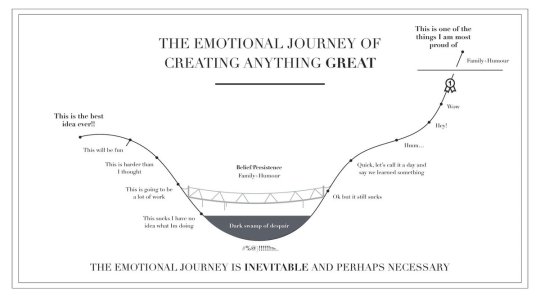
    I found the following chart on Howard Lindzon’s blog. It’s called “The Emotional Journey Of Creating Anything Great" and it’s getting shared around town right now.

    I’m sure that you’ve seen other similar charts before, but it doesn’t hurt to drive home this point, particularly as all of us kickstart the new year and promise ourselves that we’re going to be better, faster, stronger.

    The point of this chart is that when you’re creating anything new and great, there will always be the period of time that this diagram refers to as the “dark swamp of despair.” This is where you question your life decisions and wonder if you’re wasting your time trying to create this new and great thing.

    I never fully appreciated this phenomenon until I worked on a startup. Though for me, it felt more like a manic depressive rollercoaster. One week I was killing it and the next week I was in a dark swamp of despair searching for a way out. 

    And it’s because when you’re creating something new, you have few, if any, points of reference to reassure yourself that you’re on the right path. If it is truly great, then it’s probably something novel. And if it’s new, then by definition it hasn’t been done before. So it is unknown whether it’s truly a dark swamp of despair or if it just feels that way right now because things are tough.

    Because of the emotional nature of this journey, I have found myself really questioning the worth of things like caffeine and alcohol. I used to think the former made me more productive – the latter certainly doesn’t – but I’m not so sure that is the case. So as an experiment, I cut out coffee last month.

    I don’t believe in new year’s resolutions, so that’s not what all of this is about. It’s far better to talk about the things you’ve remained committed to, than to talk about the things you’re planning to do.

    This is simply a reminder that there will always be ups and there will always be dark swamps of despair. The key is to have the confidence and conviction to charge through those swamps any way you can. Onward my friends. I’m really looking forward to 2017 and I hope you all are as well.

  • Our urban history in 50 buildings

    At the time of writing this post, it’s still 2015 – at least here in Toronto. But by the time you (subscribers) get this post in your inbox, it will be 2016. So happy new year! I am thrilled about getting this year started and I hope you feel the same way.

    To kick things off, I thought I would share a great interactive post from Guardian Cities called, A history of cities in 50 buildings. It’s a look at our urban history through 50 important and pivotal buildings. Buildings such as Southdale Center, which was the first fully enclosed, climate-controlled shopping mall, and Chicago’s Home Insurance Building, which was a building that really set the stage for the modern skyscraper that we know today.

    Not all of these buildings have left a positive legacy on our cities. I am sure that some of you would argue that the creation of the suburban shopping mall, with its corresponding “sea of parking”, was not a step forward for cities, but a step backwards. The architect behind Southdale Center, Victor Gruen, has even gone on record saying that he refuses “to pay alimony for those bastard developments.” He hated the shopping mall.

    But like them or not, these buildings are part of our urban history, and I think it’s not only interesting but important to understand their impacts. If you want to see which important buildings were missed, at least according to Guardian readers, click here. I have to say that I was happy to see both Montréal and Toronto represented in the original list, as well as a few other buildings that I’ve written about here.

    On that note, happy new year to you all, again, and many thanks for reading Architect This City. If you have any suggestions for content you would like to see on this blog in 2016, please leave it in the comment section below. This may be my personal blog, but my goal is to make it valuable for all of you. Hopefully I achieve that sometimes.

  • Measuring urban form

    Last night the Toronto Transit Commission offered free service starting at 7pm. This is typical of Toronto on New Year’s Eve, as it is with many other cities. I think it’s great thing to do and I love seeing so many people taking transit to get around. I took it everywhere last night.

    Since I knew I would be doing a lot of walking, I charged up my Fitbit Flex and strapped it on around lunch time. Here is my New Year’s Eve according to Fitbit. I took 11,239 steps yesterday afternoon/evening.

    Activity tracking and health monitoring devices have really taken off over the past year. And I absolutely do think they help motivate. But beyond an individual level, I also think this data could be really interesting in aggregate and overlaid with other data points, such as where people live, where they work, how they travel/commute, and so on.

    Many have speculated that urban sprawl makes people fat since it privileges driving over walking. But with all the data that companies such as Fitbit and Nike are collecting, it would be interesting to see some hard data on how much more urbanites really walk compared to suburbanites.

    One idea would be to use Walk Score and examine the correlation between the walkability of a person’s neighbourhood and the average number of steps they take everyday. Intuitively, it seems like there would be a strong one. But it would be cool to see it quantified. I’d happily share my data if somebody would like to take this on.

    Happy New Year, everyone. Welcome to 2014.