Daily insights for city builders, delivered every morning at 6 AM ET. I’m Brandon Donnelly — a Toronto-based real estate developer and founder of Globizen. I’ve been writing here since 2013.

Tag: happiness

  • Happiness vs. satisfaction

    I have heard from some of you that you don’t like it when I write about crypto and NFTs. This personal blog is supposed to be largely about city building after all. So today I thought I would write about crypto and NFTs. More specifically, this podcast episode, which I watched last night.

    It’s with Marc Andreessen and Chris Dixon of the venture firm a16z, and it’s actually less about specific things like NFTs and more about the reinvention of the internet in general. Why I found it particularly interesting is that Marc co-invented the first widely-used web browser. Anyone remember Netscape?

    So he was around for what we are now calling web 1 and he is around for what we are today calling web 3. And there are lots of parallels between then and now. Similar to today with crypto, the early internet had lots of critics and lots of people who thought it was dumb and that it would never amount to much.

    Oops.

    Here are a few other thoughts and ideas from the podcast that I found interesting (some of them even relate to city building):

    • No matter how many times we have seen the same movie, humanity seems doomed to repeat the same mistakes when it comes to, among other things, embracing new ideas and innovations. I agree with Marc in that part of this is generational. Younger people are often more open to new ideas because they view it as a way for them to establish themselves and make their mark on the world. Whereas older people (established people) often view new ideas and change as a threat to their current position in the world.
    • Marc drops a number of books throughout the talk and one of them is The Mystery of Capital — Why Capitalism Succeeds in the West and Fails Everywhere Else. This is a well known book by Hernando De Soto and the big idea is that property ownership and property rights are really the fundamental ingredients in our modern world. People need to know that if they hold title and invest money into something, it’s not just going to get taken away by someone. And it is this underlying legal structure that has allowed people to leverage property into wealth.
    • This is a fascinating observation in its own right, but it also relates to crypto. Hear me out. Chris Dixon makes the argument in the episode that web1 democratized information (anyone can search for stuff), and that web2 democratized publishing (anyone can share stuff through platforms like Twitter or the blogging platform I’m writing on right now). He then goes on to argue that the promise of web3 and crypto is really to democratize ownership of the internet. Anyone can buy crypto tokens.
    • Why might this be a big deal? Well if property rights in our offline world are a fundamental ingredient to modern society, it seems logical to me that property rights in our digital world(s) might also be equally transformative. And this is precisely one of the things that blockchain technologies enable for the very first time.
    • Finally, on a mostly unrelated note, I liked Marc’s comparison of happiness vs. satisfaction in life. Happiness, he explains, is like getting an ice cream cone on a hot summer day. The first and second feel great, but after that you move on. Satisfaction on the other hand is enduring. It’s the feeling you get from working on something really challenging and then finally succeeding. And that’s exactly how I feel about real estate development. There are lots of shitty days and lots of grinding. But in the end, I do feel very satisfied.
  • Delivering happiness

    I was both surprised and saddened to learn about the death of Tony Hsieh this weekend. Forty-six years old is far too young.

    Though best known as a pioneer of e-commerce (he was previously CEO of Zappos) and for his brilliant/wacky management ideas, Tony was also a city builder, particularly in Las Vegas.

    Here’s an excerpt from a recent WSJ article:

    In Las Vegas, Mr. Hsieh became beloved locally for investing $350 million into revitalizing part of the city’s downtown including real estate, restaurants, retail and a tech startup fund starting in 2012. His vision included the development Container Park, a quirky shopping and entertainment center where retailers operate in converted shipping containers. Visitors are greeted by a giant sculpture of a praying mantis that shoots fire.

    But perhaps more importantly, everything I have read this weekend about Tony describes him as a good human being with a great sense of humor and a commitment to “delivering happiness.”

    Here’s another excerpt from the same article:

    After Zappos had a rash of late deliveries, he sent an apology note to customers and provided a phone number for use by anyone who suffered “undue hardship.” As for those who were merely annoyed, he said, they were welcome to call Zappos and “ask whoever answers the phone to do something weird and embarrassing, like sing ‘I’m a Little Teacup.’”

    Happiness. I can’t think of anything better to be delivering to people in the world right now.

  • The case for being a generalist

    As many of you know, I am huge of Malcolm Gladwell. And one of the things that he has popularized through his writing is this idea that we all need to spend at least 10,000 hours specializing on someting in order to become truly exceptional at it. The Beatles did this because of all the time they spent playing music. Bill Gates did this because he was fortunate enough to have access to a computer at an early age. And Tiger Woods did this because his father gave him clubs as a toddler and got him to start practicing the game of golf. But is this truly the rule or the exception?

    In this recent TEDx Talk by David Epstein (embedded above), he argues that we’re actually ignoring one of the less intuitive but more common journeys. For every Tiger Woods, there are many Roger Federers. For every success story that hyperspecialized at an early age, there are countless examples of dilettantes who dabbled — and perhaps struggled — across different fields, only to find their true passion later in life. And so while it may seem like they’re not making progress, or even falling behind in the short term, this may not be the case in the long term.

    All of this reminded me of a post I wrote early last year about finding meaning in life and business. In it, I cited an article from New York Times Magazine recounting the outcomes of Harvard Business School graduates — some of which went on to be happy and wildly successful, and some of which ended up miserable after school. The takeaway here was that non-linear paths, experimentation, and a bit of struggle along the way, is nothing to be ashamed about. In fact, it may be exactly what is needed in order to prepare for today’s increasingly complex and wicked world.

  • Positivity in life (The happy secret to better work)

    https://embed-ssl.ted.com/talks/shawn_achor_the_happy_secret_to_better_work.html

    Earlier this week I watched the above TED talk called, The happy secret to better work. It’s only 12 minutes long.

    In it, Shawn Achor argues that we’ve got it all wrong and backwards when it comes to our happiness. We constantly set (moving) goals and then tell ourselves that once we achieve those goals we’ll be happy.

    We tell ourselves that once we get that degree, buy that new home, or secure that new promotion, that we’ll be happier. And I’m definitely guilty of that sometimes. I think many goal oriented people are.

    But his argument is that if happiness sits outside of those moving targets, we’ll never be as happy as we could be. Happiness needs to sit within those goals. In other words, we need to focus on being happy today, not tomorrow.

    But the other powerful thing about this approach is that greater happiness has been shown to improve productivity. So if you simply flip this equation, you’ll probably be not only happier but more successful.

    At the end of last year, somebody told me that they were really enjoying my blog because of how positive I always seem to be about the future of cities and the world.

    And that was honestly one of the nicest things to hear from a reader, because I truly believe that optimism, not pessimism, is what moves the world forward.

  • Dimensioning pedestrian happiness

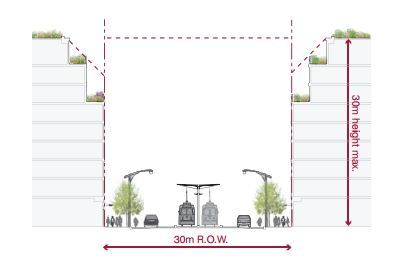
    The area that stretches between the property line on one side of a street and the property line on the other side of a street is called a public right-of-way here in Toronto. It may be called something different in other cities and countries.

    In the example below (taken from Toronto’s Avenues & Mid-Rise Buildings Study), it includes the sidewalks, the car lanes, and the streetcar lanes. But it could also include other public elements. In this instance, the buildings on either side of the street are assumed to be built right up against their property lines.

    ROWs obviously serve an important public function. But their size also has important urban design implications. As a pedestrian, it feels different to walk on a narrow street than it does on a broad street.

    The width of a ROW can also be used to inform what the preferred height of the buildings along it should be. In the example above, they’re talking about a 1:1 relationship between the width of the ROW and the preferred height of the buildings.

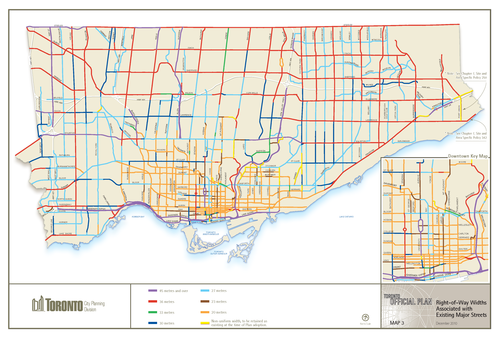
    Given their importance, I thought it would be interesting to share this map of Toronto (dated 2010) showing ROW sizing throughout the city. The mustard colored lines in the core of the city represent 20 metres, the red lines 36 metres, and the purple lines 45 metres or more. The rest of the colors fall somewhere in-between. For the most part, the purple lines represent highways, although there are a few other instances of purple.

    What’s interesting – but not surprising – to see is how we basically kept expanding the size of our ROWs as Toronto grew outwards. This was obviously to make more room for cars on the road.

    But the other, perhaps more interesting thing about this map, is that it could also serve as a guide to pedestrian happiness. The mustard/yellow lines are where it’s most enjoyable to walk. And the red and purple lines are where it’s least enjoyable to walk.

    If you’re from Toronto, give this framework a try and see if it holds true.