Daily insights for city builders, delivered every morning at 6 AM ET. I’m Brandon Donnelly — a Toronto-based real estate developer and founder of Globizen. I’ve been writing here since 2013.

Tag: hamilton

  • City-states and superstar cities

    During the recent election here in Toronto, mayoral candidate Jennifer Keesmaat raised the idea of this city region, maybe, becoming its own province. It wasn’t the first time this idea has been floated, but it once again didn’t stick.

    Earlier this week, Richard Florida spoke at the Urban Land Institute’s Toronto symposium and he brought up a similar issue: Toronto is a ‘city state’ and needs to start acting like it. Here is an excerpt from a recent Star article about his talk:

    He also noted that in terms of total economic output, the GTA [Greater Toronto Area] — he included the Golden Horseshoe — is responsible for about “$700 billion” (U.S) in economic output.

    “Which means our … region is equivalent to that of Sweden. So we are a city state, a mega region.”

    He later added: “we are a powerful global city with lots of assets to build on,” he said.

    But he went on to say that despite all of these successes there’s a “sense that something is amiss, something is wrong.”

    I have long supported the notion that city regions need to see and think of themselves as one united and contiguous economic landscape. In our case, it is not about, for instance, Hamilton vs. Toronto. This is about our entire region vs. New York or Singapore (a city-state) or the Pearl River Delta megalopolis.

    The headlines coming out of Amazon’s recent announcement are clear: In Superstar Cities, the Rich Get Richer, and They Get Amazon. This is winner-take-all urbanism where you need to be a “superstar” in order to compete. 
  • The Future of Hamilton

    image

    As many of you know, we have a development project in Hamilton, Ontario – more specifically in the Corktown neighborhood. We filed our development application earlier this summer.

    Because of this I was invited to participate in a Bisnow event on The Future of Hamilton. It takes place the morning of Wednesday, September 12, 2018 in The Alley by Core Urban. I walked this space last summer while it was under construction and so I’m excited to see it finished.

    For those of you who aren’t familiar with Core Urban, they are doing some really great work in Hamilton and have established themselves as a responsible city builder with a focus on adaptive reuse projects.

    Steve Kulakowsky, who is co-owner of Core Urban, will be speaking at the event along with the mayor, some guy who has pretentiously included his middle name, and many other smart people. To see the full list of speakers and to buy a ticket, click here.

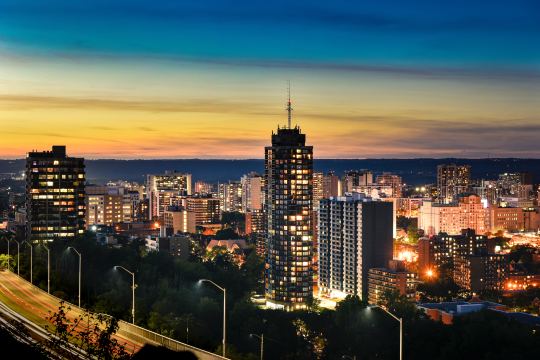
    Photo of Hamilton by Vivek Trivedi on Unsplash

  • Inaugural meet-up: Planners on bikes getting coffee

    Remember my post from a few weeks ago about “planners on bikes getting coffee?” Well it happened. That’s the potential of blogging and Twitter. (I sold $TWTR too early.) 

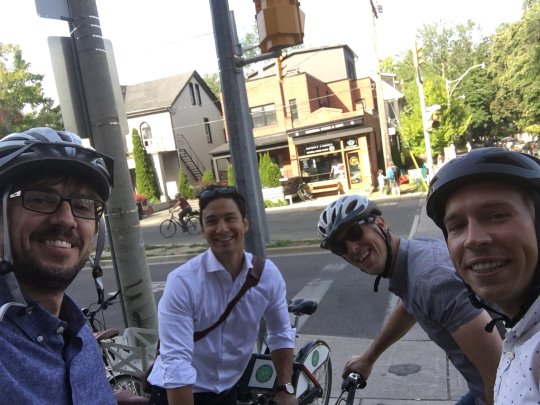
    Here is the selfie to prove it:

    Jason Thorne and I met up with Gil Meslin and Liam Hanebury (Liam needs Twitter) of Artscape and they toured us around a few of their projects, including one of their first artist live/work projects on Queen West.

    I do, however, have to confess that we didn’t have any coffee. I can’t drink coffee in the evening because it keeps me up at night. I already have too many things on my mind.

    Trying to hold a group conversation on a bike is also not as easy as talking in a car, but I would still label the inaugural session a success, even if I was posing as a planner without a bicycle helmet.

    If any of you have any suggestions for the next meet-up or I would like to join, drop me/us a line on the Twitter machine.

  • Introducing the new Corktown Plaza

    This evening Slate hosted a pre-application community meeting in Corktown, Hamilton, where we presented our proposed design for the redevelopment of Corktown Plaza

    There was a short presentation by Slate, GSP Group, CORE Architects, and Janet Rosenberg and Studio, and then we shifted to an open house format where members of the community could speak directly with all members of the project team.

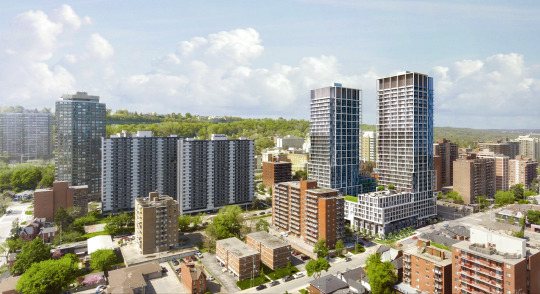
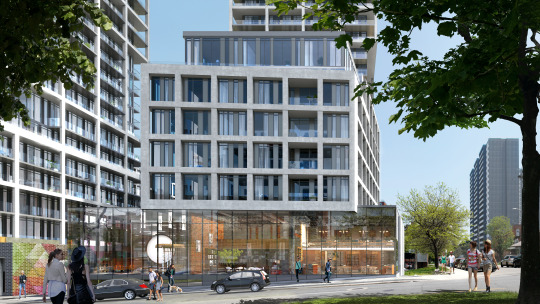
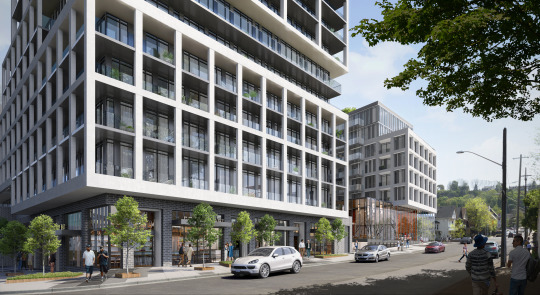
    Below are a few of the project renderings, all completed by our friends at ADHOC Studio

    imageimageimageimage

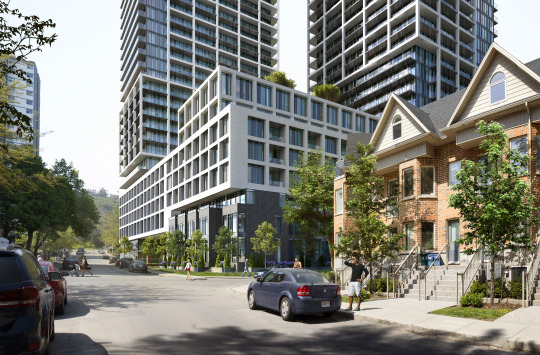
    The proposed design includes fine grain and large format retail spaces and a 9.5m pedestrian setback along John Street South (rendering #2 and #3); grade-related family-oriented townhouses on Young Street and Catharine Street South (rendering #4); and two 100% rental towers (31 and 34 storeys) to be built over two phases.

    The other notable feature is a mid-block pedestrian connection that will run from John to Catharine and become an important place for local public art. The plan is to work with the community and Councillor Jason Farr to run a separate engagement process for this component of the project. We want to work with local artists. If you have any suggestions, please send them over.

    Here, here, and here are what some people had to say about the proposal on Twitter. Thanks to everyone who attended this evening.

  • Pre-application community meeting in Hamilton

    At the end of last year, Slate hosted a “pre-design community meeting” for the redevelopment of Corktown Plaza in Hamilton. It was the first time we hosted a meeting like this.

    We learned things that evening and this May 24th we’ll be hosting our “pre-application community meeting.” See above for the full invite details. Lots of pre things.

    At last year’s meeting we had no design. It was about learning. At this month’s meeting we will be presenting a design proposal for the site. So hopefully some of you will be able to make it out.

    Regular scheduled programming will resume tomorrow on the blog.

  • Hamilton’s Pier 8

    In December of last year, the City of Hamilton launched an RFP process to find a team (from the list of prequalified bidders) to develop a new urban community at Pier 8 along the waterfront. The ambition is somewhere around 1,500 new residential units and approximately 13,000 square meters of commercial and institutional space.

    That process has narrowed the pool to 4 teams and 1 will ultimately win the exclusive right to develop the new community. Here are the teams, along with a link to their submission materials, including a short video that I understand was a requirement of the RFP.

    – GulfDream (link)

    – Tridel (link)

    – Urban Capital / Core Urban / Milborne Group (link)

    – Waterfront Shores (link)

    This is a super exciting project for Hamilton. So I would encourage you to take a look at the presentation materials. At this point, you only have until Tuesday, April 17, 2018 to provide any comments to the City’s evaluators. If you’d like to view the boards in person, you can do that this Monday and Tuesday in the main lobby of City Hall.

  • We’re hosting a pre-design community meeting in Hamilton

    This fall Slate acquired a retail center in Hamilton called Corktown Plaza. It is the block bounded by John Street South, Young Street, Catharine Street South, and Forest Avenue. It is just south of the Hamilton GO Centre in downtown.

    It is currently a much used single storey retail plaza with a large surface parking lot facing John Street South. It’s still early days, but the long-term plan is to redevelop it into a mixed-use retail and residential complex.

    Before putting pen to paper, the team is hosting a “pre-design community meeting” this Tuesday, December 12, 2017 at 7pm at the Church of Ascension down the street. Address is 64 Forest Avenue (accessible entrance at 258 John Street South).

    Here is the invite (embedded tweet):

    https://platform.twitter.com/widgets.js

    The purpose of the meeting is to gather feedback from the community before beginning design. We want to know what’s working today, what’s not working today, and what would be ideal for the future. 

    CORE Architects and GSP Group (planning) will be in attendance along with the Slate team. The format will be brief presentations followed by interactive breakout sessions. There will be trace paper on hand so that we can all put pen to paper.

    If you live and/or work in the area or are simply interested in the future of Hamilton, please feel free to join us on Tuesday evening. If you can, send a quick email to rsvp@kga-inc.com letting us know you’ll be coming. But just showing up is also perfectly fine.

  • Screw Toronto

    Hamilton, Ontario is on the rise. It’s no secret. 

    In fact, Toronto Life just ran a piece called The New Hamiltonians, where it profiled ex-Torontonians who have made the move west for more affordable housing and a higher quality of life.

    What stands out for me about the article is how there’s already growing resentment toward both developers and the local business owners who are helping to revitalize the city. Here is an excerpt:

    As builders encroach on Hamilton’s old neighbourhoods, a simmering resentment is building toward the upstart businesses that make rundown areas attractive to developers in the first place. Dave Kuruc, who owns Mixed Media, says that last year, the front door of his and neighbouring shops got slapped with a sticker that read “FUCK YOUR BOUTIQUE. DEFEND HAMILTON.” Last June, a bus tour for ­developers—branded “Try Hamilton!”—was interrupted by masked activists spraying sour milk out of water pistols and wielding signs that read “Developers + Investors = Predators.”

    So it’s not just developers. It’s also those damn boutiques. But the City of Hamilton eliminated development charges and put in place many other incentives for a reason. It wants to see more new construction. 

    Some people clearly aren’t happy about that.

  • Adaptive reuse in Hamilton

    Yesterday evening I was in Hamilton, Ontario for an adaptive reuse building tour that was put on for the 2016 OPPI Symposium (Ontario Provincial Planners Institute). 

    Hamilton has lots of these sorts of projects underway. The city has a rich history and, because it never saw the development pressures that cities like Toronto saw from the 70s to 90s, many of these buildings now remain ready to be reused. That’s my theory at least.

    I was told that last year downtown Hamilton delivered about 600 residential units. This may not seem like a lot, but keep in mind that the number was zero for a very long time. In fact, just seeing a crane up in the air is exciting for those who lived through that period of inactivity. I can’t fully relate to that.

    But it’s not just development that is going on. It’s city building. 

    The city is creating new cultural spaces and developers such as Core Urban have carved out niches working on boutique-scaled “pain in the ass” heritage projects. How’s this for commitment: Core Urban has been awarded heritage builder of the year 3 times, but they have yet to work on a designated heritage property.

    I’ve said before that I think there’s a new breed of developer emerging in cities today. Hamilton is no exception. And that’s very exciting for this region.

    If you’re interested in Hamilton, check out the blog Rebuild Hamilton. It’s written by Thomas Allen who I think of as Mr. Hamilton. It’s a phenomenal resource for architecture and city enthusiasts.

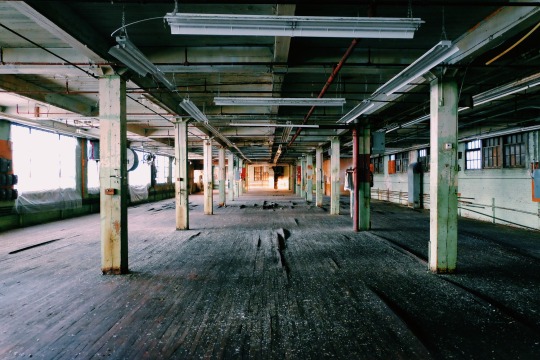
    The photo at the top of this post was taken by me within the proposed Beasley Park Lofts by Stinson Developments.

  • Urban migration, household type, and housing supply

    Here is an interesting discussion paper on the Toronto region’s economy, demographic outlook, and its land use. It was recently published by IBI Group and Hemson Consulting to support the 10-year review of our regional transportation plan.

    I wanted to share a couple of charts from the report that I thought were interesting. If you’re not in the Toronto region, I would be very curious to hear how your city might compare in terms of the way it is trending.

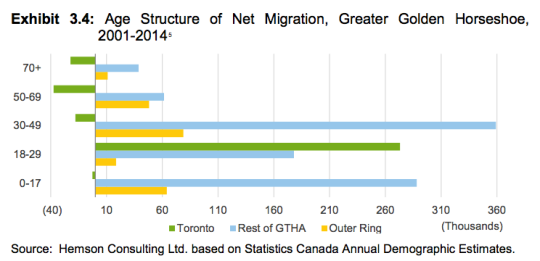
    The first chart is net migration by age group. Like Vancouver – similar chart posted here – people have been moving into the city/Toronto when they’re young and then moving out to the suburbs once they start having families. 

    Will that continue? The oldest Millennials are now hitting their mid-30′s and I am very interested to see if there will be any reversal in this.

    image

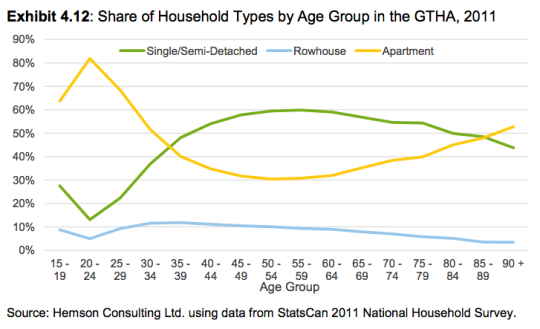
    Given the above trend, people in this region are not surprisingly also swapping apartments for ground-related housing as they get older. The crossover point seems to be (or at least has been) when people hit their mid-30′s. Again, I am curious how this may evolve as the city matures.

    image

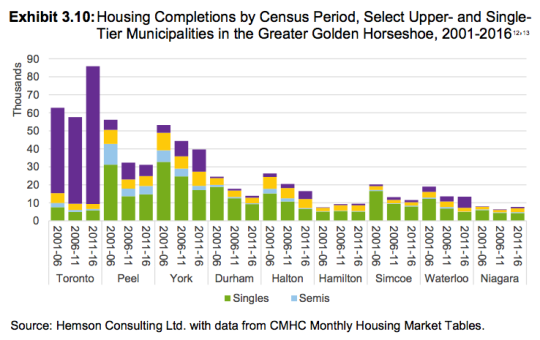
    Because if you look at housing completions from 2001 to 2016 (chart below), the only municipality that was able to meaningfully increase its housing supply was Toronto. 

    Every other municipality – except for Hamilton, which posted modest gains – experienced significant declines in the number of new homes delivered to the market over the last census periods. 

    Of course, the only reason Toronto was able to increase its housing supply was by building up – in other words by building condos and apartments. (Shown in the purple below. For some reason the legend is incomplete in the report.) 

    image

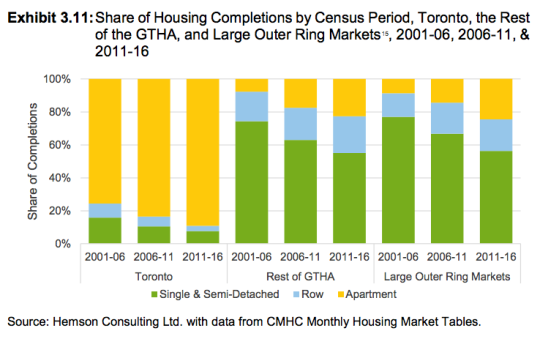
    If you look at the share of housing completions, over 80% of new homes in Toronto are now in apartment form. 

    image

    Intensification is a deliberate policy choice. And we can certainly debate whether it’s a good or bad thing (I believe it’s a good thing). 

    But putting that aside, the above charts are a great answer to the perennial question: “How is it that Toronto is building so many condos?” This is why.