Daily insights for city builders, delivered every morning at 6 AM ET. I’m Brandon Donnelly — a Toronto-based real estate developer and founder of Globizen. I’ve been writing here since 2013.

Tag: gym

  • The great reopening: Planet Fitness vs. Peloton

    I came across this chart in Charlie Bilello’s latest newsletter. It was under the heading “the great reopening in 2 charts.” The other chart was live nation (so concerts) vs. zoom. Both are showing returns over the last year. And both are showing a similar divergence between in-person and online activities.

    Now, I’m not a Peloton guy.

    But I know many people who swear (or swore) by them. Maybe it’s because I’ve never been a class guy. I prefer to self direct myself at the gym and I like doing lots of different things. So I have a hard time believing that connected at-home gym equipment can completely supplant traditional gyms. There’s also a social aspect to in-person workouts that I think a lot of people value. I personally find it more motivating to be working out around others.

    But this wasn’t the narrative last year. We were all going to move to the country, zoom into our meetings, and then switch to another sitting device and another screen so that we could connect with our trainers. For me, this chart is yet another reminder that 1) cities are resilient and 2) there are always opportunities in the midst of short-term market dislocations.

  • Why we work out

    This recent article by Amanda Mull makes an interesting argument about “Why Americans Really Go to the Gym.” In it she argues that gyms aren’t just about being healthy and looking beautiful. Part of the satisfaction of working out in a collective space is that, among other things, you get to be around people with similar values and you get to prove to others that you are someone with enough self-discipline to stay consistently active. In her words, “proving something to others is often a big part of proving it to yourself, and that’s difficult to do when no one else can see you.” Depending on how you interpret this, it might lead you to believe that we’re all looking for a bit of validation from others. But I think the other way to look at it is that spaces such as gyms and offices aren’t just empty vessels where we come to do our necessary work. They are also social environments that serve some potentially important psychological functions.

    The other thing Mull’s article touches on is the evolution of physical activity:

    In the past 70 years, physical activity in America has transformed from a necessity of daily life into an often-expensive leisure activity, retrofitted into the foundation of people’s identities. As a concept, fitness was a response to the flourishing, sidewalk-free postwar American suburbs and what the fitness pioneer Bonnie Prudden dubbed “the tyranny of the wheel”: Americans went from strollers to school buses to cars, stripping out much of the on-foot transportation that had long characterized life in cities or on farms. “In the ’50s and ’60s, the body became a problem, and exercise developed—it had to develop—because people realized that we were all going to die of heart attacks,” Shelly McKenzie, the author of Getting Physical: The Rise of Fitness Culture in America, told me.

    In short: we had no choice but to create a fitness industry because we systematically removed physical activity from our daily lives. You could argue — as the above excerpt does — that this was largely because of suburbanization and changes in mobility. But I don’t think that’s everything. We also changed the kind of work that a lot of us do and created technologies that allow us to do more without, frankly, moving all that much. Today, doing good work and being productive is often characterized by sitting still for extended periods of time and subsisting on empty calories so that you don’t have to lose focus for very long. Indeed, working out our bodies, and consequently our minds, has become somewhat of a luxury.

  • The global gym market and gyms per capita

    Many of us are now working out from home. The Financial Times just reported that Peloton experienced its highest level of participation last week. Some 23,000 people tuned in for one of its streamed classes. Naturally, anything that was possible to go online has gone online.

    I’ve never really been a class guy, but I’ve been a regular at a gym since high school and it’s one of the things I’m most looking forward to getting back to as things subside. For many, the gym is a kind of third place. Though I would imagine it’s not the best place to hangout during a pandemic.

    According to FT, the fitness industry was among the first to suffer in the UK (~£5.1bn industry), showing signs of decline even before any government lockdown. The UK also had one of the most profitable fitness industries in Europe. Here’s an interesting chart comparing gym penetration to revenue per club.

    It’s interesting to note some of the outliers. Latin America has low penetration and low average revenue per club. And parts of Asia — notably Hong Kong and China — have relatively high average revenue per club, but still have fairly low penetration percentages. Do only rich people go to the gym in Hong Kong?

    This chart maybe makes it seem like nobody in Latin America is working out. But if you, instead, look at the number of fitness clubs in each country, the data looks vastly different. In this case, there are two very clear outliers: the United States and Brazil. (The below chart is from Statista and is based on 2017 data.)

    But Brazil also happens to be the most populous country in Latin America with around 209 million people. So let’s consider this chart on a per capita basis against, oh I don’t know, the US (~328 million), the UK (~67 million), and Canada (~38 million). Once again, the ranking switches. Brazil and Canada now come out on top with around 16 fitness clubs per 100,000 people. (I guess we’re just as body conscious as the Brazilians.) This is in comparison to 12 per for the US and 10 per for the UK.

    So what does this all mean for our post-COVID-19 world? Who knows. But I’ll sure as hell be at the gym.

  • The geography of gyms

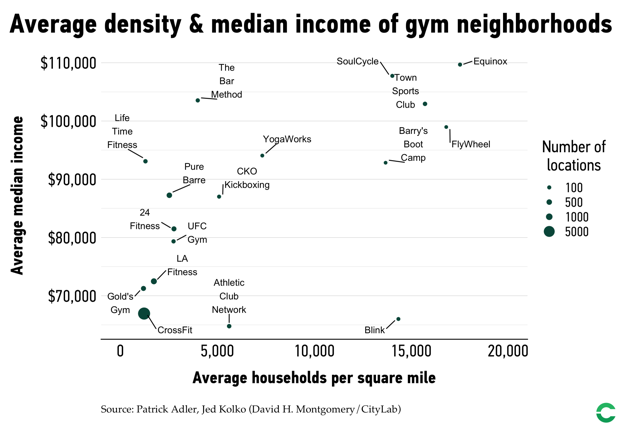
    Richard Florida and Patrick Adler recently looked at the geography of gyms across the United States. They analyzed 17 different fitness chains, over 10,000 gyms, and nearly 5,000 zip codes. Full article over here at CityLab.

    image

    The findings probably won’t surprise you, but it’s still interesting to see some of the data. Gyms and fitness studios tend to concentrate themselves in affluent neighborhoods with a high number of college graduates.

    The median household income of the average zip code with a gym or fitness studio is $72,720. This is compared to $56,694 for all zip codes. And when it comes to zip codes with an Equinox, SoulCycle, The Bar Method, or Town Sports Clubs, the median income jumps to over $100,000.

    Above is from the second post in the two part series they are doing on “the geography of fitness.” For the first one, click here.

  • The most popular building amenities (according to a small subset of people)

    Here are the results from my primitive multi-unit building amenities survey:

    Gym is number 1. No surprise there. 46% of respondents said it was in their top 3. 

    Rooftop outdoor space at number 2 was perhaps a bit surprising. But then again, who doesn’t love a good rooftop patio?

    As for concierge service, I tend to think this was driven by package delivery. That’s certainly the biggest value add for me.

    One standout near the top, for me at least, is co-working space. Andrew LeFleur made mention of this on Twitter and I think he’s right: The changing nature of work is making these spaces more valuable in multi-family dwellings.

    And now some color on the above results.

    436 amenity selections were made as part of this survey. 

    About half of the respondents were from the Greater Toronto Area, followed by Calgary, San Francisco, Ottawa, Boston, New York City, Denver, Los Angeles, Paris, Miami, and many other cities. Shoutout to whoever responded from Kuala Lumpur and Porto Alegre.

    In terms of “Other” amenities, there were suggestions for a band rehearsal space, a vending machine, a grassy area for sports, and programming the helps you meet your neighbors.

    In terms of this one last, it can be tricky for condo buildings. Developers only provide the space. It’s then up to management. But I’ve seen it done very well in rental buildings.

    Are you surprised by any of the results from this survey?

  • The definition of a habit

    I recently heard someone define a habit as something that you need to do in order to feel normal. In other words, until you do it, you don’t feel yourself. 

    This, of course, could refer to both good habits and bad habits. And most of us probably have habits from both camps. But I like it as a clear and simple definition. 

    I’ve written about disciplines and habits a few times before, because I think of myself as having a few. The most public of my habits is this blog and, at this point, I certainly don’t feel normal if I don’t write everyday. I’ve missed a few days since I started writing in 2013 and each time I felt bad.

    My other big habit is going to the gym and lifting weights. And since my snowboarding injury back in February, I haven’t been able to do this properly (though I still tried). It’s easily the longest break I’ve taken from it since I started this particular habit when I was 16.

    Because of this, I really haven’t felt myself for about 2 months. My energy levels aren’t the same and I just don’t feel as mentally sharp. Those are some of the main reasons why I love this habit. And I still haven’t adjusted.

    Thankfully (with some help from Totum Life Science), my back and shoulder are finally starting to feel better. And so today, instead of writing about cities, I’m going to go to the gym and try and do one of my regular workout routines.

    I’m not quite at 100% yet, but I should be soon. And then I’ll finally feel normal again.

  • The hard things about retail

    image

    Retail is one of the hardest – if not the hardest – real estate category to get right. If you don’t have the right setup, the right location, and the right tenant mix, you can fail pretty easily. It’s a bit of an art. And that obviously applies to both landlords and tenants. I mean, we all know what recently happened with Target Canada.

    This past weekend I had the opportunity to visit the Aura Condos in Toronto, which is supposedly the tallest and largest residential condominium in Canada. There’s about 1.1 million square feet of residential space across 79 floors and somewhere around 150,000 to 180,000 square feet of retail space (the estimates I found online varied). The main anchors include Bed Bath & Beyond, Marshalls, and Hard Candy Fitness (which also serves as the gym for the residences above).

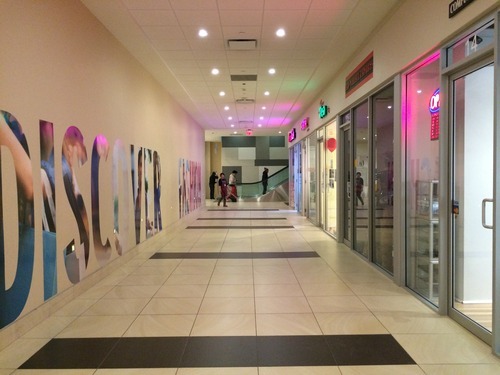
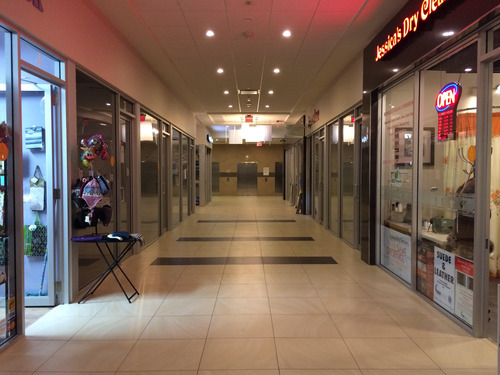
    But what’s probably most unique about the retail component of this building is the P1 level (the first underground level). It’s made up of small retail condos, some of which looked to be about 90 square feet. That means that each retail unit is individually owned, just like a residential condominium, and there’s no singular landlord focused on curating the tenant mix and ensuring the entire retail center does well.

    Now, I’m told that this approach works perfectly well in other parts of the world and I know that we’re trying it in other parts of the Greater Toronto Area, but I worry about the long term viability of this (P1) space in particular. When I was there on Saturday there was almost no foot traffic and probably half of the retail units were vacant.

    Maybe it’s because there isn’t enough employment density in the area. Maybe it’s because it’s not well connected to other P1 level retail. Or maybe it’s because the anchors all sit above this space, as opposed to around it (as they do in traditional malls). Whatever it is, I wasn’t feeling product/market fit.

    I hope I’m wrong.

    Images: P1 Retail at Aura Condos