Daily insights for city builders, delivered every morning at 6 AM ET. I’m Brandon Donnelly — a Toronto-based real estate developer and founder of Globizen. I’ve been writing here since 2013.

Tag: grocery

  • Delivery > mobility

    I was picking up food the other night on Bloor Street (via Uber Eats) and the lineup of delivery drivers outside of the restaurant was at least ten people deep when we arrived. While we were waiting, another handful of drivers pulled over to quickly pickup their deliveries. This is what is happening in our cities right now, especially here in Toronto while we live through another stay-at-home order. And the numbers certainly reflect it.

    Last month in March, Uber’s delivery business (which is separate from the company’s mobility business) recorded a 150% year-over-year increase in annualized gross bookings. The company’s run-rate as of March is now $52 billion. To put this number into perspective, the company’s mobility business also had its best ever month in March with an annualized gross bookings run-rate of $30 billion.

    Delivery > mobility right now. Makes sense.

    To further put this into perspective, total restaurant spending across the entirety of the United States was $670 billion in 2019 (figure from Benedict Evans). So Uber Eats has quickly become a meaningful part of how we eat. I obviously believe that people are dying to get out and eat at restaurants again, but these figures are still interesting nonetheless.

    It’s also interesting to think about the above trendline from a broader logistics perspective. Alongside the rise in Uber Eats, we are seeing a wave of capital move toward “rapid delivery apps.” These are platforms that allow meals, groceries, and other stuff to be delivered, in some cases, almost right away, which aligns with where I think consumers are moving. Rather than making lists and doing weekly shops, it’s now about just-in-time delivery.

    It’s arguably a lazier way of going about things, but water will always find the path of least resistance.

    Many, or perhaps most, of these platforms have adopted an asset light approach. Instacart, which partners with existing grocers, would fall into this category. Their model revolves around gig workers going into existing stores, picking orders directly from the shelves, and then delivering those orders. And it is what Blair Welch was getting at in his recent RENX interview when he reasoned that grocery shopping is still being done, almost exclusively, at local stores.

    This approach is enough for Instacart to be valued at nearly $40 billion, according to the Financial Times. So something seems to be working.

  • Voi Cube — the first store in Switzerland without any employees

    Swiss supermarket chain, Migros, has just launched what is being called the first store in Switzerland to not have any employees. The concept, called the Voi Cube, is a small container-like outparcel space that is open 24/7 and offers about 500 or so everyday items. You enter using their app, you grab what you need, and then you check yourself out. (Presumably the doors don’t open back up until you’ve paid.)

    The concept is being positioned as a convenience add-on to its existing grocery store business. Swiss federal labor laws still prohibit retail staff from working on Sundays, and so this is a clever way for people to shop for essentials during that time. They just got rid of the labor component. It also begins to show just how flexible and adaptable grocery stores can be as the retail landscape continues to evolve.

  • Ecommerce during lockdown

    The United States and the United Kingdom recently published some official statistics on the impacts that this pandemic has had on ecommerce. The above chart is from Benedict Evans and he has some more over here. It’s worth a click through. What is clear is that lockdown forced a whole bunch of adoption and accelerated trends that were already underway. More people turned to shopping online. The UK went from 20% ecommerce penetration to over 30%. And the US went from 17% to about 22%. What is also clear is that grocery has demonstrated to be exceptionally resilient. Most physical retailers saw a decline in sales during lockdown. Grocery proved to be a notable exception. But what is unclear is how much of this adoption will actually stick. The UK is reporting monthly (as opposed to quarterly for the US) and already you can see signs of a possible reversion. My guess is that — provided we don’t see another major lockdown — there will be a meaningful reversion before the trend line resumes its march.

  • Grocery and home & garden

    It’s interesting to think about the psychology behind this FT chart outlining consumer spending in the United Kingdom from March to early July. You can see the initial panic buying of groceries in late March (well, food and toilet paper). And you can more or less see the moment where people suddenly realized — after working at home for a few weeks — that their home was in desperate need of a refresh and that planting tomatoes might be a good hobby to take up given that there isn’t much else to do. In case any of you are wondering, I remain well-stocked on the toilet paper front and my tomatoes are doing just fine.

    Image: Financial Times

  • South Korea buys 20% of its groceries online

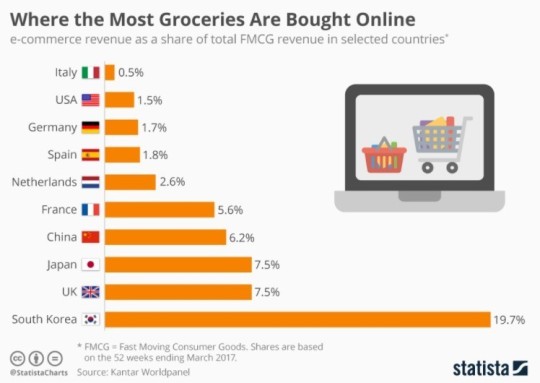
    The World Economic Forum recently posted the below chart showing that 1/5 of all grocery purchases in South Korea are done online. The calculation is e-commerce revenue as a percentage of total fast moving consumer goods revenue in the country.

    image

    The explanation they give for this high percentage is that South Korea has some of the fastest and most ubiquitous internet access in the world. 

    But as soon as I read this I thought to myself: This can’t be the only reason. When was the last time you really wanted to order groceries online but your internet connection was too slow? 

    Also, if you look at all online shopping (not just FMCG), South Korea no longer shows up as such an outlier. So what’s happening with grocery?

    Without actually knowing the market, I would imagine that there are companies in South Korea who have simply figured out how to offer a great online grocery shopping experience.

    South Korea is also one of the denser countries in the world at about 513 people per km2. That would help with distribution. 

    But then again, the Netherlands is also quite dense (414 people per km2). Why are they only at 2.6%? (For comparison, the US is about 33 people per km2.)

    If any of you are familiar with the South Korea market I would love to hear from you in the comments. If they really are at 20%, I am surprised more people aren’t talking about this.

  • Two-hour grocery delivery

    Today it was announced that Amazon is planning to launch its “Prime Now” service in Vancouver and Toronto this November and January, respectively. 

    The pilot program will offer two-hour deliveries for members and, according to the Wall Street Journal, will be be heavily focused on groceries. 

    It’s worth noting that most of Whole Foods’ stores in Canada (now owned by Amazon) are in and around Vancouver and Toronto. And that Amazon has already started lowering prices to make those stores more competitive.

    Right now a “Prime” membership in Canada costs CAD$79 per year. I’m not sure if the price will change at all for “Prime Now”, but let’s assume for the sake of argument that it won’t. 

    If this service was available to you today (or if you’re in a city that currently has it), would you (do you) use it? I would love to hear your thoughts in the comment section below.

    Two common objections around online grocery shopping are that many people want to touch and feel the goods before they buy and that perishable deliveries are a challenging thing to coordinate.

    I think I can work around those objections and would certainly try this today if it was available in Toronto. What about you?

  • The grocery wars: Why Amazon bought Whole Foods

    The big news on Friday was that Amazon has agreed to buy grocery chain Whole Foods for $13.4 billion.

    Some people – such as Bruce Berkowitz, who manages the $2.3 billion Fairholme Fund and who is the second largest shareholder of Sears Holdings Corp. – believe that this says to the market that “there is a need for physical space in retailing.” Everything can’t be online.

    I obviously agree that there’s value in real estate / physical locations, but I don’t see this as Amazon capitulating in any way. This is not Amazon saying to itself: “Well, AmazonFresh hasn’t grown as quickly as we’d like, so let’s forget this ecommerce thing.” No, Amazon is determined to win.

    Indeed, the fact that shares of supermarket operators tumbled across the U.S., Canada, and Europe, probably signals that the market is expecting something other than the status quo following this acquisition. 

    All of this is a big deal because grocery is a big deal. 

    There’s a reason Wal-Mart ramped up grocery (and now derives over half of its revenue from it). There’s a reason why drug stores are proliferating across our cities (and expanding their grocery offerings). In Toronto it’s Shoppers Drug Mart and Rexall. In New York it’s Duane Reade.

    We buy groceries frequently and we overwhelmingly still buy them in person. So online grocery is the holy grail of ecommerce of right now. Everyone wants to nail it first.

    How does this acquisition help Amazon do that? Here are two thoughts.

    1) The real estate still matters. 

    Even in a world where most groceries are purchased online, you need still need physical distribution centers in close proximity to lots of customers.

    Whole Foods has more than 460 stores across the U.S., Canada, and Britain. Their formatting would obviously evolve, but the bones are there for Amazon to leverage.

    Startups such as Instacart have tried to circumvent this requirement by fulfilling only the delivery portion. And arguably their pitch to other grocers may now be stronger: “You need to offer this to compete with Amazon/Whole Foods.” (Instacart currently provides this service Whole Foods.) But you can bet Amazon will want to squeeze/control this part of the supply chain.

    2) The data.

    Many analysts are already assuming that Amazon will work to automate away cashiers, similar to what it’s trying to do with its Amazon Go concept store. If you combine this with other offerings such as 15 minute pickup (Amazon Fresh PIckup), you can easily imagine a world where us customers get weaned off of in-person shopping.

    For example, if my regular grocery store made better use of its data, it would probably come to the conclusion that I generally buy things like orange juice, milk, and avocados (I’m a Millennial) every X days. I’m sure if you look at my shopping habits, I’m pretty predictable. Whenever I go to a new store it always takes me 100% longer to shop because I don’t generally wander. I target my stuff.

    Now if I could get somehow prompted to re-order my regular items every X – 1 days, chances are I would gladly tap order. And now I’m shopping for groceries online. Get ready for the grocery wars.