Daily insights for city builders, delivered every morning at 6 AM ET. I’m Brandon Donnelly — a Toronto-based real estate developer and founder of Globizen. I’ve been writing here since 2013.

Tag: grocery stores

  • Eating by algorithm

    Grocery shopping is one of those things that — despite a lot of people really trying — has remained a stubbornly in-person activity. However, the pandemic did give online grocery shopping a significant boost, and lot of that has stuck, even if it has been trending slightly downward from its peak. Here are a few slides from Dan Frommer’s Consumer Trends: 2024 Food & Wellness Special report:

    Part of the challenge may be that the majority of people say they actually like grocery shopping, and doing so in a physical store:

    So it is very possible that, for the foreseeable future, there will always be a large segment of buyers who prefer to shop in-store. But then again, if you asked me these same questions, I would also tell you that I like grocery shopping and that I prefer buying in-store. However, that doesn’t mean I wouldn’t be open to alternatives. I just haven’t explored and found a suitable online option.

    At the same time, and according to the same Consumer Trends Survey, about 10% of Americans say they currently dislike grocery shopping. Maybe this is the same 10% who are right now shopping online. Either way, this is already a large segment of people who would rather not go into a grocery store.

    Intuitively, as the online offerings get better, one would expect this number to grow. Here, for example, is an interesting overview of the service Hungryroot. One part “meal kit” delivery and one part online grocery shopping, the company uses machine learning and algorithms to determine what its customers might want to buy. Already, about 70% of what it sells is picked automatically.

    On the back end, McKean explains, among other actions, Hungryroot is “clustering” its new customer with other users who have answered its onboarding survey similarly and have already been with the service for multiple years. “And so we can say, ‘okay, people who filled out that signup flow like you… they loved these top recipes with high probability, so we think you’re going to love these recipes with high probability’.”

    What I like about this is that it requires fewer decisions; it has the potential to feel like you have a private chef (one that learns what you like and adjusts accordingly); and it promotes dietary variety. For the typical American, 75% of what they buy in a grocery store is the exact same as what they bought the last time. There’s very little variety, because it’s always easier not to have to think.

    Given this stat, it is maybe surprising that this 75% hasn’t become more automated for more people. Perhaps it’s the 25% that keeps most of us going into stores. I’m not sure, but I think I’m ready to try a service like Hungryroot.

  • Amazon moves away from “Just Walk Out” technology at its grocery stores

    Back in 2018, Amazon opened its first cashier-less grocery store. The technology — which it later branded as “Just Walk Out” — was intended to allow customers to do exactly that. All you had to do was put items into your cart and walk out of the store. And then, through the magic of sophisticated computer vision, machine learning, and lots of sensors, you would be billed and sent a receipt.

    However, this month the company announced that it will be moving away from this technology, and instead focusing on its Dash Carts (more on this shortly). It turns out that the technology wasn’t nearly automated enough.

    Last year, The Information reported that “Just Walk Out” was relying on at least 1,000 off-site workers in India to constantly review video footage and figure out who had bought what. This is why it apparently took so long to receive a bill sometimes; humans far away were working to figure out if that was a persimmon in your hand, or a tomato.

    I’m not an expert on this space, but I’m guessing it is not (yet) feasible to do what Uniqlo and other retailers now do with their supply chains and checkouts. So this was the workaround. Whatever the case, Amazon has now said that it will be focusing on its Dash Carts, which are kind of like roaming checkout counters. They come with screens and scales for weighing things.

    Obviously the ideal solution is to not have to do or scan anything. But being able to avoid check-out lines still feels like meaningful progress. I just wonder if these smart carts will encourage or discourage spending. Because now everyone will have a live receipt in front of them. That might discourage spending unless you can offset it with rewards and/or other incentives.

  • The banana test

    One of the reasons why “new small-scale retail, service, and office uses” are now permitted in low-rise neighborhoods of Toronto — and why many are on to talking about these uses in our laneways — is because it’s a way to serve the “needs of residents” and “reduce local automobile trips”. But what are these needs exactly? And if you had to choose only one, what would it be?

    Let me provide some further background.

    According to this mapping, 94% of Parisians live within a 5-minute walk of a bakery. And according to this mapping, 94% of people in Mexico City live within a 5-minute walk of a taqueria. So in other words, these two cities seem to have the kind of “small-scale retail, service, and office uses” that satisfy at least some of the needs of their residents.

    People in Paris need bread. And people in Mexico City need tacos. But what do people in Toronto need? I’m not sure we have a perfectly parallel thing. But according to Instacart, the top-selling grocery item last year across both the US and Canada was — bananas. One and four carts typically contain them, and apparently this number has remained fairly consistent.

    So maybe this should be our small-scale retail and walkability test metric: What % of the population lives within a 5-minute walk of fresh bananas? (I’m open to other food suggestions here.)

  • People like TikTok and grocery stores

    Dan Frommer has just just released his latest Consumer Trends report (2023). If you’d like to download a free copy, you can do that over here. It is amazing to see how big of a deal Tik Tok has become. In Q3 2022, the average Android user spent 98 minutes per day in the app. That is a lot, and it’s roughly 2x what Facebook and Instagram each saw (though if you combine these two apps, I guess they’re pretty similar). Either way, this is where people’s attention is now being spent. For those of us in real estate, the report also has some interesting slides on grocery stores. The key message here is that physical stores remain hugely important.

    The year-over-year change in online grocery spending is now flat to a little negative:

    No matter which generation you ask, more people prefer shopping for groceries in-store, versus online:

    And even when people do shop for groceries “online”, they still tend to pick them up from their local store or have that local store deliver it to them (so the store matters):

    For the full report, click here.

  • Grocery-anchored real estate as food logistics

    Blair Welch, co-founder of Slate Asset Management, was recently on Institutional Real Estate’s podcast talking about grocery-anchored real estate. In it, he talks about the role that this asset class plays in last-mile food logistics, why ecommerce might actually be strengthening its importance, and why it needs to be considered as being distinct from other kinds of retailing. This is a topic that we have covered a few times before on the blog and I think many of you might find it interesting. To have a listen, click here.

  • The history (and future) of the grocery store

    Slate just published a new thought piece on the evolution of the grocery store. It starts with the first “self-service” Piggly Wiggly in Memphis (an innovative approach at that time) and ends with the important functions that grocery stores serve today and will likely serve in the future.

    The shopping experience has become increasingly omnichannel (i.e. online & in-store), which means that grocery stores are in the midst of transforming from simple retail stores to hybrid retail and last-mile distribution hubs. (Related post here.)

    All of this is central to how we think about this real estate asset class and we are to happy share it publicly in this new thought piece. Slate plans to publish more of these and so, if you’re interested, I would encourage you to subscribe at the bottom of the page.

    Full disclosure: I am personally long Slate Grocery REIT.

  • Grocery and home & garden

    It’s interesting to think about the psychology behind this FT chart outlining consumer spending in the United Kingdom from March to early July. You can see the initial panic buying of groceries in late March (well, food and toilet paper). And you can more or less see the moment where people suddenly realized — after working at home for a few weeks — that their home was in desperate need of a refresh and that planting tomatoes might be a good hobby to take up given that there isn’t much else to do. In case any of you are wondering, I remain well-stocked on the toilet paper front and my tomatoes are doing just fine.

    Image: Financial Times

  • The threat to big box retailing

    image

    Earlier this week, I was having a conversation with a number of smart real estate people about the future of retail in today’s internet and smartphone world. This, of course, isn’t a new topic. The industry has been discussing it for years. And while internet retailing still accounts for a relatively small percentage of overall retail sales (~10%), we all know that change is coming.

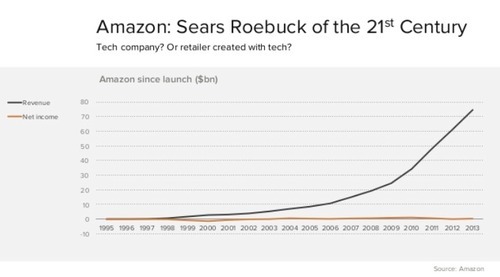
    One company that came up during our discussion was not surprisingly Amazon.com. But the initial comment was that they don’t make any money. Fortunately for me I had just gone through a presentation by venture capitalist Benedict Evans the night before called: Mobile is eating the world. And so I pulled out my phone and presented this slide:

    image

    The fact that Amazon operates with basically no net income is on purpose. Look at their revenue growth! So I wouldn’t dismiss them as being a fad. They may only account for 1% of all US retail sales today, but I’d put money on that percentage growing.

    The other reason I bring up Amazon is because, in some ways, I think of them as the online equivalent of a big box store. Just like a Walmart or Costco, where you can buy everything from tires to groceries to prescription drugs, I buy a lot of different things, besides just books, off of Amazon.com. You might do the same as well. And this is where I see the immediate threat to offline retailing and retail real estate: big box stores.

    In the second half of the 20th century, big box stores were incredibly disruptive to the retail landscape (and to cities). They used cheap land on the outskirts of cities, cheap buildings, and economies of scale to offer rock bottom prices to consumers. The value proposition was about cheap, not about differentiation. But as cheap as they may be, the internet can still do it cheaper.

    And retailers know this, which is why I think they all now sell groceries. Groceries have a very low online penetration. Basically everybody still buys groceries in-person. So if you offer that, you have a reason to draw people inside your store, where they will hopefully buy all the other stuff that they need. But as the online value proposition continues to get stronger, I think we’ll see many other, more significant, changes.

    Image: Flickr