Daily insights for city builders, delivered every morning at 6 AM ET. I’m Brandon Donnelly — a Toronto-based real estate developer and founder of Globizen. I’ve been writing here since 2013.

Tag: gridlock

  • Toronto’s congestion crisis needs solutions, not politics

    People in Toronto are deeply and rightly frustrated about our traffic. We have truly world-class congestion. But here’s the thing, the way we’re going about solving this problem is all wrong.

    Transportation staff seem to believe that congestion charges would not reduce or deter traffic from coming into Toronto. Never mind all the global precedents, never mind that we have the tolled 407 highway to look to, and never mind that economics tells us that when the price of something increases, the quantity demanded decreases.

    Instead, we seem to think that we can solve this problem with fewer bike lanes, improved traffic management, and better policing, including higher fines for disobedience. (Interestingly enough, higher fines are supposed to deter people, but congestion charges won’t do the same. I’m confused.)

    None of this will fix the mess we’re in.

    This is a case of politics over data and experience. Identify something that people are pissed off about, and then create the illusion that you’re doing something to fix it. Good politics. But the reality is that this problem is much trickier to solve. It will require vision and meaningful change. That’s a much tougher sell.

    Think of this way. Can you identity a large car-oriented global city with millions of people that doesn’t have a traffic congestion problem? Even the Katy Freeway in Houston, which counts as many as 26 total lanes, has a congestion problem. And the last time I checked, it didn’t have any bike lanes.

    https://twitter.com/joshuahind/status/1837347617304424620

    Now let’s look at the largest city region in the world — Tokyo. The city proper has about 14 million people and the broader region has about 41 million. This is the entire population of Canada in one city region, and yet it’s generally viewed as being one of the most well-run and efficient cities in the world. How do they do it?

    Here are the modal splits within Tokyo’s 23 wards (2018 data):

    • 36% public transport (rail and bus)
    • 27% passenger cars
    • 23% walking
    • 14% bicycles and motorcycles

    Now compare this to the splits in Toronto’s census metropolitan area (2021 census data):

    • 76% passenger cars
    • 16% public transport
    • 5% walking
    • 1% bicycles
    • 2% other

    Of course, if we were to look at the modal splits within the core of the city they would look quite different and much closer to Tokyo’s numbers. This is why it can be so hard to achieve consensus on many city building issues — we are quite literally a divided and different kind of city.

    In the end, this is the root cause of our traffic problem. The vast majority of people in this city region drive. And they are not to be blamed. It’s because we’ve designed this to be the only practical option.

    But if we’re serious about solving congestion, it’s going to require some bold changes. It’s going to require reducing this 76% figure. We can fool ourselves into thinking that better construction coordination, fewer bike lanes, and higher fines will somehow solve this enormous and deep-rooted problem, but the inconvenient truth is that they won’t.

    What we need are real solutions. Is anyone going to take the lead?
  • Slot-based intersections

    If you don’t follow the work of MIT’s Senseable City Lab, I highly recommend that you start. 

    Earlier this year, researchers from the Massachusetts Institute of Technology, the Swiss Institute of Technology, and the Italian National Research Council developed something that they call “slot-based intersections.” In a world where cars have sensors and drive themselves, it is intended as a more efficient alternative to traditional intersections. Goodbye traffic lights.

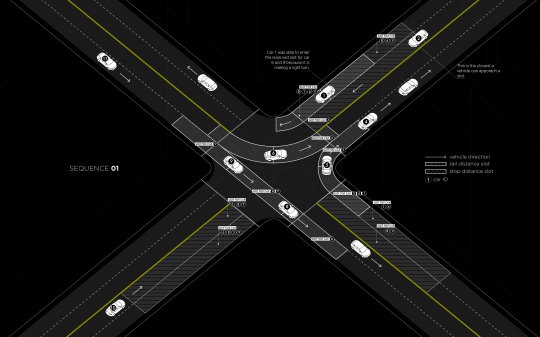
    Much like air-traffic control, the way the system works is by assigning individualized time slots to each car for when they may enter an intersection. For example, in the diagram below (Sequence 01) the car approaching from the bottom left (#10) has a “stop distance slot” in front of it reserved for 3 of the cars that are currently in the intersection. The two that are traveling perpendicular to it and the car currently turning left into the same lane as #10 (on the other side of the intersection). The car in the midst of turning right (#5) is exempt because there’s no possibility of collision. 

    image

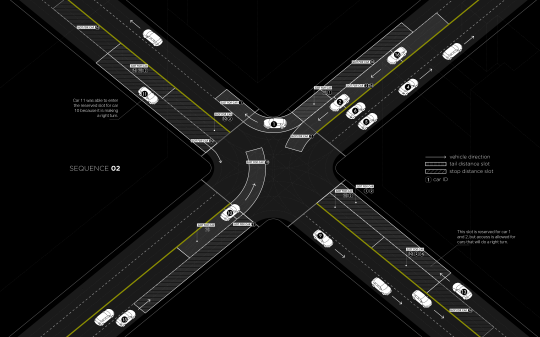
    In Sequence 02 (below) you can see that car #10 is now turning left, which means it has its own time slot in the intersection. Other approaching cars now have a “stop distance slot” dependent on car #10.

    image

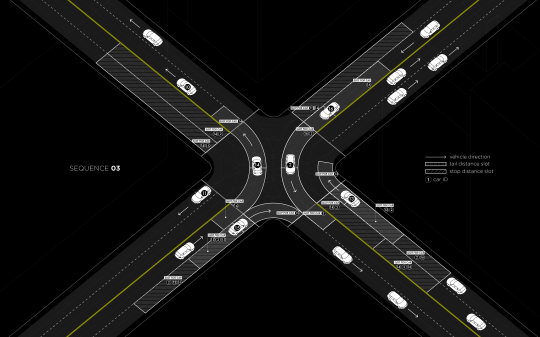
    In all cases, cars making a right turn are able to move freely, provided they will not interfere with any other cars.

    image

    The researchers estimate that real-time slot allocation might double the number of vehicles that a traditional traffic-light intersection can handle today and, in some cases, it might completely eliminate stop and go traffic.

    Often when I write about self-driving vehicles I hear people tell me that cars are still cars. It doesn’t matter whether they are self-driving or not. The same inefficiencies apply. They are not the solution to urban gridlock. Elon Musk was also criticized (following his Master Plan) for not properly understanding urban geography.

    But self-driving cars will create new efficiencies. I am not saying that they are a silver bullet, but I am saying that they will help a great deal. I don’t think that anyone truly understands the extent of these efficiencies, but there are a myriad of possibilities. This Senseable City Lab project is a perfect example.

    What I am grappling with right now is the relationship between self-driving vehicles and traditional forms of public transit. Until we get a handle on the efficiencies and overall impact, it’s hard to ascertain how these different forms of mobility will work together. My gut tells me that the lines are bound to get blurry and that self-driving “cars” will feel less and less like the cars we know today.

    Below is a video that was published along with the research. If you can’t see it, click here.

    [youtube https://www.youtube.com/watch?v=4CZc3erc_l4?rel=0&w=560&h=315]

  • Climate change gridlock

    I spent this morning reading an article called: How climate change is rapidly taking the planet apart. Here is an excerpt from the introduction: 

    “According to Naomi Oreskes, a great number of climate change scientists (she interviewed most of the top 200 climate change scientists in the US) suffer from some sort of mood imbalance or mild or serious depression. It is easy to understand why: we see the climate change taking the planet apart right in front of our eyes. We also clearly see, right in front of us, what urgently needs to done to stave off global disaster on an unprecedented scale. We need carbon taxes and the reconversion of industry and energy towards zero CO2 emissions systems. This route is without any doubt technically and economically feasible, but politically it seems to be permanently locked. If we do not unlock it, the future looks bleak, not to say hopeless, for humankind.”

    It’s clearly not a positive article. But it is an important read. We know we need to immediately and drastically reduce CO2 emissions (for all the reasons explained in the article), but we simply aren’t doing that.

    Part of the problem, I think, is that it’s easy to lull ourselves into complacency. We read about it and we notice the erratic weather patterns, but for the most part the status quo isn’t all that bad for most of us. Life just goes on.

    There’s evidence that revenue-neutral carbon pricing could actually increase productivity levels. It would force innovation. But it doesn’t yet appear to be 10x better than what we have today – which is often what you need to get people to accept change.

    So instead we hold largely ineffectual climate change conferences, which allow us to tell ourselves that we are, in fact, doing something. But I don’t think we’re being bold enough. And that’s too bad.

  • How much should a ride on the Union Pearson Express cost?

    When I was in Chicago a few weekends ago, one of the things we did was take the train from Midway Airport to downtown. We were a large group, but since it was only $2.25 and we figured it would be easier and faster than contending with traffic, we decided to take it.

    Since it was their local transit service (as opposed to a dedicated airport rail line), the train came within a few minutes and it took us about 25 minutes to get to the Loop. It was a great experience. And I would take it again the next time I go to Chicago.

    I mention this because there’s been a lot of debate in Toronto recently about the potential ticket price for the new Union Pearson Express train to the airport. Some are suggesting that it could cost upwards of $30 for a one way ride, which would also take 25 minutes and would leave every 15 minutes.

    The concern is that at this price, the train will only serve the business community and the rich. And indeed, it’s a lot more than the $2.25 I paid when I landed in Chicago earlier this month. But at the same time the Union Pearson Express promises to offer a more refined travel experience than your regular old subway train. So how should it be priced?

    Pricing exercises are really interesting because, as David Fitzpatrick pointed out in a recent tweet, increasing the price of the ticket will lower ridership. And at a certain point, this will cause overall revenues to also decline (the loss in ridership stops being made up by the higher ticket price). So, in theory at least, there exists a magic, profit maximizing number.  

    Of course, profit may not be the only goal. One might also be interested in reducing the number of vehicles on the road, promoting sustainability, and generally providing people with a convenient way to get to and from the city’s biggest airport. And should this be case, then those factors also need to be worked into the pricing model.

    Now, I don’t know what that magic number should be off hand, but I do think we need to be clear on our goals as that decision is made.

    I personally believe that we underprice roads in this city, which is why we have such a supply and demand imbalance (i.e. gridlock). And so if we decide that rail travel should be a premium service, then I don’t think it’ll do much to correct that imbalance.