Daily insights for city builders, delivered every morning at 6 AM ET. I’m Brandon Donnelly — a Toronto-based real estate developer and founder of Globizen. I’ve been writing here since 2013.
We talk a lot about the greenbelt here in Toronto. Some argue that it’s squeezing the housing market and driving up prices.
But what about the yellowbelt? (Credit to Gil Meslin for the term.)
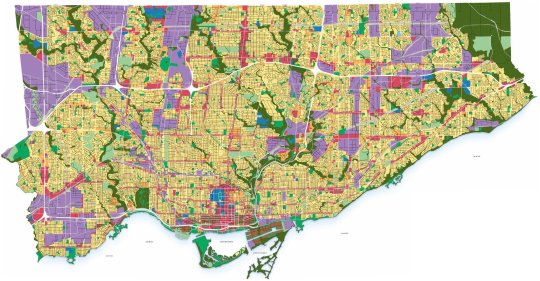
Here is a land use map of Toronto:
The yellow areas are “neighborhoods.” They, along with parks, ravines, watercourses, and valleys, make up ¾ of the city’s land area. The Official Plan describes these areas as being “stable” – meaning they will see little physical change. Supply cannot adjust to demand.
I get why this is the way it is and I understand how difficult it would be change something like this. But let’s not ignore the impact that this land use constraint has and will continue to have on the housing market.
It’s the yellowbelt. Thank you Gil for letting me to steal the name.
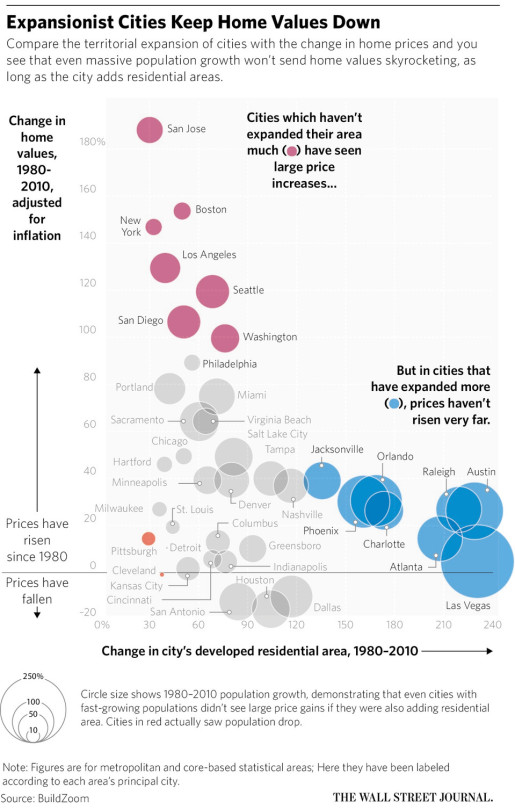
The WSJ article is about the growing divide between affordable and expensive cities in the US. And the argument is that expansionist, or sprawling, cities are better at suppressing home values and maintaining affordability:
“The developed residential area in Atlanta, for example, grew by 208% from 1980 to 2010 and real home values grew by 14%. In contrast, in the San Francisco-San Jose area, developed residential land grew by just 30%, while homes values grew by 188%.”
Now, here’s a chart saying that same thing:
The reality is that greenfield development (suburban sprawl) generally has far fewer barriers to development than urban infill development. So I’m not surprised to see cities like Las Vegas, Atlanta, and Phoenix clustered towards the bottom right.
At the same time though, I’m obviously not convinced that sprawl is an optimal outcome. I think there are other costs not reflected in the chart above. So what’s the best solution here, assuming we want to build inclusive mixed-income cities?
We all know that the Greater Toronto Area is growing and intensifying at an incredible pace. In fact, last year the region set a record with 25,571 new condominium units completed.
If you listen to industry experts, such as George Carras of RealNet, they’ll tell you that this level of intensification — which usually means condominiums — is really a decade in the making. That’s when the government set out to explicitly encourage this type of growth.
But in the decade since that decision, we’ve seen both government and the market evolve in terms of what that intensification should look like. It started out with a largely high-rise building typology. Tall buildings were to be allowed in the downtown, as well as in specific growth nodes throughout the region. But for everything in between — the officially designated “neighborhoods” — there was to be no development.
This is what I’ll call the first stage of intensification.
Then, we started to think about mid-rise intensification along the avenues. Most of these “avenues” (also an official term) cut through those same stable neighborhoods, but the main streets were seen as an appropriate place to allow additional growth. It makes perfect sense and so guidelines were created to help dictate what this new building typology should look like.
This is what I’ll call the second stage of intensification.
And it’s one that I’d argue we’re currently living through with new mid-rise projects like DUKE in the Junction (TAS project), Kingston&Co in Kingston Road Village (another TAS project), Abacus Lofts on Dundas West, and The Hive in Etobicoke. These are all mid-rise buildings going up in established neighborhoods.
With the recent decision to also allow wood frame buildings up to 6 storeys in Ontario (instead of 4), we’ll probably see an even greater surge in mid-rise buildings once the private sector gets its head around this shift.
So what’s next?
I think it’s inevitable that we’ll eventually see low-rise intensification within our established neighborhoods. We started by avoiding them altogether, and then deciding that it was desirable to build along their periphery. But as demand for urban housing continues to increase, I believe it’s only a matter of time before we start to loosen the reins on our single family neighborhoods.
Some of you might be thinking that this is going to be a bad thing, but I actually think the opposite. Projects such as Vancouver’s Union Street EcoHeritage prove that it’s entirely possible to intensify existing neighborhoods through sensitive and beautiful infill interventions. And of course, let’s not forget about laneway housing.
The fact of the matter is that Toronto has already been intensifying its neighborhoods for a very long time — likely since the beginning — by converting single family homes into duplexes, triplexes, and other multi-family dwellings. We just haven’t been doing it in any sort of structured way.
I don’t know when this will change, but I think it’s only a matter of time. And that will be the third stage of intensification.
The headline immediately caught my attention because conventional economic wisdom would suggest that supply constraints – whether natural or artificially created – generally have a negative effect on housing affordability.
To be clear though, I support Ontario’s greenbelt. I think an urban growth boundary is the right thing to have if we want to build sustainable, walkable, and transit-oriented communities. But I’m also not blind to some of the potential (negative) externalities.
However, Keesmaat’s article got me wondering just how prevalent those externalities might be and to what extent our greenbelt is actually impacting housing affordability in Toronto. In her article she cites a recent report by the Pembina Institute that very clearly argues the following:
“There is no shortage of land throughout the GTA [Greater Toronto Area] to build single-family homes for decades to come, but this land is predominantly located far from the City of Toronto and other established centres of employment in the GTA.”
More specifically, the report found that of all the land available for development in the region (within our growth boundary), 81% of it is projected to still be unused by 2031. This got me thinking: it’s not that there isn’t land still available in the region; it’s that there isn’t land in the areas where demand is the greatest.
Put differently, young families aren’t clamoring for single family homes in High Park and Leslieville because the greenbelt has restricted their ability to find new housing. They’re doing so because they want to live in neighborhoods like High Park and Leslieville.
If you dive into the data, the report shows that in 2004 the average price of a detached home in Toronto was about $117,000 more than the rest of the Greater Toronto Area. As of 2013, that spread had grown to about $200,000. And indeed the data shows that it’s the core of the city where home prices seem to be appreciating the fastest.
So when it comes to housing affordability and supply, the greenbelt may actually be a red herring. Releasing it would not increase the supply of housing in areas where demand is already high, which is probably why this same report also found that – with or without an urban growth boundary – most Canadian cities are seeing similar increases in home prices.
So what should we be doing?
I think we should do two things: (1) focus on accommodating more growth in the areas that people already want to live in, and (2) figure out ways to transform the less desirable areas into more desirable ones. This second one will be the hardest, because it’s likely going to mean changing car dependent areas into transit-oriented ones, which is no easy task.
The good news though is that we are already doing these things. There’s more that I would like to see happen, but we’re headed in the right direction.
If your city has a greenbelt or you have experience with greenfield development in the Toronto region, I’d love to hear your thoughts in the comments. This is an area of development that I’ve never really been involved with.