
Daily insights for city builders, delivered every morning at 6 AM ET. I’m Brandon Donnelly — a Toronto-based real estate developer and founder of Globizen. I’ve been writing here since 2013.

Tag: graffiti

  • When does vandalism become art?

    “I think that street art is illegal and it has to stay illegal.” –Invader

    I was in an Uber on the Don Valley Parkway today and, for some reason, all of the graffiti on its sound barriers caught my attention in a way that it hasn’t before. Maybe it’s because I don’t travel enough by car or maybe the highway people haven’t yet done their spring cleaning. Either way, I caught myself thinking, “Hey, a lot of this looks pretty cool. Here are boring and utilitarian sound barriers that have been covered with colorful things.”

    Of course, street art is a tricky thing. Because, at the end of the day, it is, as French artist Invader says, illegal. It is an act of vandalism. And so there is a fine line between street art and criminal behaviour. When I leave my home in the morning and I discover that someone has spray painted nonsense on one of its exterior walls, it absolutely pisses me off. How about I come spray paint your home?

    But what if it wasn’t nonsense? What if Invader had decided to “invade” Toronto and I instead found a pixelated neon green Pac-Man outside of my lobby? It would still be illegal and it would still be vandalism, but I would frankly feel excited that Invader had decided to come and bestow my home with one of his art pieces. I would then proceed to take a picture and send it to all of my family and friends.

    Now, obviously it makes a difference when it’s a known artist. Context matters. But Invader had to start his illegal pursuits somewhere. And I find it interesting to think about the line where something is able to pass, in our minds, from being an illegal nuisance to a desirable art piece. I experienced moments of that along the Don Valley Parkway today.
  • High-rise graffiti in downtown Los Angeles

    About five years ago, a project in downtown Los Angeles, called Oceanwide Plaza, halted construction. I don’t know exactly what happened, but the reports suggest corruption, financing problems, and the Chinese developer running out of money.

    Under typical circumstances, once you secure your financing and start construction, it should mean that you have enough money to finish the project. That is unless there are significant cost overruns, you experience a cash crunch somewhere else, and/or somebody does something bad.

    In fact, on some projects, the peak equity requirement occurs before construction commencement, meaning that once you do secure your construction facility, you should be able to reduce the amount of equity that you have remaining in the project (i.e. you can pull out some cash).

    Here it sounds like a combination of things went sideways. And now today, Oceanwide Plaza looks like this:

    The towers have been tagged pretty much all the way up. And it kind of looks like each artist commandeered their own suite in the building. Not surprisingly, this has been attracting a lot of attention and debate. The project is also across the street from the Crypto.com Arena and so there are a lot of eyeballs on it.

    On the one hand, you have artists being creative and doing something with an abandoned set of buildings — ones that are beset with corruption charges and that people are generally upset about. But on the other hand, you have a busted project, and you have artists trespassing and creating what others see as another symbol for a spiralling downtown.

    LA police are reporting that the site is going to be better secured and that all of the graffiti will be removed. But until then, this has got to be one of the tallest expressions of graffiti ever created.

  • Art vs. transit

    This September 25, 2019, the Bronx Museum of the Arts will be opening up a new exhibition called, Henry Chalfant: Art vs. Transit, 1977-1987. Henry is a renowned photographer who is most known for his work on graffiti, breakdance, and overall street culture. This exhibition is about all of this, but there’s a particular focus on the subway car art that was once ubiquitous in New York City.

    There’s also a Kickstarter campaign if you’d like to support this exhibition. What struck me as I watched the campaign video, was that the “urban street culture” of this era doesn’t seem to exist in quite the same way today (or maybe I’m missing it). In the video, Henry talks about things like the birth of hip hop, which he documented outside, on the street.

    We shouldn’t forget that New York was also a scary place at this time. Removing the subway art that Henry fastidiously documented was one of the ways in which the city is thought to have broken its patterns of crime. But at the same time, there’s something really special about new ideas forming out in the public realm.

    It’s also a uniquely urban phenomenon.

  • My old Philly apartment

    I’m in Philly right now for a good friend’s wedding. 

    I always feel nostalgic when I come back to this city. Some of my most memorable years were spent here. I grew a lot in those 3 years. I also think that Philly is a highly underrated city – such an intimate urban scale.

    I’m staying at the newly renovated Warwick Hotel in Rittenhouse Square. The lobby is beautiful, as are the corridors, but the rooms already feel a bit a dated to me. However the Barcelona Chair in my room is a welcome addition. That thing will never go out of style.

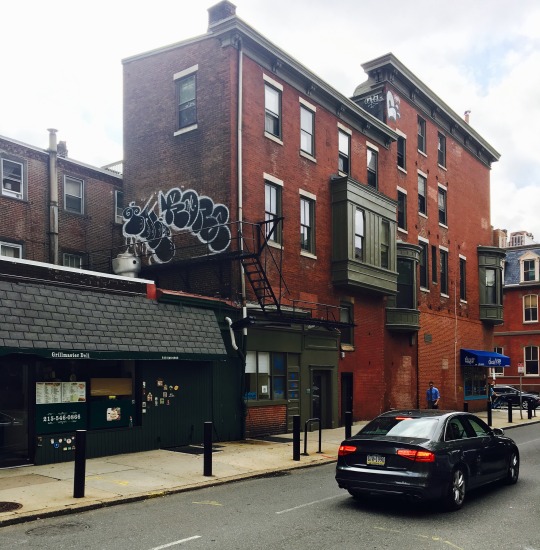
    My hotel happens to be two blocks away from my old apartment at 17th and Spruce. So I decided to do a walk-by while I waited for my room to be ready. My roommate and I had the entire second floor of this building:

    It was palatial, especially given the bargain price and its location in Rittenhouse Square

    The graffiti you see above is located on the north wall of the kitchen. I think that’s a recent addition. The fire stair you see provided access to the roof of the building (as well as the street, I hope). I’m not sure we were supposed to go up there, but we obviously used it for parties.

    Grillmaster Deli is still next door. They kept me fed when I was studying at home and too busy to cook. That was often. And across the street is the Italian restaurant with its sidewalk patio that I used to look out onto from my bedroom.

    This walk-up apartment was by no means fancy. Though it did have ensuite laundry, which was a nice improvement from my previous place. But it was unabashedly urban. My kind of place.